
There is always something interesting in every exhibition I visit, whether it features painting, sculpture or any other form of art.
But it is through photographs, or the art of photography, that one can see what the photographer saw, because his lens is an extension of what he sees and also of what catches his eye, of what he feels. The photographs convey many of the artist’s emotions, those of the photographer as such, and even more so when the body of work stems from a long and extensive journey.

This particular exhibition stirred a great deal of emotion in me, because the overall composition formed by the various photographs within the gallery created a great travel book, a story—the story of journeys, paths, visits to places, views of buildings, monuments and historic sites.


I was looking not only at photographs, but at everything that this English photographer—a literature student at Oxford University, yet with a great desire to discover the world and travel—had experienced.


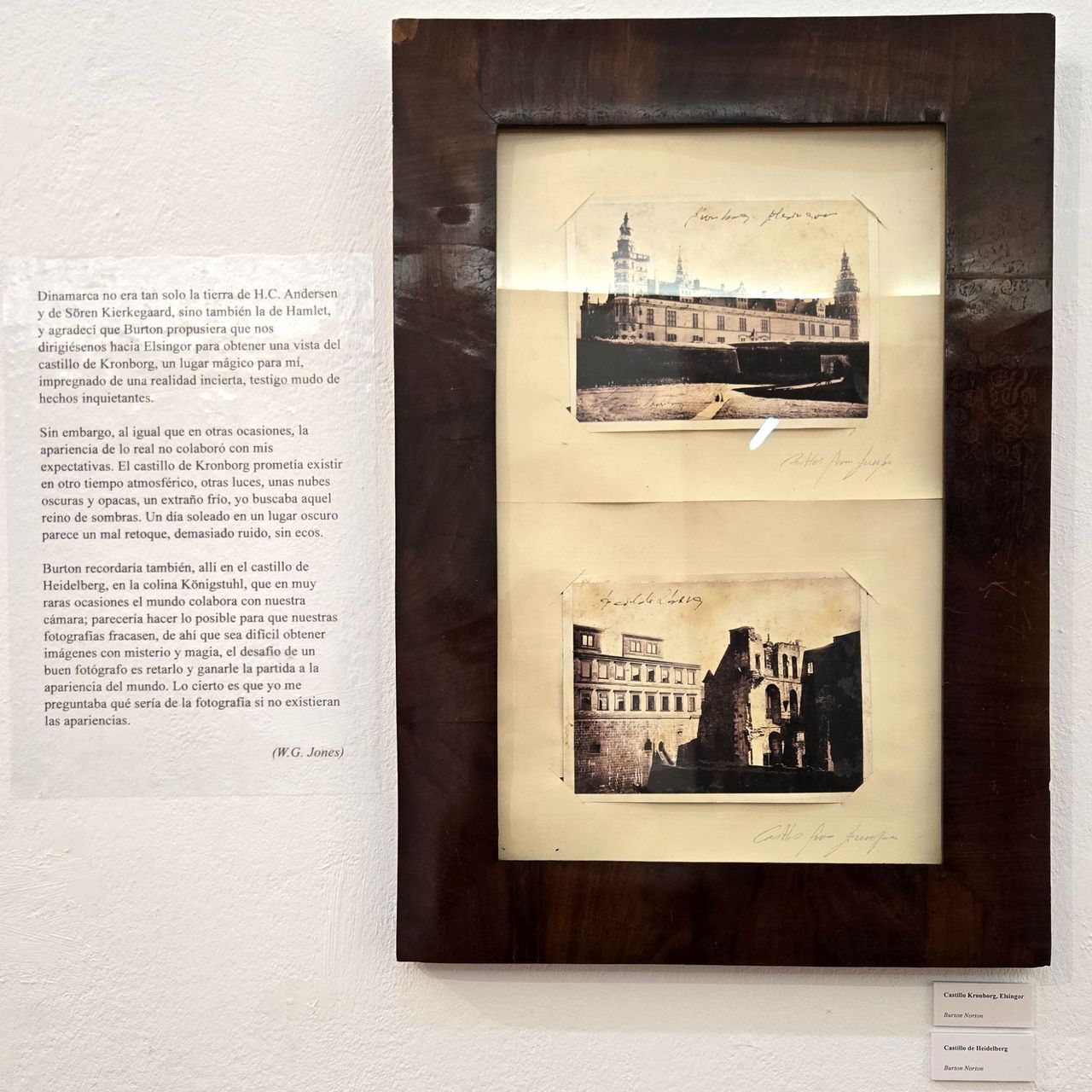
Beside the photographs was a text recounting the story behind each one: why he had visited that place, for what reason or interest, and what he had done there. On one hand, I had before me a book written in stages; on the other, the visual record in the photograph of that moment experienced.


It was as if I had been transported alongside this photographer as he explored each place, or as he made his way to a cathedral, a square, or any other location.


Through the photographs and the accompanying texts, the exhibition recounts the great journey Burton Norton undertook across Europe alongside his assistant W.G. Jones. A journey that took place in the 19th century, meaning the photographs truly tell a story—another story, a rather distant one—of Victorian Europe, where one sees not only churches, cathedrals and buildings of all kinds, but also ruins.




He also collaborated with Eduardo Momeñe and the Escuela Apertura. It was an era when photographers could explore, leave their studios and travel to distant places, leaving a record of the world and their own experiences through their photographs and books.


 |  |
|---|---|
 |  |
All the texts were in Spanish; this is always the case in art galleries, although some museums, such as the Pompidou, provide texts in three languages. But galleries like El Ateneo focus on the country’s own language. Yet it was truly wonderful to look at each of those old, analogue photographs from another era and have a sense of the context in which they were taken—and not only that, but to know what the photographer felt, thought and how he experienced those moments.

 |  |
|---|---|
 |  |
In many of the photographs, which I sometimes saw grouped together, I took individual, closer-up shots to capture the detail of the places from that era. It was like reading a history book with many illustrations, but presented in a wonderful exhibition.


The entire artistic production and the concept itself were directed by Momeñe, taking into account approaches to art and photography.
It is, therefore, a documentary photography exhibition, but it is truly an exquisite and wonderful display, rich in history, art and, above all, experiences, where a reality is portrayed. Momeñe is also a photographer and has written many articles; he has been responsible for publishing books on photography and photographic vision, and there are both public and private collections of his work.


This journey through each of the photos, this great voyage through 19th-century Victorian Europe, has been so beautiful, as if I myself had been there at that time. Of course, they are not like today’s digital photos, which are so realistic; they are much more akin to illustrations and drawings—at least that is what I see in many of them—but their excellence is beyond doubt.
It was a visit I absolutely loved and enjoyed immensely; there is always something to learn and share, and that fills me with joy.
Thank you very much for joining me today; I wish you all a very happy Sunday. See you soon.
Amonet.
All photographs are my own.
