
I published a post ten days ago. In the WEEKEND EXPERIENCES community. It was about a wildfire. One of the many summer fires in my region. Today I visited the same area, and since the weekend is behind me, I decided to publish this second part of the wildfire saga in another cool community.

I visited the same rural area around the small town of Svetvinchenat, about 30 - 35 kilometers from where I live. The same area caught by the same fire.
But I didn't revisit exactly the same place.

Last time I explored the terrain by the narrow country lane that leads to the village of Shtokovtzi, and you can see that part of the story by clicking on the link below.
@borjan/after-the-wildfire

Today I parked my car by the side of the two-lane road to Svetvinchenat.

The fire must have been burning strong here and the temperatures must have been very uncomfortably high along the road ...

... judging by the deformed, curved plastic of the laid-down roadside columns.

The shrubs and trees near the road were completely carbonized ...

... this one looked like the remains of some giant burned arachnid...

... but about a hundred meters further the foliage was still on the trees ...

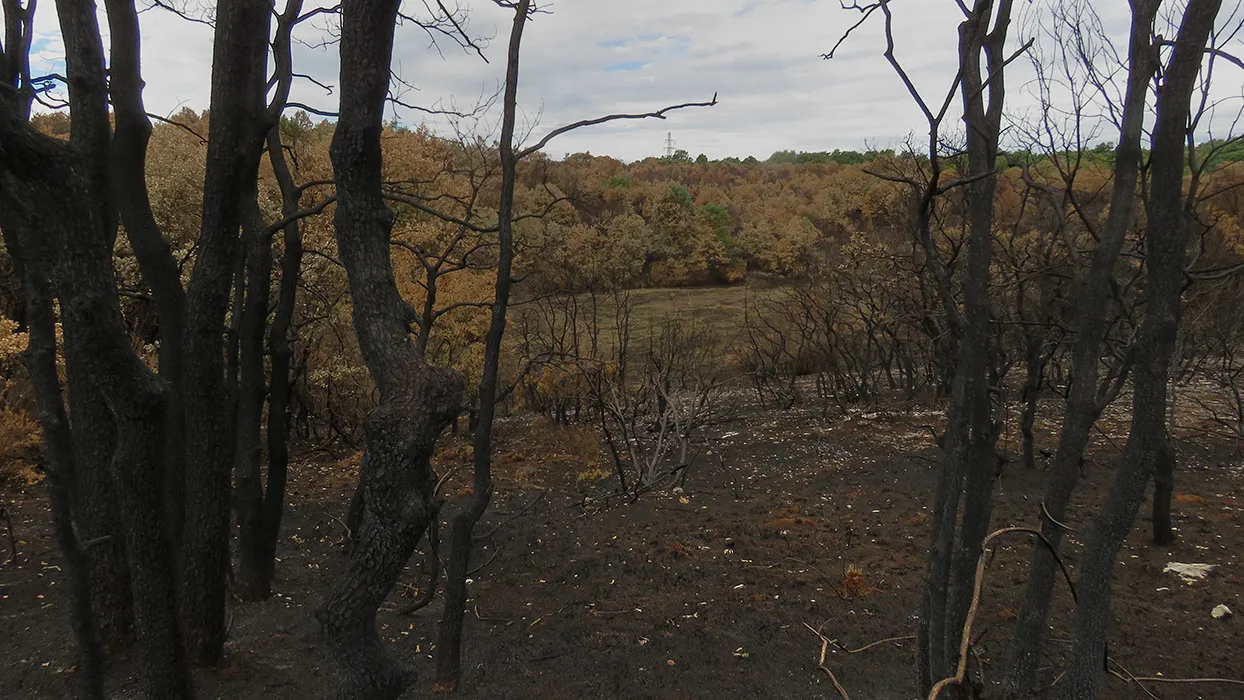
... creating an interesting, slightly surreal atmosphere. Different types of trees with different types of leaves, by reacting to the fire in slightly different ways, created a nice variety of autumnal colors - definitively out of place and out of season in this part of the year.

In some places, the desolate scenery was very beautiful.

By burning the vegetation, the fire revealed some hidden treasures.

This forgotten piece of machinery near the road ...

... and this pond, about fifty meters further ...

... across the street. The pond isn't very small but was well-hidden by the shrubs and trees before this wildfire. I passed this way many times through the years and stopped quite a few times by the side of the road ...

... but I wasn't aware of this waterhole.

It's great to find something new and unexpected in a familiar place.

I spent almost an hour around this muddy water covered with algae. There wasn't much to see on the surface ...

... these bubbles were the only thing worth photographing ...

... but I found some interesting details on the dark, burned ground around the pond.

Here you can see a spider.

It looks like a small, juvenile spider, far from being close to reaching its full adult size. The family is definitively Lycosidae, but I can't tell you the exact species.

Not far from there I found a small, baked corpse ...

... of a grasshopper.

Unlike in the surrounding burned areas, there was a bit of green, here near the water.

The fresh new grass has started the revitalization of the devastated terrain.

Here, from above, you can see the pattern made of black, green, and brown elements. If you take a good look at the center of the picture, especially if you enlarge the photograph by clicking on it, you'll notice a small orange-colored area. In the following shot ...

... I came closer with the camera.

Here you can see the juicy young leaves ...

... of the Glechoma hederacea plant, another early green colonizer.

A meter or two further, I found more of that orange thing shown in previous photographs.

Can't tell you what is this exactly.

It looks like some fungal growth.

A colorful fungal growth that looks like the ember that could ignite another fire.

After some more sniffing around the same area, I came across this mummified frog.

In this wider, enlargeable shot, you can see the frog and the nearby pond.

Here you can see some interesting burned & desiccated plants that grew near the pond.

It looks that only the protruding parts, leaves or spikes were burned. The fire must have been too fast to destroy the rest, and the plant's tissue too resilient to burn quickly.

I'm not sure about the species, but it has some similarities with the Eryngium campestre. These are only the remains of the plant, some important features are missing. That surely doesn't help the identification. After taking this shot ...

... it was time to leave the area around the pond.

I photographed some dead leaves on my way back to the asphalt road.

These leaves have fallen from the oak trees.

Here you can see some of those oaks.

Soon my attention got caught by a small red fragment down on the ground.

The green stripe is part of the butterfly wing. This is the forewing of the red admiral (Vanessa atalanta)

A bit further, I came across this mound.

It looks like something built by ants. But I'm not sure. Maybe this isn't an ant's work.

When this photograph was taken ...

... I reached the terrain across the street.

Some plants here were completely carbonized.

This piece of wood looks like something that was burned on the campfire.

Here you can take a better, more up-close look at the texture.

This small tree with a broken branch allowed me to photograph the interesting contrast ...

... between the carbonized surface and the resilient, fibrous interior.

I took a few more shots of the stuff at the edge of the area affected by the fire ...

... and then ...

... I continued along the road.

There, near the asphalt ...

... I photographed another deformed roadside column ...

... and I found more garbage.

This shiny piece of something looked kinda precious.

Soon I reached my car and drove back home.
AND THAT'S IT. AS ALWAYS IN THESE POSTS ON HIVE, THE PHOTOGRAPHS ARE MY WORK.