
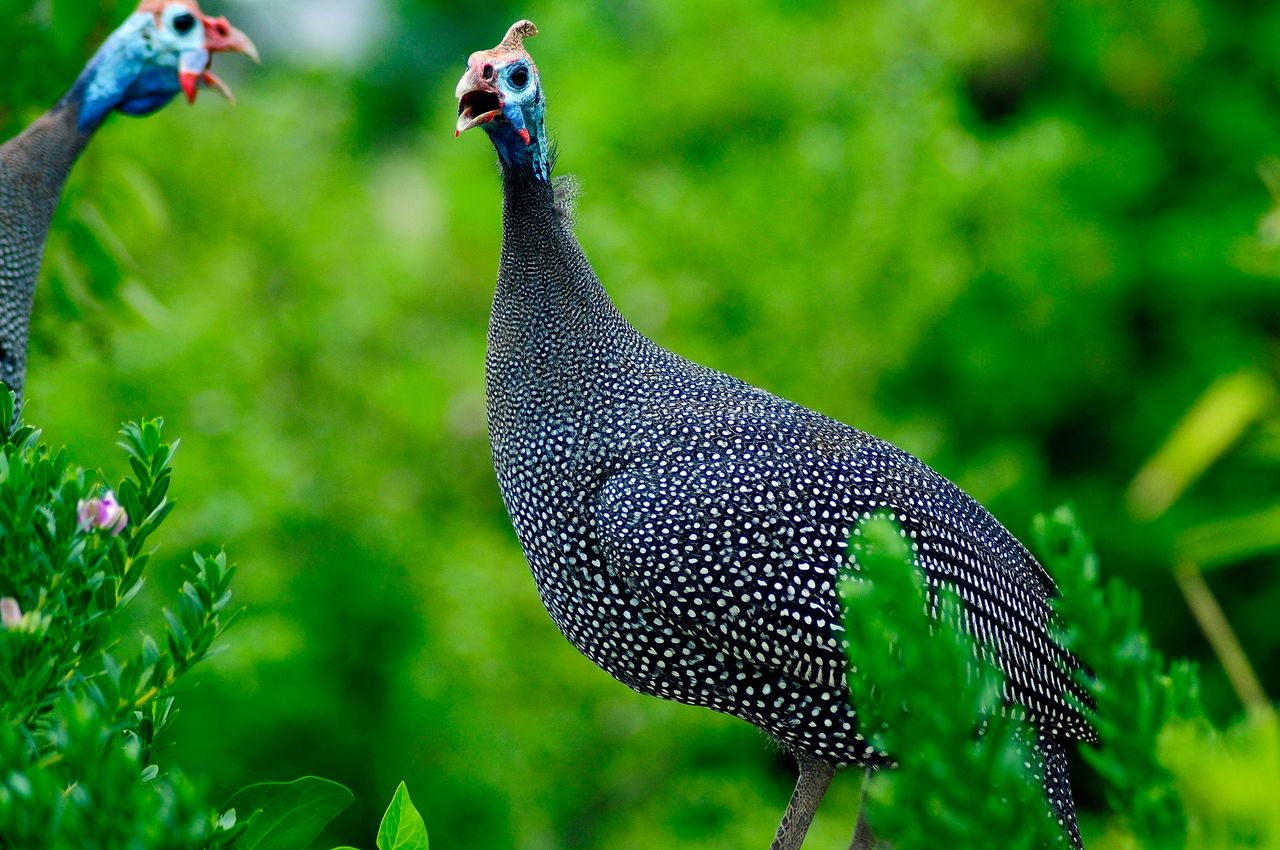
A couple of days ago, a family of about fifteen helmeted guineafowls visited my garden. As I went closer to get some close-up photographs, they flew over the wall into the neighbor's garden. Unbeknownst to them, the dogs in the neighbor's garden did not want them there. As they flew back into my garden, a weird predicament stared them in the face: the dogs in one garden, this weird human-photographer in the other garden. They sat on the wall running between the gardens and ensued with their loud screams. Some of the other scattered family members responded to these loud shrill calls. It was a to and fro shouting game, and I was lucky to witness the madness. Or was I the cause of all this raucous?
In any case, today I want to share with you close-up portrait-style photographs of these helmeted guineafowls shouting to one another, and I want to share with you a philosophical essay I call "Us and Them". As per usual, I will intersperse the photographs with my essay, or I will interrupt the photographs with my musings and thoughts. Also, if you are not much of a philosopher, please skip these musings and enjoy these dinosaur-look-alike birds screaming from the depths of their throats.
Us and Them

Where do we as humans enter the equation of "us and them"? Do we occupy the us or the them? This is a rather important point to clarify before ensuing as it will (en)frame the whole argument from that specific vantage point. That is, if one (en)frame "us" humans in the us and the birds I photographed in them, my words from now on will take the human perspective as the point of departure. If we turn this (en)framement around, if we place the birds in the position of us, the essay will have a totally different meaning to it.

This is not a problem, and already in the subtitle of the essay I alluded to this idea, them and us. But yet again, it depends on where you "put" us.
So easily, we are sucked into this idea that we are the point of departure. That is, without questioning it, we take our perspective as the natural one. Read any popular philosophical piece and you will immediately be aware of the preferred point of view of the author. Again, depending on where you place "us" humans in the us and them formulation. (To the avid reader of philosophy, it might be obvious that this is a play on the idea of Otherness.)

Shouting from the heavens, the screams of their voices filled the air like a stadium full of sports hooligans or members of a congregation. No one could make out the individual shouts, only the collective throng of screaming. Enmassed, assemblage, glued together by the joint effort not to be identified. From here—where is here?—no one could move. Metamorphosing into a single blob, the shouting choir persisted.
A brief interruption, a mental protrusion of sorts.

The idea of us and them is simple: we love to (en)frame us, humans as the natural (i.e., normative), as if the human point of view is per definition the point of view. This is not a novel idea, nor is it very complex, but if you have never though about it, it might be strange.

For the remainder of the essay, I want to place the shouting helmeted guineafowl in the us category and us humans in the them category. That is, I turn the common phrase of us and them around on itself. I want to (en)frame the world as if their position or point of view is the normative point of view. Bear with me.

We inhabit the world with fellow creates, small to large. We are covered in small "creatures" and we inhabit the earth like these small creatures inhabit us. We are, so to speak, their earth. I digress. The idea is, yet again, simple: we are one amongst many other animals.
Yet, we rarely see this.

Why? we might ask. Because we (en)frame ourselves as the normative position. The reason I want to turn the us and them formulation around (so to speak to them and us) is to make us more aware of this fact. But the mere act of turning the formulation around is not enough. In deconstruction terms (a convoluted philosophical "position"), we need to break this (en)framement as well, because whilst we keep it there the same will just happen again, it will get reproduced just in other terms.

In short, we are humans are now seeing the world from the position of the "other" or the "them". We are not in the normative position, the us of the birds are. The screaming bunch. Screaming for their recognition, and now they have it!

(The stern look of a conquering philosopher bird.)

If you paid attention to your class in Derrida, if you were the philosopher type, you know no that in the reversal of hierarchies (simply: the turnaround of us and them) we need to "destroy" it otherwise the helmeted guineafowl will now merely profess with normative position we just gave up. (In political terms, one dicator should not merely overthrow the other one, both are bad.) We should be able to find that in the dissolution of the hierarchy of us and them we become equals.

But is this always the case, shouts the guineafowl and the modernist philosoher. Is there something as equals?

The guineafowl shouts yes.

But the others does not seem so convinced of this fact.
The fact remains, we are merely another species occupying yet another planet floating in space. But hang on, this is a rather depressing thought. Alas, we have wine as humans to calm our existential pangs. I will conclude with a more positive note. Standing on the wall of our kingdom of normative rule, our kingdom looks vast and unconquerable. But rather than viewing it as such, we should recognize the feeble nature of our ruling position. If we realize this weakness we can actively work to strengthen it. Alas, we are sometimes shortsighted. Let us drink to that.

Post Scriptum or Something Concluding
I hope you enjoyed the portrait photographs of the shouting or screaming helmeted guineafowl. It was a rather fun piece to write, even though the musings ventured more towards drinking at the end. All of the photographs were taken with my Nikon D300 and Tamron zoom lens. The musings, albeit inspired by the feathered folk, are of my own making. Maybe I should drink less, or in fact maybe I should drink more! That is, the philosopher's thought juice, .