
Greetings, Fellow Natural Satellite Observers!

Quite strange my chance was yesterday. It's the season of summer storms that come a bit before real summer. There was another one in the afternoon, with proper thunder and lightning. But it cleared a couple of hours before dark.
And the sky was still heavy with interesting clouds.
I went out to the grocery store to fetch some stuff before it closed. And I saw the nice contrast of lead and blue above the rooftops so remembered what my wife told when she came back home half an hour before that.
We should go to the hills and enjoy the view. Or we could stay home and have another boring evening.
Well, it seemed as good a time to head for the hills as any.
Without taking my shoes off I said,
Let's grab the cameras and some jackets, jump in the car and go to those hills to have a nice look around!
There's a large hill west of town, blocking the view towards the sunset. And there's a road around it, connecting the southwest and the northwest exits. It gains altitude and at some point there is a smaller road heading straight west and towards the archaeological site where an old fortress once stood, overlooking the valley in that direction.
With clouds all around and more than a 270 degrees view I thought it would be a nice spot to hunt for storms and lightning shots. I have none this year despite it currently being the season for that.
Well, the storm was over but there was a nice strip of light where the sunset would be, lined with cool clouds above.
It was what drew our attention.
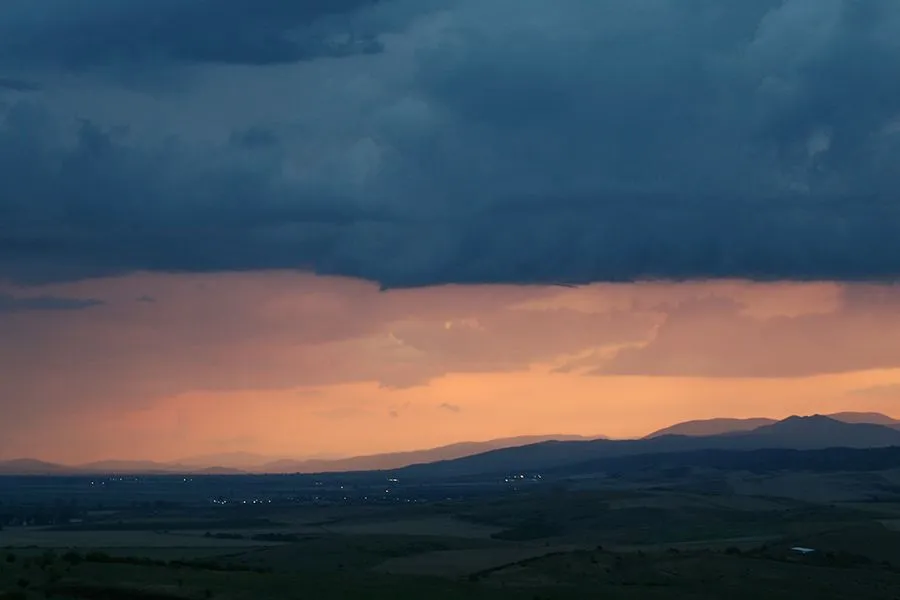
Then we bumped into the moon driving back from that scene. It was above the hills and peeking through the layers of water vapors.
Sunset behind us, Moonrise ahead...
Almost like in Bloodmoon scenarios but this time it's because both celestial bodies are near the horizon. Sun setting and shooting warm rays through a lot of atmosphere due to the stacking of air molecules between us at that angle...and a replication of the same conditions but on the exit side. Where that light leaves the atmosphere once again to be later reflected by the surface of the Moon.
Or is light just glancing through the upper layers?
That depends on the exact moment, I guess. A series of moments. To be captured.
And I had no tripod so I just leaned the camera with the heavy 70-200 mm lens upon the top of our car. The winds were rocking it from time to time and so was my daughter who was often enthusiastic about what she was seeing.
Still, I was able to get relatively decent exposures of one to four seconds.

Camera Settings:
Aperture F 4; Shutter Speed 2.5 seconds; Light Sensitivity ISO 640; Focal Length 118 mm.

Same but at 200 mm Focal Length — my maximum zoom.

Camera Settings:
Aperture F 4; Shutter Speed 2.5 seconds; Light Sensitivity ISO 400; Focal Length 200 mm.

And a crop of the title image...

...with the same settings but disregarding the Focal Length in terms of proximity. The angle is the same, of course.
Camera Settings:
Aperture F 4; Shutter Speed 3.2 seconds; Light Sensitivity ISO 400; Focal Length 176 mm.
In short, I was not prepared for this but I was glad we saw it. And I am still able to share some of it.
Peace!
M.