

Imagen de mi Meliponario (espacio que presenta dos o más colmenas de abejas Meliponas)
Image of my Meliponario (space with two or more hives of Melipona bees)
Good morning to all the hivers, I hope you are all very well, I greet you from Cuba, in this opportunity I come to share a project that I started a year ago. Since I was a child I have been very fond of bees and their products, this passion was transmitted to me by my maternal grandfather, who besides being an auto mechanic was a beekeeper, a profession he learned from his father, my great-great-grandfather, whom I had the pleasure of knowing and from whom I also learned, today unfortunately I do not have his presence, but I do have his valuable teachings.
Translated with www.DeepL.com/Translator (free version)
It is noteworthy that the survival of human beings depends largely on the availability of food that is present, and for this food to be available to us it is necessary that a process called pollination occurs, this process is performed by a variety of animal species, but its greatest representation is in charge of the "Bees". Due to this important characteristic of these wonderful insects, projects are being developed all over the world to guarantee the pollination processes in different crops and plant development in a natural and environmentally friendly way, obtaining as a result of their application agricultural products of excellent quality and in abundance, thanks to the daily and effective work of bees as pollinating agents.
Translated with www.DeepL.com/Translator (free version)
There is a wide variety of bees, it is considered that worldwide there are more than 30,000 species, which are essential in the conservation of the environmental balance of the areas where they live, but the best known are the Apis Melifera bees (bees with sting, which are the ones that produce those stings so painful), and there are the bees of the "Mellipona Beecheii" family (known as stingless bees, so they do not sting people or animals), precisely this last one is the one that won my interest, since I live in an urban area where I can not develop the breeding of Apis Melifera because of the danger of their stings.
Translated with www.DeepL.com/Translator (free version)
Melipona bees came to me about a year ago, from the hand of a group of Cuban entrepreneurs who were given the task of spreading urban meliponiculture in Cuba, looking on the internet I found this group and began to establish a beautiful friendship with them, who are also wonderful people with a lot of knowledge, lovers of the environment and all nature. The first person I met was Dr. Walberto Lóriga Peña (professor of the agrarian university of Cuba) he told me that, in Havana, there were several meliponicultores (person who breeds Melipona bees) and put me in contact with them, in that way I met several of these breeders, but there were two who helped me to get my first hive, my friend Denis, who kindly took me to buy my first hive and my friend Dairon, who with his vast knowledge helped me to divide that single hive in 3 which are the ones I currently keep and with which I enjoy wonderful moments of relaxation while observing the tireless work done by these incredible insects.
Translated with www.DeepL.com/Translator (free version)
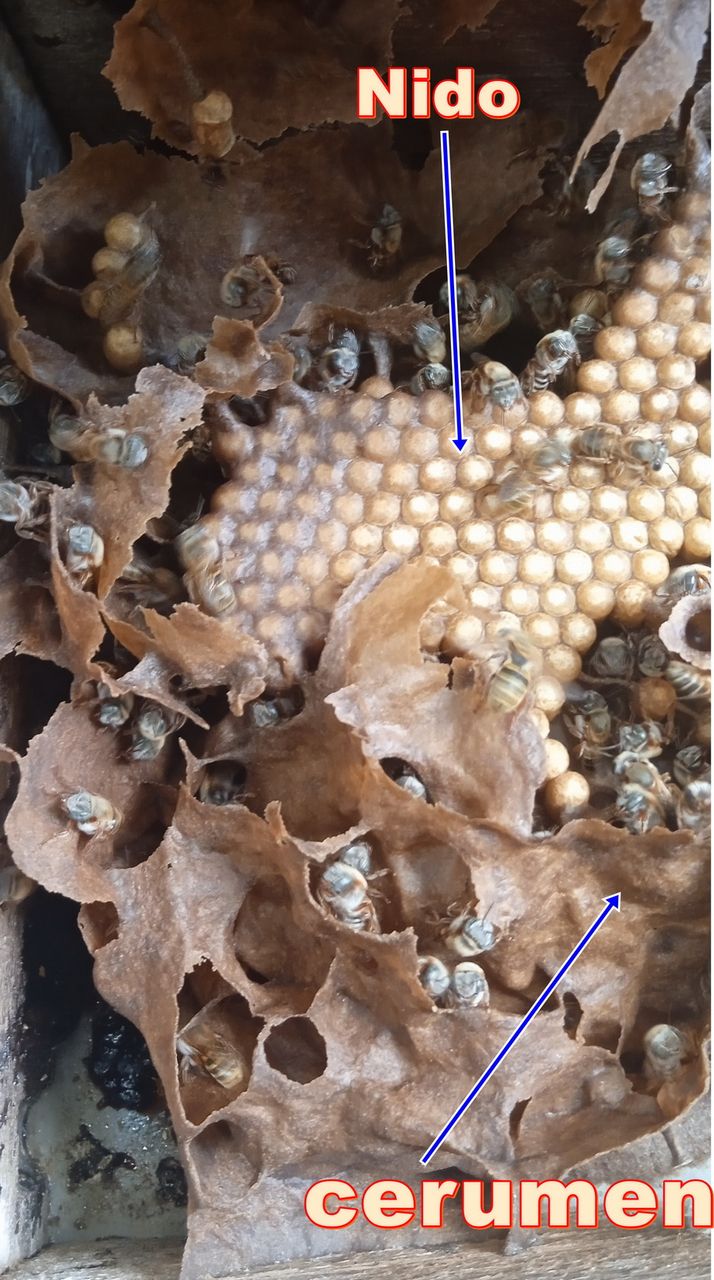
In addition to the importance that we addressed on the subject of the great benefits that these animals produce to agriculture and flora in general, it is important to say that their work also produces products of wonderful quality and importance such as honey, bee bread (known as pollen), cerumen and propolis.
With propolis and cerumen the bees build their nests and with honey and bee bread they feed the hive.
The bees obtain propolis from different tree resins, which has antibacterial and other properties that help them fight diseases in the hive and with it they seal the holes in the hives.
Translated with www.DeepL.com/Translator (free version)



Bee bread (pollen) is a product rich in protein, vitamins and minerals, which is collected by bees and stored in the barrel-shaped pots that this species uses to store their food and honey around the brood panels.
Translated with www.DeepL.com/Translator (free version)
In Cuba, as in other countries where meliponiculture is developed, a great medicinal value is given to the honey produced by this species, considering it to have greater medicinal properties than the traditional Apis honey, its bee bread is used to treat infections and flu-like conditions among other pathologies, and its honey is recognized to have very effective properties in the treatment of ocular cataracts.
Translated with www.DeepL.com/Translator (free version)
In my case my meliponary is still very young and since I created 3 new hives from a single one, I have not yet been able to enjoy large honey harvests, but I have had the opportunity to count on their bee bread to improve my family's colds.
Translated with www.DeepL.com/Translator (free version)
In short, it has been very useful for me to have the presence of these magnificent animals not only to enjoy their products, but also to develop in my daughters their passion for nature, since I have shown them the procedure to care for and obtain benefits from the meliponary, and also the importance of the conservation of species for the development of life on earth.
Translated with www.DeepL.com/Translator (free version)

Estos insectos se merecen todo nuestro amor y cuidado porque de la convivencia mutua dependerá en gran parte la supervivencia de todos.
These insects deserve all our love and care because the survival of all of them depends to a great extent on their mutual coexistence.
Translated with www.DeepL.com/Translator (free version)
Muchas gracias a todos por leer mis publicaciones y como siempre solo espero que les haya resultado de utilidad y enriquecimiento de sus conocimientos.
Todas las fotos fueron capturadas con mi movil Redmi 9A y son de mi propiedad.
La edición de las fotos fueron realizadas por mí con el programa PhotoScapeV3.7.