
Such a pleasure to have a beach that is many miles long, as one can take an endless wander on the soft sand while listening to the song of the waves.

This beach is in False Bay and they reckon that it is the largest bay at the extreme tip of the African continent.
False Bay (Afrikaans: Valsbaai) is a body of water in the Atlantic Ocean between the mountainous Cape Peninsula and the Hottentots Holland Mountains in the extreme south-west of South Africa. The mouth of the bay faces south and is demarcated by Cape Point to the west and Cape Hangklip to the east. The north side of the bay is the low-lying Cape Flats, and the east side is the foot of the Hottentots Holland Mountains to Cape Hangklip which is at nearly the same latitude as Cape Point. In plan the bay is approximately square, being roughly the same extent from north to south as east to west, with the southern side open to the ocean. The seabed slopes gradually down from north to south, and is mostly fairly flat unconsolidated sediments. Much of the bay is off the coast of the City of Cape Town, and it includes part of the Table Mountain National Park Marine Protected Area and the whole of the Helderberg Marine Protected Area. The name "False Bay" was applied at least three hundred years ago by sailors returning from the east who confused Cape Point and Cape Hangklip, which are somewhat similar in form.
The Source link will also show you the names of about 40 ships that sank here in the false bay area.
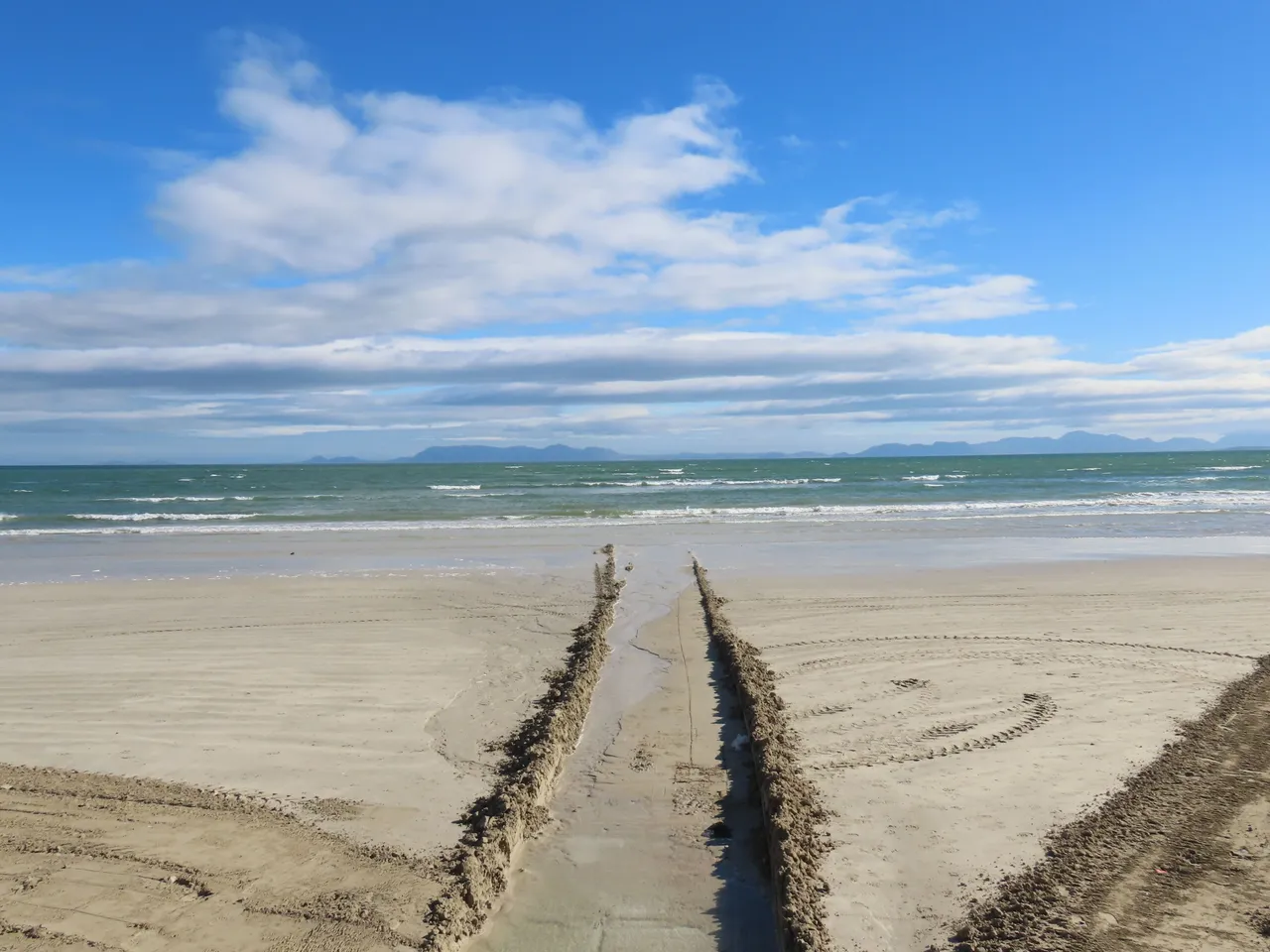
But for now, the sea was calm and cold and we saw the marks of a machine on the sand.

It seems that a temporary channel was made to guide the outflow of a storm water outlet, as we have had some very heavy rains lately.


Jakes, the canine life saver, parked his Jet-Ski on the sand below.

Yep, he was on his way to go and have a drink :)

And then it was time to go.

The beautiful white pidgeon greeted us back at our car, as we were on our way back home.

As in nature, the oceans also have their own way of life. At times very calm as seen here and at other times very forbidding. Those placid waves can rise up to about 4 or 5 meters when an angry storm arrives.
We currently have several cold fronts landing with gale force winds that create mega damages inland ripping roofs off and uprooting big trees. Then of course the ever-present floods also wreak their normal havoc and many souls become suddenly homeless.
So, it is with great respect that we treat the ocean knowing that it can change at any moment and even experienced fishermen with their boats get trapped at times.
But it is so lovely to walk on the soft sand and to listen to the song of the ocean.
I hope that you have enjoyed the pictures and the story.
And That's All Friends.
Photos by Zac Smith-All Rights Reserved.
Camera: Canon Powershot SX70HS Bridge camera.
Thank you kindly for supporting this post.