
Not every day that you will see this, and I was so happy to get it.

Freedom! I think someone captured this Jackal Buzzard (Buteo Rufofuscus), and it freed itself.
I cannot for a moment think why anyone would capture a Jackal Buzzard. But I think that whoever it was, is not very intelligent, as one cannot think to tie a bird of prey with string. Their beaks are very strong, and they will use it like scissors to cut the string. But maybe I am wrong, and the bird has somehow landed and tangled itself with some netting ties.
All that I can say, is that it towed that string all over the place as you will see below.

Then it was gone and I only got the 3 shots of it on camera.

.
And now for the jackpot.
A lovely sea view, but something else was on show. Can you see it.

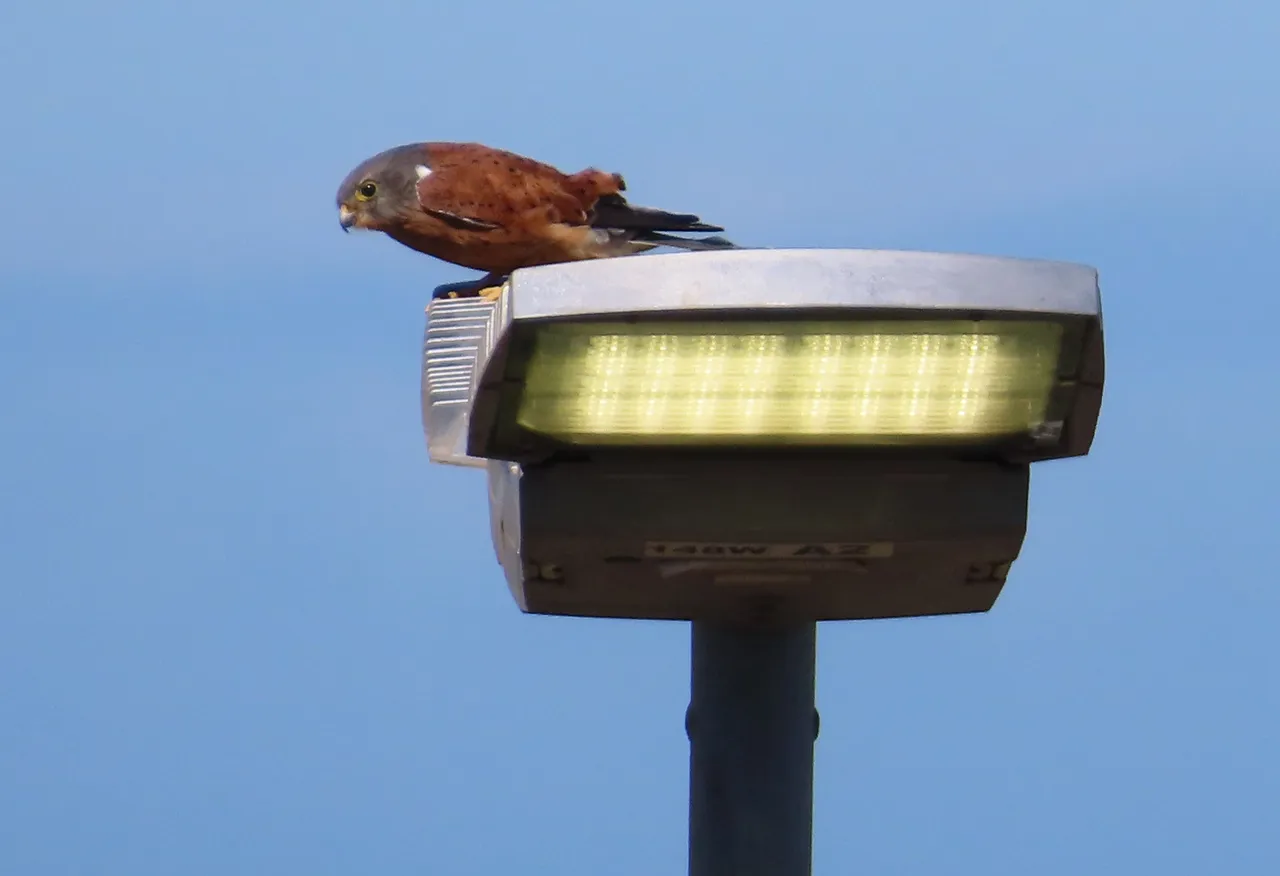
Look what was sitting on that streetlamp.

It was a Rock Kestrel (Falco rupicolus).
The rock kestrel (Falco rupicolus) is a bird of prey species belonging to the kestrel group of the falcon family Falconidae. It was previously considered a subspecies of the common kestrel (Falco tinnunculus).
This species occurs in Africa, from northwestern Angola and southern Democratic Republic of Congo to southern Tanzania, and south to South Africa.
Rock kestrels feed on a wide variety of organisms. They eat primarily invertebrates, but have been known to consume rodents, reptiles and birds.
Two primary forms of hunting are employed: hover hunting and perch hunting. Hover hunting describes the method whereby the kestrel remains stationary in the air with minimal wing flapping by utilizing updrafts. Hover hunting generally happens at medium to high windspeeds.
It is usually small prey (such as insects) which are caught via this method and are subsequently eaten during flight. Perch hunting is when the kestrel utilizes either natural (for instance cliffs and trees) or artificial (for instance electricity pylons and telephone poles) perches to scan the surrounding area for prey. Rock kestrels have been observed following baboons through grasslands and catching the insect species flushed out.
And I got a great shot of it taking off.

Only to land on another streetlamp closer to the mountain.

And finally, that's where I left it.

We are really happy to have so many species of birds of prey here in the Western Cape Province. Hardly a day goes by without us seeing one or more. The crows, in some places, keep a control on their territory and chase the birds of prey away when they near their nests, so this does keep some away. But the crows cannot be everywhere at the same time, and the birds of prey have their own territories and ways of protecting them. We enjoy watching the interactions between the birds. Now with all the extra winds, it is beautiful to watch how they navigate their way around the skies without getting hurt or blown away.
Such is life.
I hope you enjoyed the pictures and the story.
Photos by Zac Smith. All-Rights-Reserved.
Camera: Canon PowershotSX70HS Bridge camera.
Thank you kindly for supporting this post.