
Thinking that maybe in a month or two I will be able to go diving somewhere, I decided to look through my archives in search of underwater photographs, refresh my memories. So today I suggest you take a look at a small photo collection of fish that I shot underwater in the Philippines, or rather, off the coast of the Negros island. Not sure if I was able to correctly identify all of them, so if anyone notices an inaccuracy, please tell me about it. Well, let's go!
The first in today's collection is the Pink skunk clownfish in the anemones, with which they exist on mutually beneficial symbiotic conditions. Among the main advantages of such an existence, they highlight the fact that the fish protects the anemone from predators and parasites, increases the circulation of water around the tentacles of the anemone. And the anemone, in turn, also protects the fish from predators and gives it a safe place to live and reproduce - the tentacles are poisonous but the clownfish is immune to them. Overall, I think clownfish of all varieties are some of the most photographed underwater fish. Because they are quite bright, photogenic and stay more or less in one place, near their anemones :)

Next is one of the butterfly fish, it seems to be a sunburst butterflyfish (Chaetodon kleinii), although I may be wrong. They have a rather funny little tail fin.

This cute pink-orange fish is one of the members of the genus Pseudanthias. I find it difficult to decide which species it belongs to. By the way, they are harem fish: several females live with one male, so the male is probably just like a sultan for them. Why does this one swim alone? Hmm, I don’t know :)

Here we have another butterfly fish, I'm pretty sure it's the oval butterflyfish (Chaetodon lunulatus). It feeds almost exclusively on hard corals, lives singly or in pairs. This one was just on its way to eat, I hope I didn't distract it much with my camera :)

And what do you see here? I think I was talking about a collection of fish? Hmm ... it's a fish too! Take a closer look and you will see it in the center, the eye and fin make it noticeable even against the background of stones and corals with which it is used to merge. This is one of the types of stone fish, they are poisonous and dangerous to humans if stepped on, so you need to be careful when swimming and diving near coral reefs.

Here's another butterfly fish, this time it is the horned bannerfish. Hmm, maybe I should have called the post "Philippine Butterfly Fish Collection"? :) Well, what can I do, this is a large group of fish, about 130 species. As its name suggests, it has horns — you can see it in the photo, a very bizarre shape. The horned bannerfish are mostly solitary, although they can live in pairs or even small groups.

And here is another clown fish — common clownfish (Amphiprion ocellaris). It seems that this is still not an adult. And, like any decent clownfish, it always has a great background in the form of anemones in the photos. This is how they should choose a place for posing — study, other fish! :)

And now I have two damselfish, representatives of the genus Neoglyphidodon. The first one here is black-and-gold chromis or scarface damsel (Neoglyphidodon nigroris). It is noteworthy that many damselfish have completely different colors in childhood and adulthood. So, this fish in childhood is painted yellow with two horizontal stripes all over the body, and in adulthood it becomes like this. However, it is still pretty.

And this damselfish, Neoglyphidodon thoracotaeniatus, did not get a bright color in adulthood, although in childhood it could boast of yellow and turquoise colors with dark stripes.
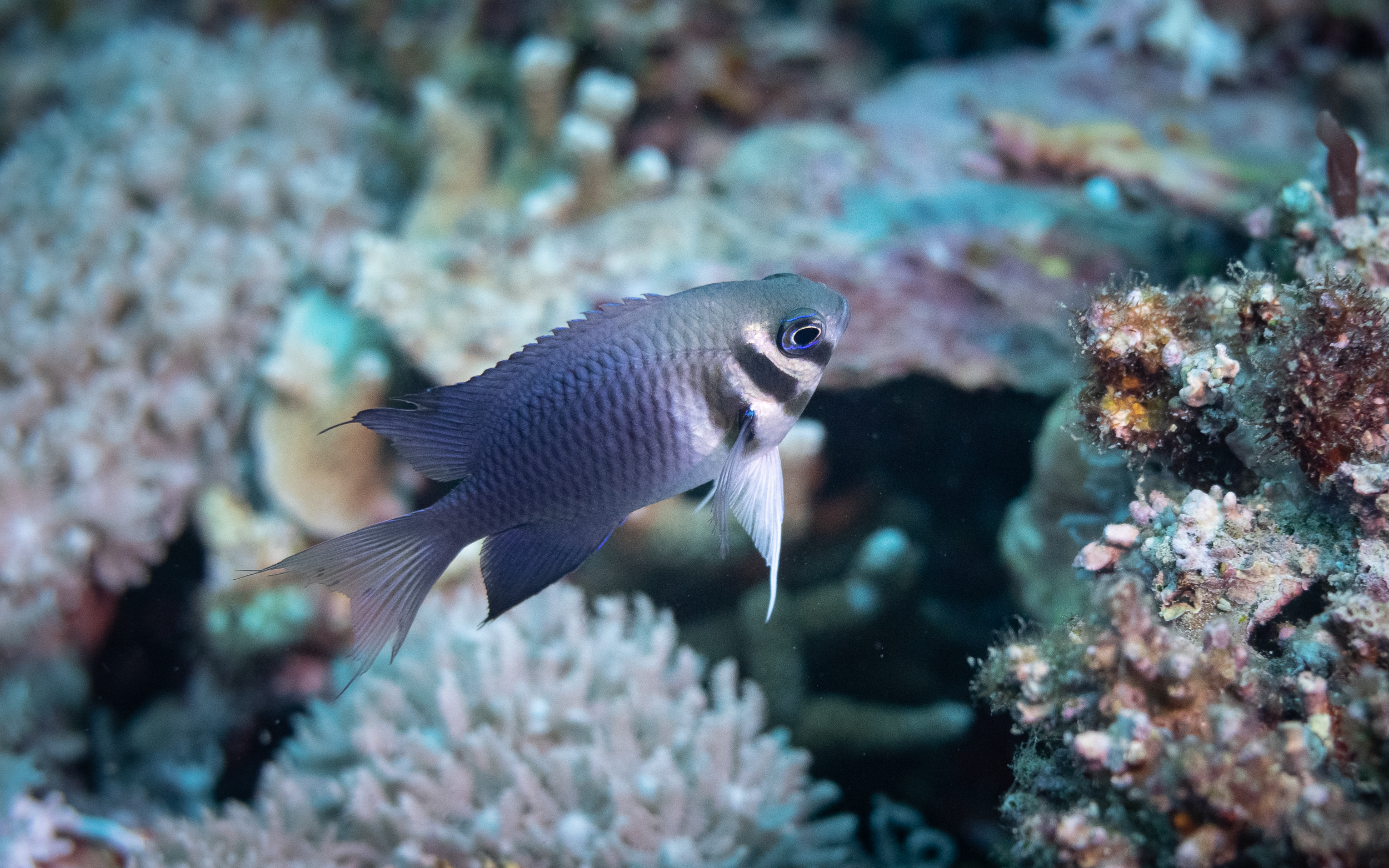
In general, looking at fish under water is a very interesting activity. Then, however, it is often difficult to identify them ... But okay, I'm not photographing for any serious scientific catalog of fish :)
It's better to watch the photo in high resolution.
OLYMPUS E-M5 Mark II
Exposure time: 1/800 sec
Aperture: F 2.8
Sensitivity: ISO 1600
Focal length: 60 mm
35 mm equivalent: 120 mm
You can also see my photos in my blog LJ and in my profile on NatGeo. You can read a short interview with me here.
