
Greetings to all and sundry on this platform once again. As a biochemistry student, today I did my research on "acetyl-CoA metabolism and some of its benefits" and decided to share it with you guys here. I hope that you will enjoy it and also learn from it. Stay tuned with me as I discuss this topic in my article.
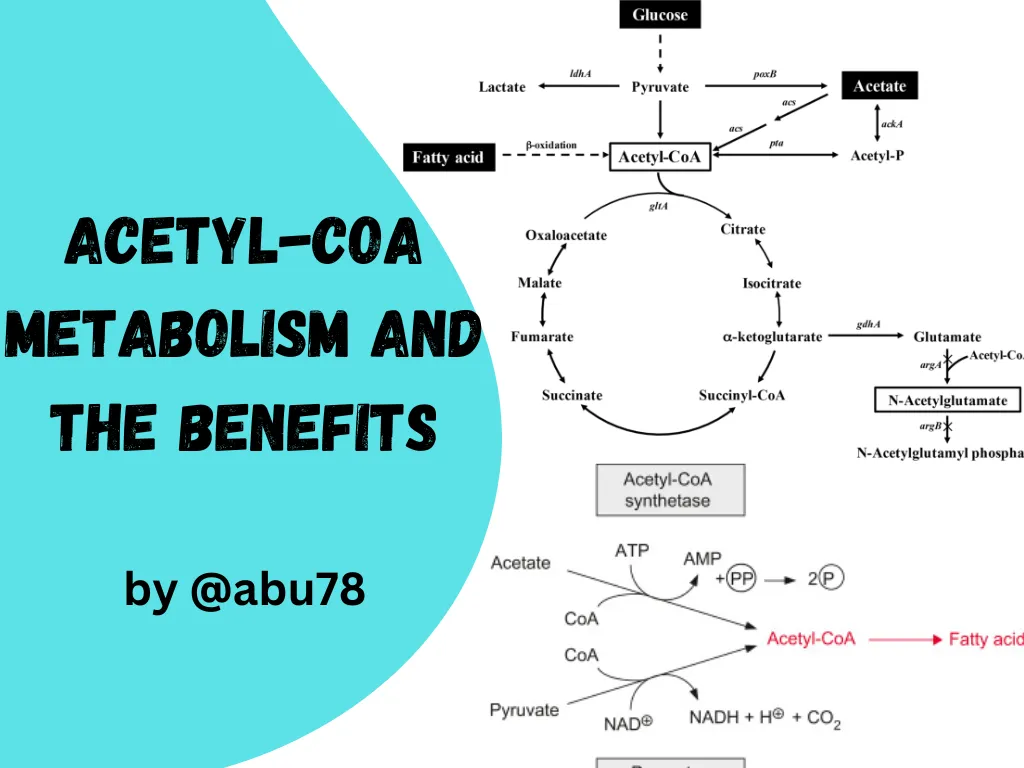
The acetyl-CoA pathway is an important metabolic pathway in all eukaryotic cells and is responsible for the production of energy in the form of adenosine triphosphate (ATP). This pathway is also involved in the synthesis of essential biomolecules, such as lipids, steroids, terpenes, amino acids, and fatty acids. The acetyl-CoA pathway begins with the reduction of a carbon dioxide molecule to a carbonyl group (C=O). This carbonyl group is then used to form the acetyl-CoA molecule.
The carbonyl group is formed through the reduction of carbon dioxide by either the enzyme carbonic anhydrase (CA) or the enzyme pyruvate carboxylase (PC). Carbonic anhydrase is found in all cells and is responsible for the enzymatic reaction of carbon dioxide and water to form bicarbonate and a hydrogen ion. Pyruvate carboxylase is found in certain cells and is involved in the conversion of pyruvate to oxaloacetate, a compound which is then used to form the acetyl-CoA molecule.
Once the acetyl-CoA molecule is formed, it can enter the citric acid cycle (also known as the Krebs cycle). This cycle is a series of reactions in which acetyl-CoA is oxidized to CO2 and H2O, releasing energy in the form of ATP. In the citric acid cycle, the acetyl-CoA molecule is converted to citrate, isocitrate, α-ketoglutarate, succinate, fumarate, and finally to oxaloacetate. Oxaloacetate is then recycled back to the beginning of the cycle, where it is used to form another acetyl-CoA molecule.
The citric acid cycle is important for the production of energy and is also involved in the synthesis of essential biomolecules. For instance, the production of isocitrate, α-ketoglutarate, succinate, and fumarate is important for the synthesis of the amino acids alanine, aspartic acid, and glutamic acid. The citric acid cycle also plays a role in the synthesis of lipids, steroids, terpenes, and fatty acids.
The acetyl-CoA pathway is also important for the synthesis of a variety of cofactors and vitamins, such as thiamine pyrophosphate and biotin. These cofactors and vitamins are important for a variety of metabolic processes and the production of energy. The acetyl-CoA pathway is also important for the provision of energy for the maintenance of cell homeostasis, as well as for cell growth and proliferation.
The acetyl-CoA pathway is a complex and intricate metabolic process, but it is important for the production of energy and the synthesis of essential biomolecules. The reduction of carbon dioxide to a carbonyl group is the first step of this pathway and it is essential for the production of useful energy and biomolecules. Without this initial step, the entire metabolic process would grind to a halt.
The references given below are sites where you can learn more about the acetyl-CoA metabolism, especially about the cycle or process in detail.
Reference 1
Reference 2
Reference 3
Reference 4
