
Madwomen of the Salpétrière (Courtyard of the Mentally Disturbed)

Image credit:1857 lithograph by Armand Gautier. Cushing/Whitney Medical Library. Public domain
The caption under this picture states that it shows, "personifications of dementia, megalomania, acute mania, melancholia, idiocy, hallucination, erotomania and paralysis in the gardens of the Hospice de la Salpêtrière."

On June 8, 1809, firebrand of the American Revolution, Tom Paine, died and was quietly interred on his farm. It is reported that he was generally despised at that time. Six people attended the funeral.
About two hundred years later, the founder of Reason Magazine, Lanny Friedlander, died in virtual obscurity (March 18, 2011). By the time of his death, he had become so removed from mainstream life that publishers of Reason couldn't find a picture of him to hang on the wall. No one at the magazine had ever met Friedlander.
Modern sources speculate that Paine suffered from bipolar disorder. Friedlander was diagnosed with schizophrenia as a youth and was treated for the disease until his death.

Brain Scan of Patient Diagnosed with Bipolar Disorder

Image credit: Petergstrom. CC 4.0 license
The caption under this scan reads: "Fronto-insular regions of grey matter reduction in bipolar disorder".

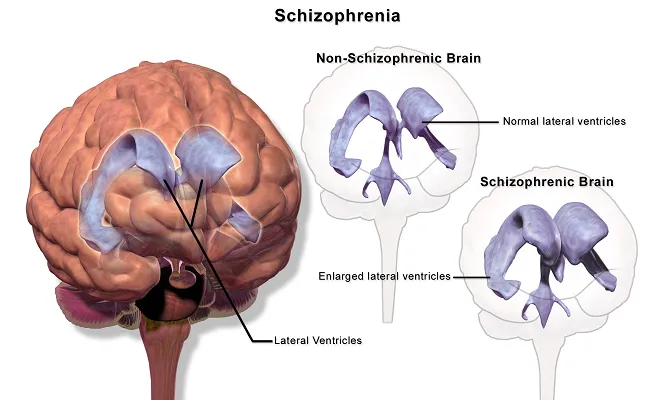
Image credit: BruceBlaus. Used under CC 4.0 license.
The caption under this picture reads: An illustration depicting schizophrenia.

These two brain scans are, in a way, reassuring. We can see the disease. We can understand it, these scans suggest, because there are pictures of afflicted brains.
Ah, if only this were so. If only we could invite suffering patients, take pictures of their brains and say, "You have schizophrenia," or "You have bipolar disorder".
Sadly, this is not the case.

Charles Meryon in His Madness, the Night Before His Removal

Image credit: Artist, L. Flemang, 1858. Photo source: [National Gallery of Art) Public domain
Charles Meryon (1821-1868) was an artist who worked exclusively in etching, because he was color blind. Meryon's life was marked by hardship. He was admitted several times to asylums and died in one.

Consider two recent studies on the ability of mental health professionals to diagnose bipolar disorder and schizophrenia. The first was published in the Shanghai Archives of Psychiatry, and the second was conducted by Johns Hopkins.
Shanghai Article on Bipolar Disorder
This article, published in 2018, begins by explaining that bipolar disorder has, "a high misdiagnosis rate and commonly misdiagnosed as...depression, schizophrenia, anxiety disorders, obsessive-compulsive disorders, and personality disorders..." These misdiagnoses result in, "mistreatment of clinical symptoms and increasing of recurrent episodes."

"Puerperal Mania in Four Stages"

Image credit: Wellcome Collection gallery (2018-03-31): https://wellcomecollection.org/works/hbqeamrf CC-BY-4.0
The diagnosis of Puerperal Insanity was quite common in the 19th century. The malady apparently struck women who had recently given birth. Over the years, this diagnosis dissolved into a variety of other disorders: manic depressive, dementia praicox, toxic confusional and neurotic states.

The Shanghai Archives article goes on to describe a study in which 177 patients diagnosed with bipolar disorder were examined in an outpatient clinic. In this group, 136 (76.9%) were found not to have bipolar disorder. The article goes on to state that many of these patients actually were suffering from depression, or other "psychotic" disorders.
Simple Mania Patient at West Riding Lunatic Asylum

Image credit: Wellcome Collection gallery (2018-03-21): https://wellcomecollection.org/works/xcr6gpkf CC-BY-4.0 1871
The Welcome citation for this image:"Mary Shaw, a patient at the West Riding Lunatic Asylum, Wakefield, Yorkshire. Photograph attributed to James Crichton-Browne, 1871."

Johns Hopkins Study on Schizophrenia
This was a small study, conducted at the Hopkins Early Psychosis Intervention Clinic (EPIC). In a cohort of 56 patients who had been referred to the clinic with a confirmed diagnosis of schizophrenia, only 26 were found to actually have schizophrenia (according to the criteria of the clinic). The remaining patients (51%) were found to be suffering from "anxiety or mood disorder".
One reported symptom that seemed to doom patients to a diagnosis of schizophrenia was hearing voices. According to the researchers at Hopkins, "Hearing voices is a symptom of many different conditions, and sometimes it is just a fleeting phenomenon with little significance..."


Image credit: Mental diseases. A Text-book of Psychiatry for Medical Students and Practitioners. Public domain. (1913) The text under this picture: "A man with schizophrenia engaged in stimming behavior".

Russell L. Margolis, M.D., professor of psychiatry and behavioral sciences at the Hopkins Schizophrenia Center, also attributes the high rate of misdiagnosis to "checklist psychiatry": a clinician reads off symptoms listed in the DSM. If a patient has enough of those listed symptoms, they have schizophrenia.
Incidence of Misdiagnosis Confirmed by Other Sources
There exists the possibility that the Shanghai and Hopkins studies are outliers, that misdiagnosis of bipolar disorder and schizophrenia is not so pronounced. The following sources suggest that Shanghai and Hopkins might be on the mark.


Image credit: Лорд Алекс edited & made the image transparent. Photo by E. Kretschmer. Public domain. The caption associated with this picture: "Dysplastic growth of fat. Schizophrenic pubertial weak-mindedness, age 19. Hypoplastic mean mid-face; plump, coarse development of cheek-bone and chin; formless obesity".
Diagnosis of Bipolar Disorder, or Schizophrenia is an extremely consequential event. In the United States, it can affect a number of rights...such as the right to own a firearm, and the right to manage one's own affairs. It can affect even the right to be free.
One of the most serious results of a bipolar or schizophrenic diagnosis is treatment with powerful anti-psychotic drugs. These drugs can have life-changing--even fatal--side effects.
This excerpt from the British Journal of Psychiatry illustrates just how consequential taking an anti-psychotic may be: "Those who had taken only conventional antipsychotics were twice as likely to die compared with those taking atypical agents (P<0.02). For those aged 53-65 years, conventional agents were associated with a sevenfold increase in mortality."

Image credit: James Heilman, MD. Used under CC 3.0 license. Although the patient in the picture gave permission to use his image, I've blurred his face. One of the potential side effects of taking an anti-psychotic is a drug-induced movement disorder. There are several kinds. This patient is experiencing dystonia, although it is not stated that an anti-psychotic brought on this condition.

My blog today is not intended to be an indictment of psychiatry. What I hope is that readers will regard psychiatric diagnoses with a healthy dose of skepticism. Many healthcare professionals who work in psychiatry want to help. However, it is unfortunate that a psychiatrist's judgment is often accepted without question. I'd like to see some more questioning, not only by patients, but also by psychiatrists themselves.

I didn't cite the Rosenhan Experiment because it is fairly well known and has been attacked vigorously (whether fairly or unfairly) by the psychiatric community. I thought using pillars of the community would be more effective.

Some Sources Used in Writing This Blog
- History.com American Revolution Thomas Paine
- Chicago Tribune
- Campbel Fine Arts.com
- Shanghai Archives of Psychology
- Science Daily
- Sage Journals.com
- Merriam Wesbster Stimming
- Acta Neurologica Belgica:
- European Psychiatry:
- Kleine-Levin Syndrome
- American Psychological Association:
- rights...
- British Journal of Psychiatry
- BMJ
- Brain and Behavior
- Brazilian Journal of Psychiatry
- Science Daily
- Current Psychiatry Reports
- BMJ Acute Dystonia Induced by Drug Treatment
- Heart
- Blake Chelmsford Funeral Home: Lanny Friedlander
- Journal of Affective Discorders
- Mayo Clinic
- Psychiatric Srv.
- Psychology Today

Sources Caduceus: https://pixabay.com/id/vectors/caduceus-dokter-obat-medis-2730761/