
Hello everyone,
In this blog post, I will be discussing about the mandible, also known as the lower jaw.

The mandible is actually divided into two parts: the body and the ramus.
The structure within the red circle indicates the body while the structure outside the circle indicates the ramus ⭕
The body is that horizontal, horse-shoe shaped part that actually forms the chin. Curve in a way that reminds me of a magnet 🧲 , the image above explains better.
Now I will talk about the ramus. The ramus is the vertical part that projects backwards from the body. It ends at the head of the mandible. The ramus plays a role in forming the temporomandibular joint (TMJ). This joint makes it possible for all of us open and close our mouths (Check the image above).
Prominent Structures and Landmarks on the Mandible
So in no particular order, I will just outline some of the important features of the mandible that you should know.
1. Mental Tubercle & Mental Protuberance

The structure indicated with a red arrow indicates the mental tubercle and protuberance
These form the part of the chin you can feel when you touch your face. The mental protuberance gives the chin its shape. It is a structure that is usually more prominent in males than in females. It is also where some muscles attach like the depressor labii inferioris mentalis and depressor anguli oris. Check the images below to compare.


The structure indicated with a red arrow indicates the Depressor anguli oris muscle.

The structure indicated with a red arrow indicates the Mentalis muscle.

The structure indicated with a red arrow indicates the Depressor labii inferioris muscle.
2. Oblique Line

The structure indicated with a red arrow indicates the Oblique Line.
This is actually a ridge that runs upwards and backwards from the mental foramen. It is the attachment point for muscles like the buccinatormuscle.

The structure indicated with a red arrow indicates the Buccinator muscle.
You might miss it unless you’re really looking for it closely 😜.
3. Mylohyoid Line
The structure indicated with a red arrow indicates the Mylohyoid Line.
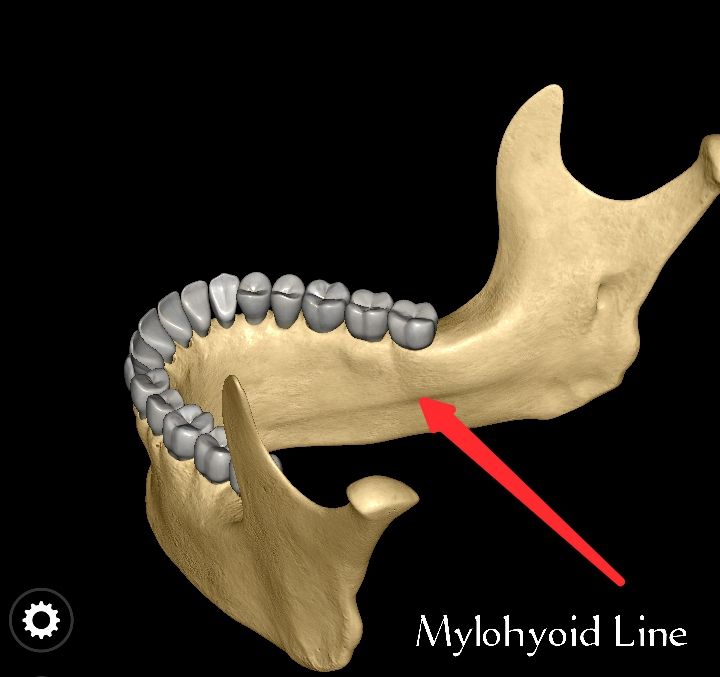
This line is located on the inner surface of the mandible. It runs diagonally and gives attachment to the mylohyoid muscle which forms the floor of the mouth.
The structure indicated with a red arrow indicates the Mylohyoid Muscle.
4. Coronoid Process & Condylar Process


The structure indicated with a red arrow indicates the Coronoid Process and Condylar Process
At the top of the ramus, there are two projections – the coronoid and the condylar (or condyloid) process.
The coronoid is the front one and serves as an attachment for the temporalis muscle (the one that helps in chewing).
The condylar process has the head of the mandible that fits into the temporal bone forming the TMJ.
5. Angle of the Mandible

The structure indicated with a red arrow indicates the Angle of Mandible
This is the angle formed where the body and the ramus meet. It varies from person to person. This can even change with age and gender. In some people it's sharp, in others it's more rounded.

***The structure indicated with a red arrow indicates the Masseter Muscle which attaches to the angle of the mandible ***
6. Mandibular Foramen & Canal

The structure indicated with a red arrow indicates the Mandibular Foramen which is continuous as the Mandibular canal
Inside the ramus, there is a hole or a passageway called the mandibular foramen. So, the inferior alveolar nerve, courses through this hole into themandibular canal. Then, it moves we through the mental foramen which is located at the front of the mandible. This alveolar nerve has an external branch called the mental nerve. Remember mental foramen and mental nerve 😉🤗.
7. Alveolar Part

The structure indicated with a red arrow indicates the Alveolar Process
This is the part of the mandible that holds your lower teeth. The sockets for the teeth are called alveoli.
Sincerely, I wanted to talk about other landmarks on the mandible. However, I have covered the ones you are most likely to notice when you are looking at a dry skull. 😊
Thanks for visiting.
Apps Used:
Anatomy 3D App
3D Anatomy App
Capcut