

All photos and videos contained in this article are of my production and therefore of my exclusive right of use. All photos and videos contained in this post are copyright-covered. All photos and videos – and their derivatives - contained in this post cannot be used without the explicit consent of the author.
A full year after the publication of some photos taken in one of my usual trips, here I am again telling you about a little nice little friend that circulates in the woods above my city. Its name is complicated like almost all the names you find in taxonomies: Dryocosmus Kuriphilus.
This companion of our adventures - now not too recent - has captured the attention of many experts concerned about its effects on some peculiar habitats such as those rich in chestnut trees. Hence the need to keep him under constant control and to seek a remedy, considering that he - or rather her, we will see later why - likes to do tantrums and does not want to part with a house that he worships so much.

Dryocosmus, I See You: Massa-Carrara as a Hotbed
The need to keep under control the territories where Dryocosmus Kuriphilus is present has been underlined by the EPPO (European and Mediterranean Plant Protection Organization), which considers this specimen a QUARANTINE ORGANISM. The international group classifies this type of parasitic organisms into 2 levels: A1, when they are potentially harmful parasites that are not yet found in the countries belonging to the EPPO, and A2, when they are already present in the EPPO countries. As quarantine organisms, the EPPO asks the various national governments to regulate the presence and spread of each bacterium/cytoplasm, fungus, insect/mite, virus or similar and nematode belonging to these 2 categories, on the whole territory of its competence.
Why is Dryocosmus Kuriphilus so dangerous for EPPO? Let's try to understand it with a 360-degree identikit.

Dryocosmus Kuriphilus (called Chestnut Gall Wasp, Oriental Chestnut Gall Wasp or Asian Chestnut Gall Wasp) is a phytophagous insect of the order of Hymenoptera; it is called GALL WASP because it causes the appearance of galls on the trees it infests; it is said of the chestnut because its main target is the genus Castanea, in my lands especially the species Castanea Sativa.
Distribution
Dryocosmus Kuriphilus is a Hymenoptera originating in China that over time has arrived in Japan, Korea, and Nepal, to then reach the most distant continents and land in the United States, Europe, and Turkey. The methods by which this was possible are essentially 2:
- Active Transport: the flight of cynipid specimens, valid on short-distance journeys, for example neighboring territories;
- Passive Transport: direct transport of specimens by truck or other means, or indirect transport by planting plants contaminated by eggs or larvae.
An example of passive transport comes from Holland: a batch of young chestnut trees to be buried - coming from Italy - was blocked in a usual quality control test, finding it infested with Dryocosmus Kuriphilus. The lot was immediately isolated and burned, so as to avoid the spread of the infection. This served only momentarily because in 2015 it was again found on the Dutch territory where it is currently present, albeit in a very limited way.
In my country, in Italy, the presence of the cynipid was ascertained for the first time in Cuneo, in 2002. Numerous sightings followed throughout the peninsula. Data dating back to 2009 speak of 15 regions out of 20 infested.
I live in Tuscany, near the border with Liguria. While in the latter the first sightings date back to 2007, in Tuscany we go even further back, precisely to 2005. In the province of Massa-Carrara the presence of Dryocosmus Kuriphilus has been ascertained since 2008 in 6 different municipalities, both in Lunigiana and along the Riviera Apuana, bordering the better known Versilia.
The last update of the spread by the EPPO dates back to 2019: the organization declared Italy as a territory with a high spread of the parasite.

Systematic Framework – Species Morphology – Life Cycle
Family: CYNIPIDAE
Genus: DRYOCOSMUS
Species: DRYOCOSMUS KURIPHILUS

Defined phytophagous (= plant-eater), because it is a specimen that feeds on plant species. It reproduces by Thelytoky Parthenogenesis, therefore it does not present male individuals: all specimens of the species are female. Its reproduction cycle foresees only one generation per year, a feature that in zoology makes it defined with the term univoltine. Its development cycle includes 4 phases: egg, larva, pupa and adult.
The specimens move to the buds, to the vegetative apexes, and here they make holes where they lay the EGGS (from 100 to 150). The eggs are piriform and whitish, with a long peduncle, and are not visible to the naked eye. The oviposition holes are no longer visible on the plant during the summer season.
After about 30-40 days, the period in which embryonic development is complete, the eggs pass to the state of LARVA, which however becomes visible only from the second decade of April, not giving tangible signs of its presence throughout the winter. The coloring remains whitish and the dimensions reach approximately 2.5 mm in length. The larva, abode, and anophthalmic, grows very slowly. It passes to the state of PUPA starting from mid-May, maintaining hyaline color and dimensions during the first phase, then to darken until it turns black and passes to the ADULT state. At this point, the specimens still have a length of 2.5, at most 3 mm. Entirely black with ocher legs, they have geniculate antennas (which bend at an angle), composed of 14 antennomeres, where the scape and pedicel are not very developed in length, much in diameter. The flagellum gives the antenna a thread-like appearance. The wings show little evident ribs. The abdomen is large and round and ends with an ovipositor consisting of 3 valves. While the third serves more as a protective shell, the first and second valves form the terebra which is normally scarcely visible.

OVIPOSITION. Between June and July, the females emerge and move towards the buds. By means of the terebra, they penetrate the plant tissues. Here they release the eggs, which remain there until August-September when they hatch and begin the larval stage. Some researchers have observed here in Tuscany that the chestnut sprouts that contain the eggs already seem larger from the earliest stages (6 mm3) compared to the corresponding sprouts without eggs (3 mm3). In addition, the density of the eggs decreases going from the apical area towards the basal area.
So, having explained all this, I would ask myself: what is the problem of Dryocosmus? Very simple: the problem are the galls.
GALLS
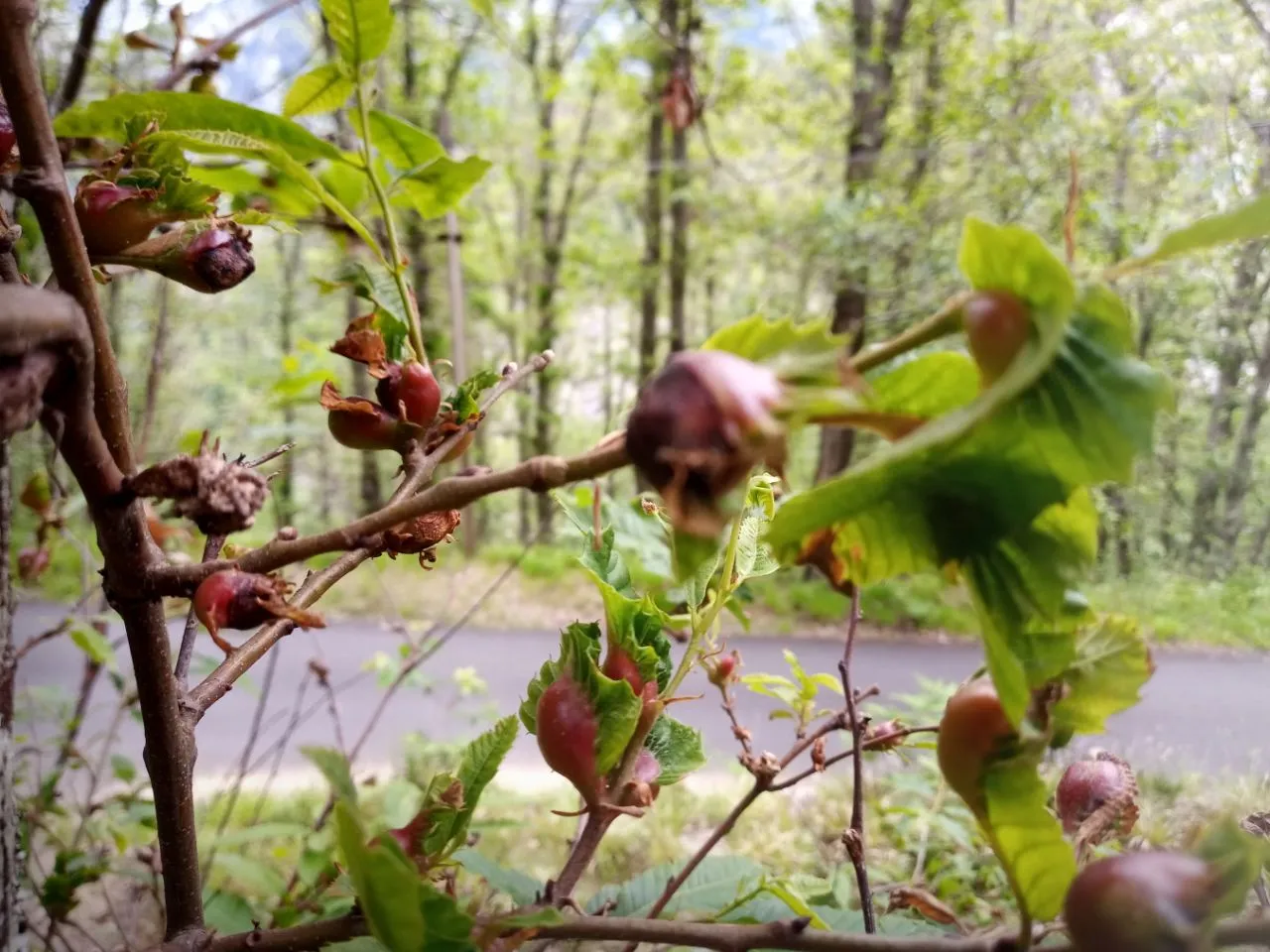
The galls caused by Dryocosmus are swellings present on the chestnut leaves. They are - in technical terms - proliferative- growths formed by the excessive proliferation of plant tissues. The galls have a very variable diameter, reported from 0.5 to 3 cm, but from my direct experience, I have seen some more developed in length up to 7-8 cm. Their size depends on the growth potential of the affected plant and not on the Hymenoptera itself.

In fact, the formation of the gall is caused by some substances that are released by means of the terebra at the moment of oviposition. These substances induce reactions in the plant tissues which lead - in the spring - to the formation of the galls due to excessive proliferation of the tissues themselves (a kind of localized tumor).
Being the point where the gall born the same where the oviposition took place, inside the gall there will be the specimens of Dryocosmus engaged in the various stages of their own development cycle. They are housed in some Cells, empty spaces in which the Hymenoptera can spend the necessary time for it to end its development.
Click Here: LARVA IN THE CELL - VIDEO
From observations of some researchers here in Tuscany, it seems first of all that the size of the gall depends on the number of cells that are found inside it. They also measured the incidence of galls in 3 different variants of Castanea Sativa: Fusca, Cesurone, and Carpinese. The latter shows at first glance a lower susceptibility to the action of Dryocosmus and a consequent lower presence of galls.


The galls, initially formed by yellowish and greenish portions, sprout from the shoots and become clearly visible on the leaves. Over time they take on a reddish color and cause damage from the dawn of the development of the plant they infest. They block the development of the leaf or branch that they affect and thus prevent the subsequent formation of the fruiting system. This is possible because they decrease the photosynthetic activity of the downstream cellular components, i.e. those that form the leaf or the vegetal portions on which it resides. Furthermore, when the adult specimens of Dryocosmus are ready to go out, they make exit holes that will be visible on the rotting gall. Yes, because the gall begins to rot and brings with it the entire portion that developed downstream: I saw leaves, that had developed - and seemed apparently healthy -, begin to regress when the color of the surface began to vary. The more the color of the surface became red, the more the leaves regressed and appeared suffering. Eventually, the color of the surface changes from red to rotting gray and the leaves are gone. As the season progresses and the autumn comes, only dry shrubs remain and the points of the branches where the gall was located are covered with exit holes.


The main consequences of gall formation are 2:
1) The arrest of the development of the plant;
2) The decrease in fruiting.
These scenarios are as dramatic as Dryocosmus' presence years in the area. Since its biological cycle is not immune to climatic factors - altitude, exposure, earliness of development of the chestnut species can affect the severity of the infestation and therefore the consequences of the same.
There are also further observations.
It has been noted that the areas most affected by Dryocosmus Kuriphilus are also more prone to Cortical Cancer, a pathology caused by a fungus (Cryphonectria Parasitica). In the Eastern United States, it was able to almost completely eliminate the population of Castanea Dentata, while in Europe the species of Castanea Sativa would be more resistant to the action of the fungus. This does not mean, however, IMMUNE, so much so that the increase in incidence has worried the researchers, who have noted the coexistence between cynipid and chestnut tree cancer. Some Swiss research has shown that the holes made in the oviposition can be a useful means for Cryphonectria Parasitica to invade the plant.
Another coexistence noted is that between Dryocosmus and Gnomoniaceae Diaporthales, a mushroom that leads to rotting, dried up chestnut fruits with a chalky and brown pulp. Some locations infested with the cynipid have experienced an infestation of up to 90% by Gnomoniaceae Diaporthales.

TREATMENT: What can we do?
There is a natural antagonist to Dryocosmus Kuriphilus, the parasitoid Hymenoptera Torymus Sinensis Kamijo. Its use is called BIOLOGICAL FIGHT: the exploitation of a naturally antagonistic organism of another organism harmful to humans, which aims to eliminate its presence. In 1982 it was introduced to Japan and the chestnut cynipid gall wasp population was killed in 10 years. The first in Italy to study this solution was the Piedmont region, starting only in the laboratory and subsequently also in the field. Since 2009, significant decreases in the cynipid population began to occur, so much so that other regions imitated his example.
Also on Wikipedia, there is a list of the launches of Torymus Sinensis monitored and registered by the Ministry of Agriculture and Forestry in Italy in 2014-year: Campania (184), Tuscany (118), Calabria (116), Lazio (116), Piedmont ( 60), Lombardy (60), Emilia Romagna (56), Liguria (56), Abruzzo (46), Basilicata (40), Marche (40), Umbria (30), Veneto (24), Sicily (20), Trentino South Tyrol (18), Val d'Aosta (12).
Taking advantage of the experience of the Piedmont region, it is possible to give an overview of the events since the launch of Torymus. The first premise to keep in consideration is the definition of Parasitization: it is the result of the series of events that lead an organism to develop and progress at the expense of another organism with which the former comes into direct or indirect contact; in the specific case, we consider it as the elimination of Dryocosmus Kuriphilus by Torymus Sinensis. The Piedmont region has chosen launch sites spaced a few kilometers from each other, so as to create a homogeneous population of Torymus. Each site received 100 female and 40-50 male specimens. Considering that the population of Dryocosmus was several thousand for each chestnut tree, the first 2-3 years the population of Torymus increased, but without giving visible effects of parasitization. In the following 2-3 years, the phenomenon began to become evident, reaching a 50-60%. The growth of the population of Torymus is in fact exponential and the researchers who monitored the situation found that Dryocosmus and Torymus coexisted in similar numbers within the galls. It is at this point that the real change happens: the season following this observation, the production of galls falls extremely sharply. The parasitization grows to over 90% and the development of chestnut trees resumes at full speed over the following years.

Massa as a Hotbed: How long?
In 2019 a group of students from the University of Florence and various interested local communities, among which the one from Antona - a country with a strong tradition based on chestnut flour - stood out, they collaborated on a project that aims to spread the Torymus Sinensis also in the areas of the municipality of Massa. Local newspapers reported that, in 2019, 6 launches were made from different sections of the Frigido River and that, between June and July 2020, other students monitored the situation, finding an 80% parasitization. Obviously the wide-ranging effects are slower to arrive, as seen in the Piedmont example, but the project aims to evaluate areas and repeat launches over the next few years, trying to bring back an emergency that has perhaps been neglected a little too much in the recent past.
Here there are other Images from the photos I took between May and June 2020.




REFERS
Chestnut gall wasp (Dryocosmus kuriphilus) infestations: new opportunities for the chestnut blight fungus Cryphonectria parasitica?, S. Prospero and B. Forster, June 2011
Dryocosmus Kuriphilus Wikipedia Voice
Asian chestnut gall wasp in Tuscany: gall characteristics, egg distribution and chestnut cultivar susceptibility, Tiziana Panzavolta, Matteo Bracalini, Francesco Croci, Carlo Campani, Tamaro Bartoletti, Giuditta Miniati, Stefano Benedettelli, September 2011
Piedmont Region
EPPO (European and Mediterranean Plant Protection Organization)
EPPO Reporting Service no. 10 - 2013 Num. article: 2013/220
Chestnut gall wasp (Dryocosmus kuriphilus): spreading in Italy and new records in Bologna province, Ignazio Graziosi, Fabrizio Santi, 2008
Tuscany Region
Liguria Region
Voce Apuana, La Gazzetta di Massa e Carrara, IlTirreno, La Nazione Massa-Carrara