
Surgeries are often required for life threatening conditions that requires opening the patient. While there are a lot of successful surgeries, surely no one expects an unsuccessful surgery, there can be cases where things went wrong in the process of performing the surgery. These surgery gone wrong usually lead to complications. The complications can be mild or serious which could become life threatening. I will be discussing today about a surgical complication which is known as Gastrointestinal fistula, also known as Abdominal Fistula.
Surgeries in the abdomen (laparotomy) vary and they can range from C Sections, Colostomy, Colectomy, Ileostomy, and Appendectomy. Let me quickly give a brief explanation on each of the surgical procedures I listed. C Section also known as Cesarean Section is an incision made into the abdomen and uterus, to deliver babies from their mother, when vagina delivery is considered unsafe. Colostomy is the surgical operation done on patients by creating an incision to form a stoma, in other to divert the colon from its normal route through another route to get to the anus, while Colectomy is the surgery to remove all or part of the colon. Ileostomy is a surgery where waste is removed from the ileum of the small intestine as a result of the rectum not working properly. Appendectomy is a surgical procedure that has to do with removing the appendix.
Wikimedia Commons
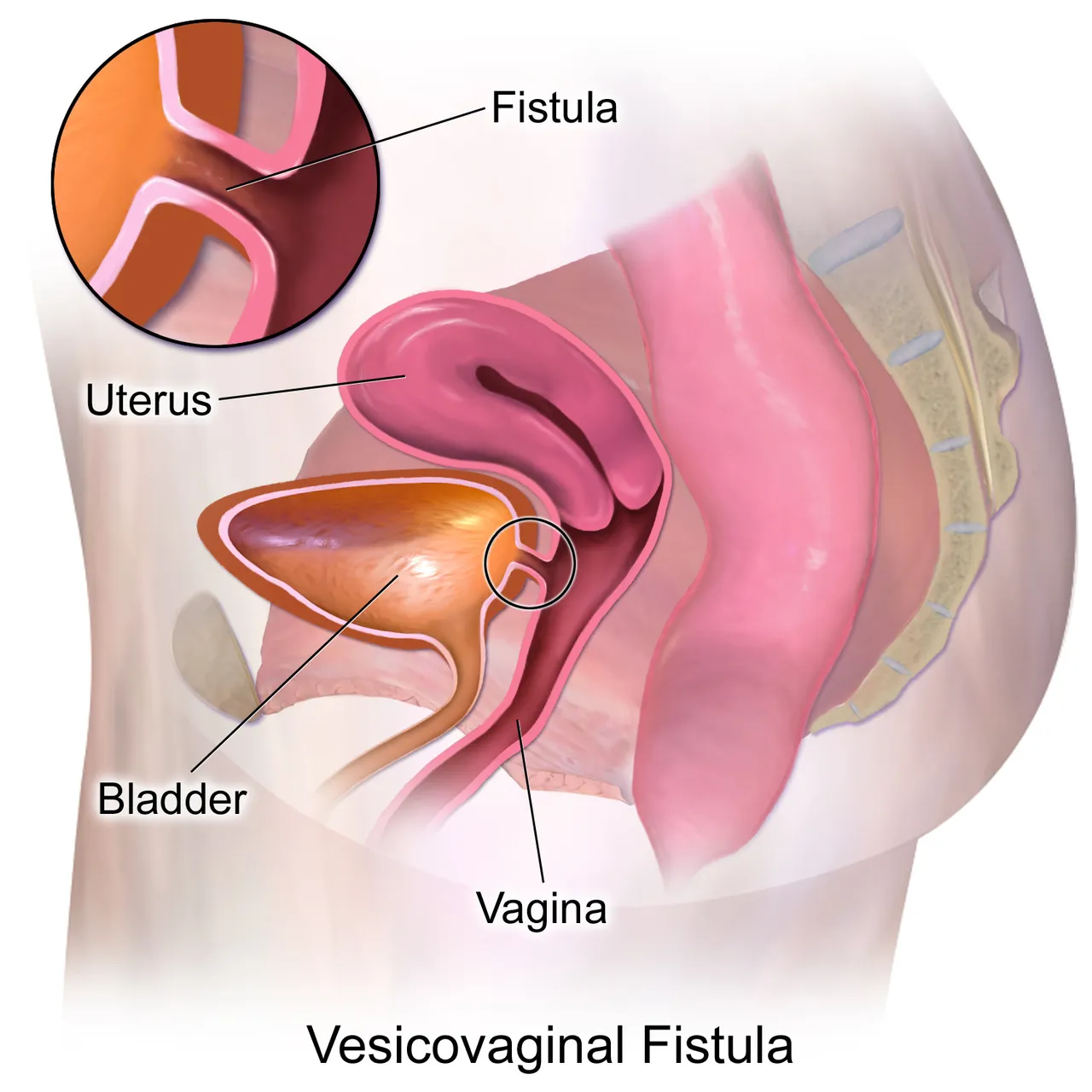
Let me quickly say that after a surgery, the body doesn't regenerate, it actually produces scar tissue in its process of healing, with little bit of regeneration. The only organ in out body which is has the ability to regenerate is the Liver. After a surgery, at the sight of the operation and the sight of the incision, there usually are scar tissues, and so, when surgeons are performing surgeries, they are always careful not to create any injury while moving the internal organs of the body, so as to prevent injuries which could lead to scaring. While surgeons are very careful, there can be a case where two different epithelial surfaces are wrongfully connected. For instance, wrongful connection of the small intestine to the large intestine, causing premature transfers for food to the large intestine without proper digestion and absorption, Abdominal fistula could involve connecting two wrongful connection in the abdomen or to the skin itself. Like in cases where the small intestine or large intestine get stitched with the skin in the process of closing up the patient, thereby causing the intestine to open up and leak into the abdomen. This is known as Enterocutaneous Fistula. When parts of the intestines starts to leak without the skin being involved, it is known as entero-enteral fistula.
Abdominal Fistula is common with surgeries, but it isn't limited to surgeries. It could occur in cases of crohn's disease, where the intestinal tract is inflamed, leading to the breaking down of the tissues around the organ, which could lead of adhering/fusing of the organs, causing them to leak, others could be from gun shot in the abdomen, ulcer in the gut, cancer could also lead to leaks, but basically, it is usually caused through surgery.
Symptoms of Gastrointestinal/Abdominal Fistula.
Patients with abdominal fistula could have diarrhea and weight loss as a result of low nutrient absorption, in cases of fistula in the small intestine, or connecting to the l arge intestine. When the fistula is a Enterocutaneous Fistula, the content of the organ starts to leak into other organs in the abdomen which could cause bloating in the internal organ, which would lead to lots of internal pressure as a result causing abdominal pain. Other signs and symptoms include fever, skin pain, irritation, excoriation, gastrointestinal bleeding, weekness, poor appetite, weight loss, cachexia, elevated white blood cell count, pneumaturia and fecaluria (entero-vesical fistula), recurrent UTIs, Vaginal pain, and discharge (in cases of colo-vaginal fistula).
Evaluation and Treatments of Gastrointestinal/Abdominal Fistula.
The treatment of a Gastrointestinal/Abdominal fistula depends on a lot of things, including the size, location, and how the fistula occurred, as well the complexity of the fistula. In the case of Surgery caused abdominal fistula, it is very difficult to cut through the patient after an immediate surgery, the patient may have to manage the fistula until they are ready to go into surgery after healing up a little. To identify an abdominal fistula, clinical evaluation, and physical evaluations should be considered. Identification can be done through Imaging such as CT scans and MRI if needed, and Endoscopy. In the case of managing the fistula, in cases of Enterocutaneous Fistula, a stoma bag (serving as a wound management system) is placed to help get contents being spilled out from the region, also Total parental nutrition is administered intravenously, so the patient won't eat or drink until it is corrected.
Cases where there is an underlying cause, treating the underlying cause such as Crohn's disease, diverticulitis, are important. Also, treating the associated symptoms with it is necessary. In most cases, where the abdominal fistula isn't complicated, having it heal up by itself will be an ideal situation, but when it is complicated and cannot heal up on its own, then Operative Approach will be the final result.
Conclusion
I was inspired to write this post after receiving a call from a friend who just had an abdominal fistula (Enterocutaneous Fistula) and she is told to wait for about 5 months so the surgery she just concluded would heal up. The proper management procedures have been done, and hopefully she would go back for the surgery and get it fixed. She will not be eating or drinking during this period, and would be using the intravenous TPNs until the surgery is performed.
Post Reference
https://www.hopkinsmedicine.org/health/treatment-tests-and-therapies/cesarean-section
https://www.nhs.uk/conditions/colostomy/
https://medlineplus.gov/ency/article/007378.htm
https://www.hopkinsmedicine.org/health/treatment-tests-and-therapies/appendectomy
https://medlineplus.gov/ency/article/001129.htm
https://www.ucsfhealth.org/conditions/enterocutaneous-fistula