
Hey guys!
If your children love to put their hands to/in everything like sand, water, dirt/mud, soil, foam, playdough, kinetic sand, bubbles, rice, pasta, cereals and other sensory things this will be a hit! 🖐️
Sensory bins are a great way to introduce children to a variety of textures in a fun way. Usually, in a sensory bin you can find colored rice, pasta, beans, lentils, corn, pieces of wood, leafs, grass, rocks and pebbles, flowers, different fabric txtures, water,& pretty much anything you can think of! Just name it! You need a bit of imagination and it's all great. I like to combine sensory materials with toys to create a fun and interesting learning activity for my 2yr toddler.

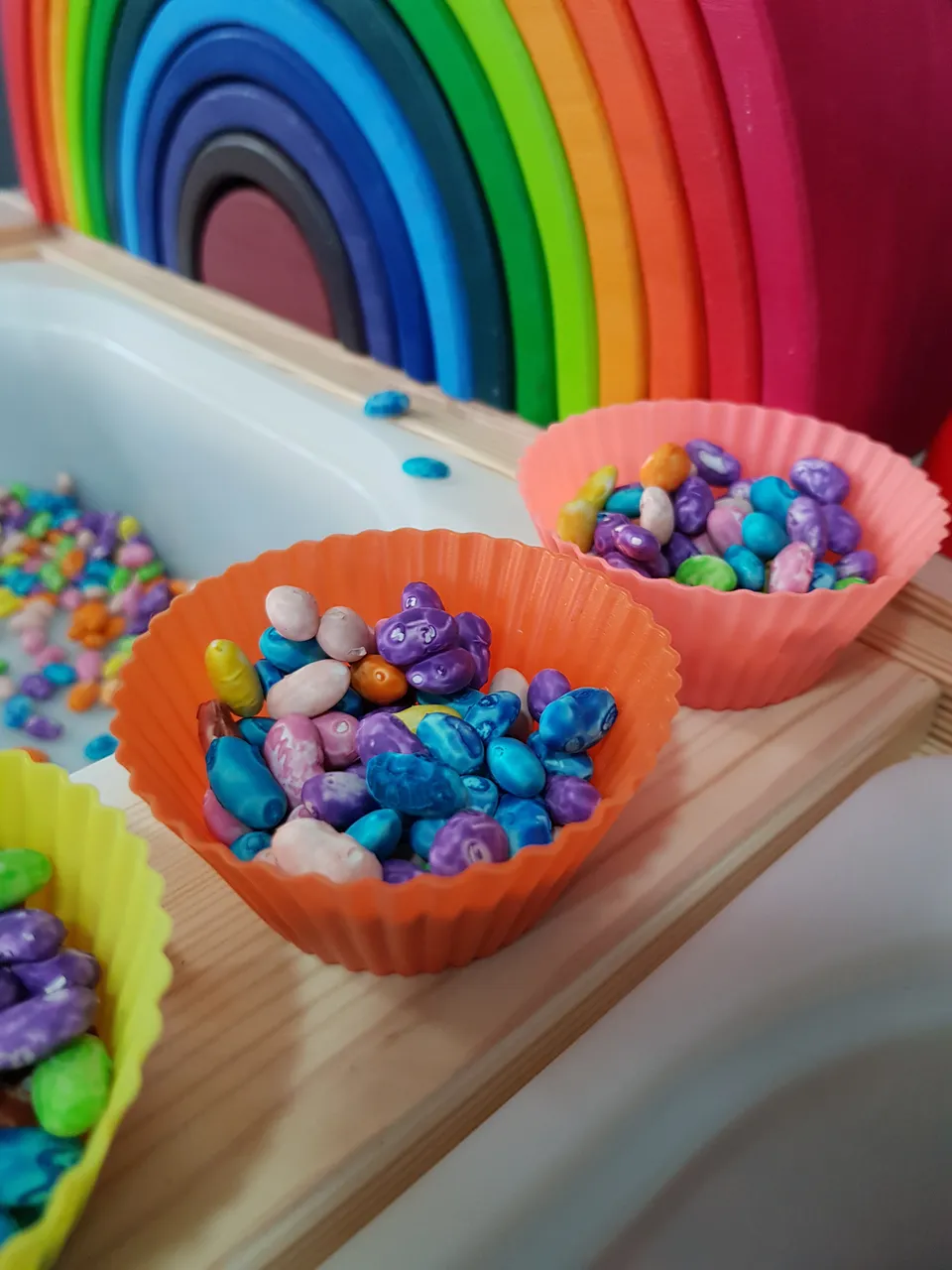
These diy colored beans are so cute they will be loved immediately! For coloring, I used acrylic paint.
The method is really simple. You need a zipper plastic bag (or a simple pastic bag), acrylic colors and white beans.
Put beans and color in the ziploc and then shake the bag until all beans are colored and covered in acrylic paint.
Let them dry on your kitchen's counter for about one day, it depends on the room temperature.


What is Sensory Play and why is it important for the little ones?
From birth to early childhood, children use their senses to explore the world around them.
In Montessori pedagogy, the emphasis is on educating these senses.
Children and even adults learn best and retain the most information when they engage their senses. Many of our favorite memories are associated with one or more of our senses: for instance, the smell of the pizza you had that summer on the greek island, or the smell of bread made by your grandma.
Sensory play includes any activity that stimulates all the senses: touch, smell, taste, movement, balance, sight and hearing.

Providing opportunities for children to actively use their senses as they explore their world through ‘sensory play’ is crucial to brain development – it helps to build nerve connections in the brain’s pathways.
We talk about the five senses. These are:
Taste – the stimulation that comes when our taste receptors react to chemicals in our mouth.
Touch – the stimulation that comes from touch receptors in our skin that react to pressure, heat/cold, or vibration.
Smell – the stimulation of chemical receptors in the upper airways (nose).
Sight – the stimulation of light receptors in our eyes, which our brains then interpret into visual images.
Hearing – the reception of sound, via mechanics in our inner ear. [source here]

Here are 5 reasons why sensory play is beneficial:
Research shows that sensory play builds nerve connections in the brain’s pathways, which lead to the child’s ability to complete more complex learning tasks.
Sensory play supports language development, cognitive growth, fine and gross motor skills, problem solving skills, and social interaction.
This type of play aids in developing and enhancing memory
Sensory play is great for calming an anxious or frustrated child.
This helps children learn sensory attributes (hot, cold, sticky, dry) [source]

Tactile Sensory and Tactile Play 🖐️
From all the 5 senses, today it's about the tactile sense, Sense of Touch.
When you hear Tactile Play it means touch and texure. It means hands on the object to learn about it. 🖐️🖐️
This is probably the type of play you’re most likely to think of when we talk about sensory play. Any time you see children exploring an object with their hands, they’re using tactile play.
From tactile play, children can learn about pressure, temperature, vibrations, and so much more.
I love messy hands, don't you? Little hands covered in paint are the cutest!! ❤️❤️

Do you remember how children, when they see something, instantly wanna touch it or put it in his mouth? Believe me, they know what they're doing!
This is a normal behaviour in babies and infants, they learn this way.
🖐️ By manipulating the pedagogical material, the child will progressively learn to recognize colors, shapes, weights, smells, noises, etc.
🖐️ The more refined these senses are, the better the child will perceive the world in which he lives.
🖐️ Sensory education begins at an early age, and thus improves over time.
🖐️ The 5 senses are developed for distinguishing perceptions (by comparison), establishing rankings (by ordering), generalization and conceptualization.


❗ ❕This is the most important thing you need to consider it! Sensory bins with tiny obects are not suitable for children that are still putting things in their mouth.
❗ ❕ Please use your own judgment with your child and do not provide objects that could pose a choking hazard to young children.
Never leave a child unattended during these activities.
In these photos, I created a sensory bin for my baby boy. I used our colored beans. It is that ind of free play, when children do what they want, where their imagination takes them.
This activity is really good for working those fine motor skill; that's because the child uses a spoon to transfer the beans from one container to another. They use their hands too. We had those silicone muffin molds and we sorted the beans by colored, then he put them by random.
We played with the car too; we used it to transfer beans over a bridge (you can't see it in the pictures). I even put the beans by color to create a RAINBOW SENSORY BIN.
This activities give me a little bit of time to do some chores on the house, even though I always keep an eye on him. He didnt try to put things in his mouth, not even when he was little, but you can't be sure when it comes to toddlers. Who knows what ideas they can have suddenly? This is the reason I mentioned before: better play with your kids this type of game if you know they tend to put things in their mouth.


ALL CONTENT IS MINE AND ORIGINAL! ALL THESE PHOTOS WERE TAKEN WITH MY SAMSUNG S8. ❤️
If you like what I'm posting about, comment, upvote and resteem! Or if you want us to stay in touch, HIT the Follow button on my blog! ❤️❤️
Thank you for reading, I really hope this is useful for some of the parents and educators of the Hive Platform! :x ❤️❤️❤️
MissDeli (and a toddler) ❤️
