
Men read the Acts of the Apostles and see it as a history book, a chronicle of the early church. They catalog the missionary journeys, memorize the speeches of Peter and Paul, and use it as a manual for church government and evangelism, as if it were a corporate expansion plan. They are studying the ripples on the surface of the water and have no concept of the stone that caused them.
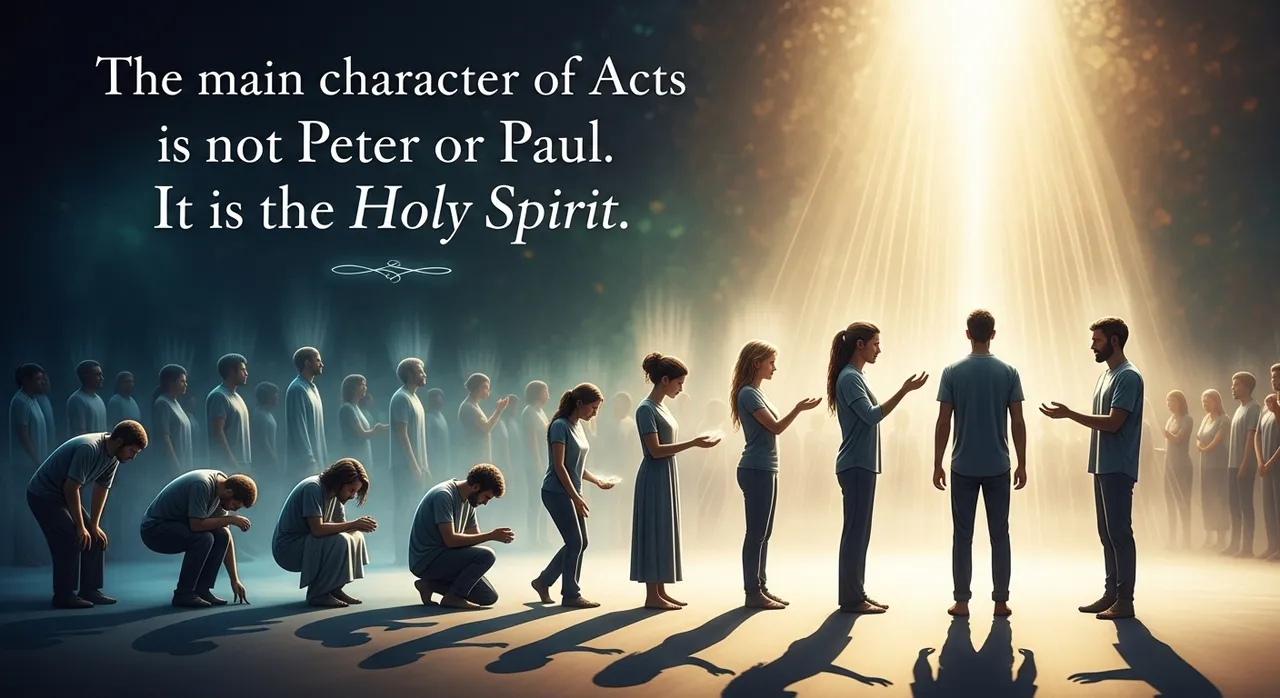
Acts is not a history lesson. It is a live demonstration of what happens when human beings stop living from their ego and start living from the Spirit of God. The main character of Acts is not Peter or Paul. It is the Holy Spirit.
1. The Activation of the Teacher Within
The entire book hinges on one event: Pentecost (Acts 2). This is not about the spectacle of fire and wind or the party trick of speaking in other languages. Pentecost is the fulfillment of the promise Jesus made. It is the activation of the Teacher within. Jesus said, "the Advocate, the Holy Spirit, whom the Father will send in my name, will teach you all things" (John 14:26).
Before Pentecost, the disciples were hiding in a locked room, driven by fear. After Pentecost, they were completely transformed. The Spirit of God, the same Spirit that was in Christ, was now in them. It was no longer an external example to follow, but an internal power that guided their every move. Acts is the record of what that power looks like in action.
2. The Death of the Emotional Ego
Look at Peter. In the Gospels, he is a mess of ego and emotion. He is impulsive, boastful, and in the end, a coward who denies Christ out of fear. But in Acts 2, he stands before a crowd that crucified his master and speaks with absolute fearlessness. Where did this courage come from?
It came from the death of his old self. The fearful, emotional ego of Simon Peter was crucified. The man speaking in Acts is a vessel for the Holy Spirit. He is not reacting to the crowd with anger or fear; he is acting from a place of still, quiet knowing. This is why the authorities were baffled: "When they saw the courage of Peter and John and realized that they were unschooled, ordinary men, they were astonished and they took note that these men had been with Jesus." (Acts 4:13). They weren't just "with" him physically; they were now operating from the same Spirit.
3. The Spirit vs. The Law (Religion)
The primary conflict in Acts is not Christian vs. Jew or Christian vs. Roman. It is the living, breathing Spirit versus the dead hand of religion and the law. The constant opposition comes from the Sanhedrin, the men who know the scriptures but are spiritually dead.
The most potent example is the conflict with the Judaizers in Acts 15. After Paul and Barnabas have brought gentiles into the fold through the Spirit, religious men come down from Judea and insist, "Unless you are circumcised, according to the custom taught by Moses, you cannot be saved." (Acts 15:1).
This is the eternal conflict. The religious ego always says the Spirit is not enough. It insists you still need external rituals, rules, and laws, the "letter that kills." Peter, now speaking from the Spirit, shuts them down: "Why do you try to test God by putting on the necks of Gentiles a yoke that neither we nor our ancestors have been able to bear?" (Acts 15:10). He recognized that salvation is an inner transformation by the Spirit, not an external compliance with rules.
Acts is not a story to be admired from a distance. It is a demonstration. It asks you a direct question: Are you, like the pre-Pentecost disciples, operating from your own emotional, fearful ego, studying a map? Or have you, like the post-Pentecost apostles, made contact with the Guide himself?