This post is about my experience during a three month stay as a volunteer at Hamsah Organic Farm, located near Bangalore.
Around midway through 2015, I realized that the daily grind of working for a mainstream design company was leaving me drained and unmotivated. I had a good life in the city with amazing friends and a great neighbourhood, but still felt hollow inside when I didn't feel any passion for my work. I knew I wanted to leave, but didn't know what I could do to navigate life's rough seas. I didn't have much in the form of savings or experience, with most appealing new jobs requiring at least five years of experience in the field. I was contemplating my choices when a friend suggested I get in touch with a local farmer called John Fennessy who runs a 5 acre farm on the outskirts of the city which is also part of the WWOOF network. The acronym stands for willing workers on organic farms. Volunteers and hosts are both part of the network where volunteers help with farm work in exchange for food and accommodation provided by the host. No money exchanges hands, yet both parties benefit from it.
I wrote to John, telling him of my situation and how I was looking to make a lifestyle change. He sympathized with my plight and graciously offered to host me at his farm for a few months while my soul got some much need detox.
After serving my notice period, and moving out of the apartment, I finally arrived at Hamsah in October of 2015. I got there expecting to be shown to a room, but was instead directed towards a small bag containing a tent that I would have to set up anywhere within the farm. I chose a spot by a cowpea field that was close enough to the community space and next to a structure that was used for storage.
My humble abode at Hamsah.
The structure was built by residents at Hamsah previously and was used to store mattresses, trunks and other community equipment. I kept my clothes and other belongings in the structure and retired to the tent at the end of every day. I later brought along a solar panel assembly that was part of an earlier design project in an effort to be just a little more sustainable. I used it to charge my phone as well as led lights to read by night.
Living in the city, I never realized how much of my time was spent surrounded by four walls in a micro environment. Here, I pretty much only used my tent to sleep in, with the rest of my time spent outside on the farm. I felt connected to my environment and the subtle beauty to be found in simple things. It's quite amazing how much is happening outside those walls.
Coming from the city and used to certain luxuries, it took me awhile to adjust to life on the farm. I had to get used to cold showers, compost toilets and learn to make do with the available resources. Sacrificing these bodily comforts was worth it though because I finally had peace of mind.
The compost loo offering words of encouragement.
There was no routine as such, as work changed according to what was needed at the time. Having nothing to plug into by night, I found myself sleeping and waking up earlier. Mornings were beautiful and worth being awake for. I've never been a morning person in the city, but I found myself enjoying them. We got work done before and after breakfast and lunch, winding down as the sun set. Evenings involved communal gatherings where we started having bonfires as the nights got chillier. I also took some time to read books from the library and doodle in my notebook before dinner time, shortly after which I fell asleep, eager to meet the next day.
This may actually be sunset, but mornings were equally beautiful.
Doodling in my notebook while drinking tea and enjoying the view.
When I arrived at Hamsah, John was on vacation with his family. I didn't have any one to tell me what to do and had to figure out how to spend the days while I waited for him to return. While exploring the farm I stumbled upon a beautiful area I later learnt was the ashram or temple/meditation spot of the farm. It looked like it needed a little cleaning up, and I decided the first thing I could do to contribute to the farm was spruce it up. I didn't have anything else to do and spent my first few days at Hamsah working on this small project. I took my time with it, working alone at a leisurely pace. It felt good to work with my hands after so long and I found the whole process relaxing.
The ashram how I first found it.
Cleaning and decorating the ashram.
Eventually, John returned to the farm and was able to guide me on what was happening around the farm. I had arrived after the planting season was done and before harvest time. There wasn't a whole lot needed to be done in the fields, but we still found work to occupy us through various activities around the farm.
Mulching and Preparing Beds
We reused old thatch material to mulch vegetable beds.
We also prepared raised beds for the next season, that would get irrigated by rainwater.
Tilling and Planting Fields
John had recently acquired a new tiller making it easier to cover more ground in a day. At the time, the two farm cows were eating most of what the farm was growing. We also planted more corn, legumes and amaranth in the newly tilled fields to keep up with the voracious appetites of the cows.
Using Farm Produce & Saving Seeds
The farm also has several fruit trees with a large mango orchard. The mangoes weren't in season at the time but we had plenty of guavas that could be collected. We also had a few plants like rosella known locally as gongura that were flowering. On slower days, we utilized this farm produce through activities like harvesting the rosella petals to make jam. Collecting all those petals, and preparing them for the jam was a fairly tedious task that took a long time to do by hand. The end result was an interesting jam with a unique flavour I hadn't come across before.
Young rosella or gongura flower petals.
We also collected mature plants that had produced seeds, and dried them out to save the seeds for the next planting season.
Collecting seeds of plants like amaranth, peanuts and sunflowers.
As there wasn't much field work to be done, I spent a lot of time at Hamsah working on infrastructure around the farm. John was pretty open-minded on how I could contribute, and I thought that I could use my design skills to build something of use. We needed a bonfire circle for our evening gatherings and I wanted to build a communal space for them.
Community Fire Circle
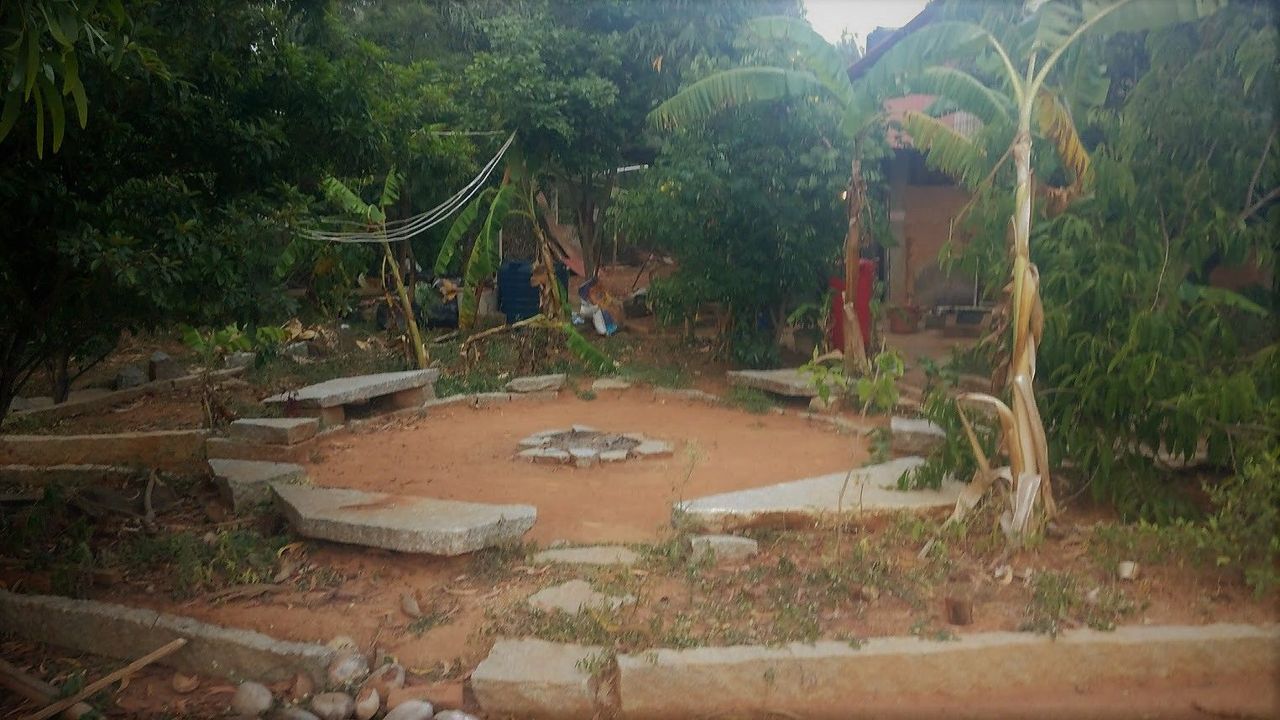
Location of our fire circle
We chose this spot as it was close to the community space and kitchen and was ideal for having evening bonfires. John used his tiller to clear up the space and mark out the circle. I started by making stone walkways leading to the kitchen and path to the community space.
Initially I placed the stone pieces on the ground, packing them together with just mud. They stayed intact when it was dry, but washed away with the first heavy rain. I re-worked the pathways again using a mud and lime mortar that was more permanent. A german volunteer had also joined us, and helped me by reinforcing my paths with granite pillars and transplanting trees and plants to make the space more lively.
All the materials used in this project came from the farm itself with the exception of lime for the walkways. We took around a month and a half to finish this, with around half my time spent on this project. I wanted to make a difference, and was so glad that my work produced something useful. We used the space for our bonfires and the first gathering we had there had me beaming with joy for our little community. I visited Hamsah again this year, and discovered that the space we created is still intact. The trees have grown and the place is still functional. What we made two years ago is still being used and enjoyed by people, and that gave me a feeling of satisfaction in my work that I never experienced through the mainstream.
The community fire circle as it existed earlier this year.
Natural Building
There was a time during my stay at Hamsah where it rained continuously for a few weeks. We couldn't do any farm work and as the fire circle was outdoors, work was halted there as well. Living in a tent during monsoon season is quite the experience. To make use of our time during the monsoon we decided to work on an indoors project by raising the height of a few walls in the community space. To do this we used a unique version of natural building where we used terracotta tiles and mud to build the walls. The tiles were from earlier infrastructure and the mud came from the farm, so everything was local with this build.
The tiles are laid out in a way that they interlock with each other. Mud is then applied between each layer. The final coat is with a mix of mud and cow dung. The space is protected by a roof, so there is no need to weather proof the walls.
Interlocking tile pattern.
The farm has two cows of a native breed. There were also many dogs and cats with their young ones. They also have chickens and ducks now, but they weren't around while I was there. They added their own charm to the space. It's almost impossible to be in a bad mood when surrounded by faces like these!
Jaaga is a co-working space run inside the farm. It's intended as a self study learning program where people from the city can work, live and learn on the farm. They also have camps on learning how to code and different programs and areas of study. A lot of its participants help out with the farm work and are part of the community at Hamsah. They have their own unique temporary structure made from pallet racks and are even self sustaining with their own solar set up and internet. I learnt the process of making a structure like this by going along with Jaaga students to set up a smaller version for an event. It's almost like giant lego!
John is one of the nicest, kindest and helpful person I've met, and I learnt a lot through him at my stay at the farm. I've covered the basics, but can't begin to describe how meaningful this experience was for me. I felt happy, healthy and that life was wholesome and good. This was the spark that led me to make a commitment to stay away from the mainstream and begin a journey of permaculture through a homestead in the hills. I hope to someday return the favour, and host volunteers myself, showing them that happy independent living is possible.
To know more about John and his farm, watch these short videos about his life.