
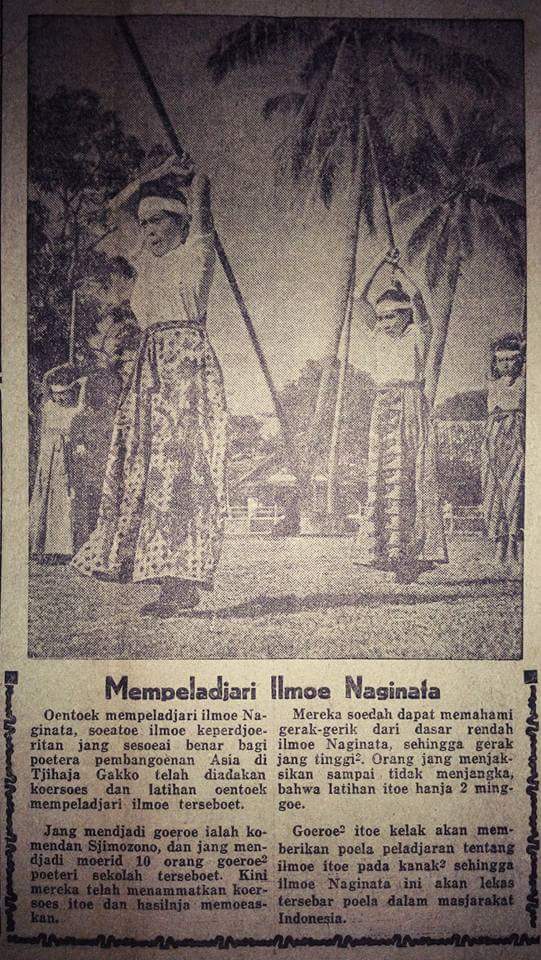
Hallo steemian. I hope all are in healthy. Healthy and opportunity are the gifts we need to be grateful for. One of my valuable trips to the Center of History and Social Sciences at Medan State University (PUSSIS UNIMED). Today, I want to share with you. https://steemitimages.com/DQmUv5NvGrBch2jkTkoGUUWf4QSuM2w9Jat9Py7nDTPKnBo/IMG20171123111442.jpg The Center for the Study of History and the Social Sciences (PUSSIS-UNIMED) stores various high-value historical sources. Most of the collection is a donation from a collector who is also one of the senior lecturers in the campus. In addition to local texts containing saga, novels, fairy tales and other memorabilia, PUSSIS also stores many old newspapers, such as Aceh Shinbun, Tempo and others. https://steemitimages.com/DQmaaZLUZq466HXQobsVQYVesTi7GdVTRiw6zCuGqhJKCNN/IMG20171123104550.jpg One of the interesting things is to observe the sources of splinters commonly called Ephemera. As one source of data for the writing of history, Ephemera can come from various documents that have various properties and purposes. Ephemera may take the form of brochures, pamphlets, advertisements or announcements from agencies or organizations, local trade agents / businesses, bus travel schedules, trains, ships and so on.
https://steemitimages.com/DQmeHkAyXcNCbfXsPb2gmJSooqe1Gx2K2kBYRXR3LejGnjs/FB_IMG_1484570396910.jpg
Ephemera as a special source is of course not only text or narrative, but can also be non-textual such as radio advertising, soap operas, TV commercials, and so on. Ephemera is a term used by Kying and Marty to refer to a special document in a mixed and 'crumb' form as a "salad" document. Documents belonging to this particular document are more widely used in local historical historiography. Utilization Ephemra is often focused in local history because the nature of Ephemera has a narrow scope and is sometimes confined to certain locales or in other words, it does not have much to do with national conditions and is less able to give a picture of a macro event.
On that occasion I was interested in Ephemera spread in Aceh Shinbun newspaper. The newspaper was first published in the Japanese colonial period, precisely Year 1942. This newspaper uses the name 'Atjeh Shinbun' accompanied by Japanese spelling in the middle. Founded under the Japanese lighting office, the Atjeh Shinbun newspaper was intended to propagandize the Acehnese by influencing public opinion. The mass media recruited Aceh's intellectuals including Aly Hasjmy and T.A.Talsya.
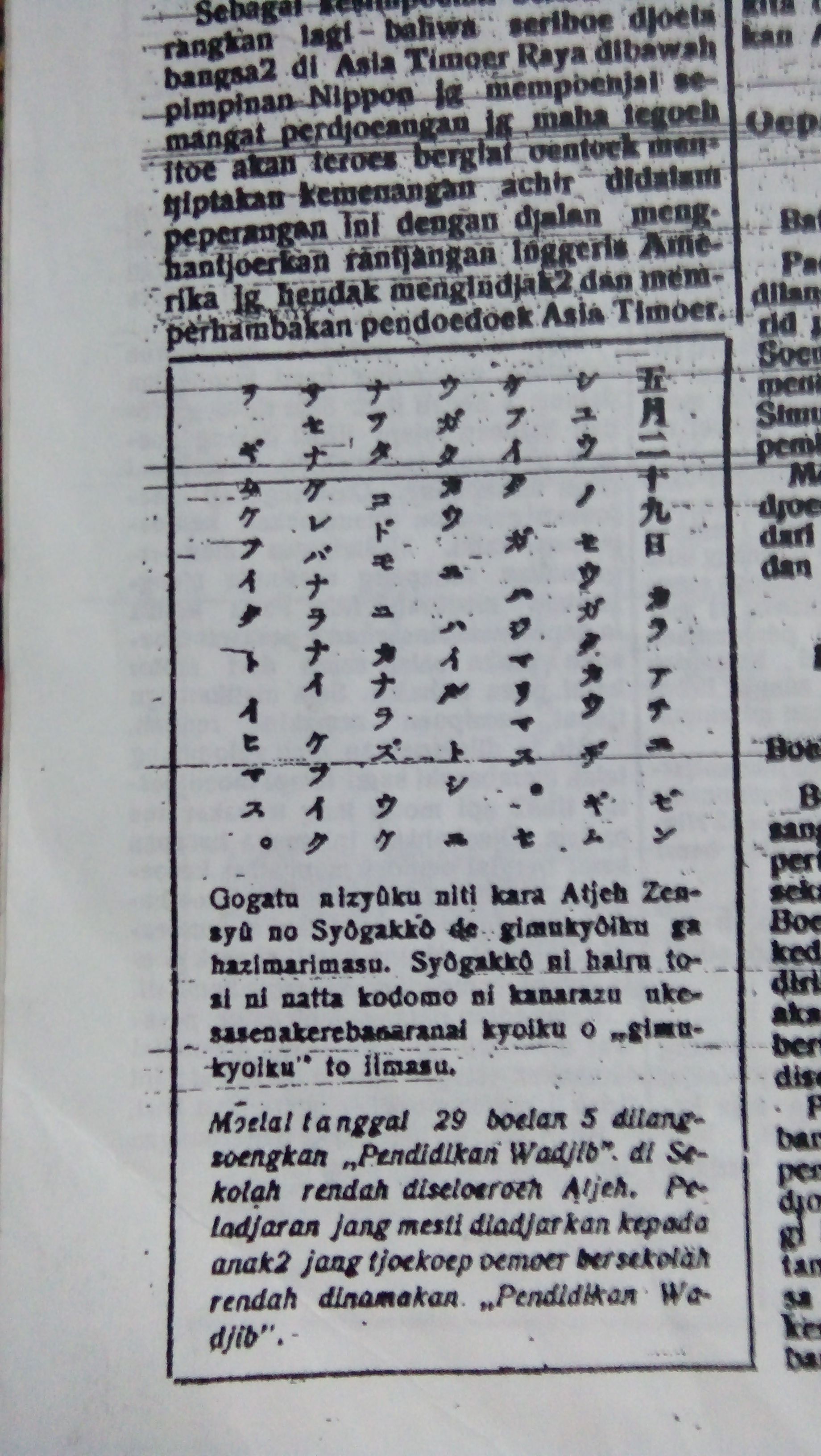
Ephemera which shows the condition of Aceh in the Japanese Occupation Period, among others, showed Japanese attention to the poetry culture. The people of Aceh are known for the art of oral tradition that develops from generation to generation. The poetical tradition is usually performed on various activities. Poetry is singing a poem with a specific theme. Japan's attention became more unique because the Poetry Composing Competition was created with the theme of the Aceh Defense Lieutenant and the requirements of using Indonesian language. https://steemitimages.com/DQmRKPn52xscpRsQQ7BKje14dQjhp4nwFCtTn2kkqu531cc/IMG20171123105249.jpg In the Japanese period, education must be held in low schools throughout Aceh. The lesson that must be given to older children is referred to as compulsory education. The policy came into effect on the 29th of the 5th month. The so-called middle-aged children are 7-year-old children. This policy applies to girls and boys. The duration of compulsory education in Japanese times is 3 years. The Japanese Himboun for school is mentioned with the phrase: "let all together go to school with joy". https://steemitimages.com/DQmc4CdKQVaxaGqYuVTCVdWCBEKf8xtgBTa5vsobgeD7q4s/IMG20171123110749.jpg
https://steemitimages.com/DQmSVoossCAoMKD52Ggs88e7AjRM4wizb564Fv44dFP8rhD/IMG20171123110732.jpg In addition to some positive things above, there is a condition that shows the rampant gambling in the Japanese period in Aceh. Lottery or money lottery that runs in Aceh a period called Atjeh Syu. Through the announcement advertisement it is known that the lottery prize is intended for 4 levels of winners. Winners I, II, III and IV with 1 winner I, II-2 sheets winners, III-3 sheets of winners to IV as many as 14 sheets. One of the draw dates is April 13, 2605 (Japanese showa dates, in the 1945 AD calendar). The prize for the ultimate winner is 11,000 guilders and can be taken at Kutaraja. https://steemitimages.com/DQmU2qsLLVaTP71R9Ppz6K2gSrxxsL9BxeM6Pb8WeDkvUpa/IMG20171123110035.jpg
The use of Ephemera as a historical source will essentially be more meaningful by dissecting it through semiotics or the science of signs. Next time I will share how semiotics works to dissect ephemera. So I can share it, please forgive me if something goes wrong. The constructive criticism is what I expect.
[IND]
Memandang Aceh di masa Penjajahan Jepang melalui Sumber Ephemera
https://steemitimages.com/DQmeHkAyXcNCbfXsPb2gmJSooqe1Gx2K2kBYRXR3LejGnjs/FB_IMG_1484570396910.jpg
Ephemera yang menunjukan kondisiAceh pada Masa pendudukan Jepang antara lain memperlihatkan Perhatian Jepang terhadap budaya bersyair. Masyarakat Aceh dikenal dengan seni tradisi lisan yang berkembang secara turun temurun. Tradisi bersyair biasanya dilakukan pada berbagai aktivitas. Bersyair adalah menyanyikan suatu sajak dengan tema tertentu. Perhatian Jepang menjadi lebih unik sebab Lomba Mengarang Syair yang dibuat bertema Syair Pertahanan Aceh dan persyaratan menggunakan bahasa Indonesia.
https://steemitimages.com/DQmRKPn52xscpRsQQ7BKje14dQjhp4nwFCtTn2kkqu531cc/IMG20171123105249.jpg
Pada Masa Jepang, pendidikan wajib di selenggarakan di sekolah rendah di seluruh Aceh. Pelajaran yang wajib diberikan kepada anak-anak yang cukup umur disebut sebagai pendidikan wajib. Kebijkan tersebut mulai berlaku tanggal 29 bulan 5. Anak-anak yang disebut cukup umur adalah anak yang telah berusia 7 tahun. Kebijakan ini berlaku bagi anak-anak perempuan dan laki-laki. Lamanya pendidikan wajib pada masa Jepang adalah 3 tahun. Himbaun Jepang untuk bersekolah disebutkan dengan kalimat: “marilah semuanya bersama-sama pergi ke sekolah dengan gembira”.
https://steemitimages.com/DQmc4CdKQVaxaGqYuVTCVdWCBEKf8xtgBTa5vsobgeD7q4s/IMG20171123110749.jpg
https://steemitimages.com/DQmSVoossCAoMKD52Ggs88e7AjRM4wizb564Fv44dFP8rhD/IMG20171123110732.jpg <p> Selain beberapa hal positif diatas, ada suatu kondisi yang menunjukan maraknya perjudian di masa Jepang di Aceh. Lotere atau undian uang yang berjalan di Aceh masa bernama Atjeh Syu. Melalui iklan pengumuman tersebut diketahui bahwa hadiah lotere diperuntukan untuk 4 tingkatan pemenang. Pemenang I, II, III dan IV dengan jumlah Pemenang I sebanyak 1 lembar, Pemenang II-2 lembar, pemenang III-3 lembar da pemenang ke IV sebanyak 14 lembar. Salah satu tanggal pengundiannya adalah 13 April 2605 (Penanggalan showa Jepang, dalam kalender masehi tahun 1945). Hadiah untuk pemenang utama sebesar 11.000 gulden dan dapat diambil di Kutaraja. https://steemitimages.com/DQmU2qsLLVaTP71R9Ppz6K2gSrxxsL9BxeM6Pb8WeDkvUpa/IMG20171123110035.jpg Penggunaan Ephemera sebagai sumber sejarah pada dasarnya akan lebih bermakna dengan membedahnya melalui semiotika atau ilmu tentang tanda. Lain waktu saya akan membagi bagaimana semiotika bekerja untuk membedah ephemera. Demikian yang dapat saya bagi, mohon maaf jika terjadi kesalahan. Kritik yang membangun sangat saya harapkan.
https://steemitimages.com/DQmesHvBVPqtfJkpFFi2xiT6CCLKtsdyK2nJTbMnT6cSphY/xz.jpg
https://steemitimages.com/DQmPsFDe6NQ5ZJUUBFKGqbUKk1nQK6NqYHka81omA1d4qCX/x.jpg