
First, a brief history lesson:
On December 9, 1942, after the start of World War II, KA-BAR submitted a knife to the United States Marine Corps in hopes that it would become general issue to that branch of the military. Working with the Marine Quartermaster Department the original design was revised and production began of an improved fighting and utility knife for the Marines.
As the War escalated, the USMC KA-BAR knives became so well recognized for their quality and so abundant in number that 'Kabar' became the name by which many referred to this knife pattern, regardless of whether the knife was manufactured at the actual KA-BAR facility.
The USMC KA-BAR was adopted by not only the Marines, but also the Army, Navy, Coast Guard and Underwater Demolition Teams. Years after World War II, many KA-BAR knives were unofficially reactivated in the Korean, Vietnam, Desert Storm, and Iraqi Freedom conflicts.
Today, the original USMC Fighting and Utility Knife remains the first choice for many men and women of service who carry it as their personal knife option. It is also a favorite of adventurers, survivalists, outdoor sportsmen and, of course, knife collectors who know that this knife deserves a place in their collection." (Source: KA-BAR)
My personal quest to learn more about a World War II-Era KA-BAR began when a friend (a serious militaria collector) gave it to me, explaining that it was a WWII piece and he wanted me to have it.
As a Marine Corps reservist whose son served with the Corps (in what is now the 2nd LAR Battalion) during Operation Desert Storm, and because I knew the Corps’ fabled affair with KA-BAR went back to WWII, I decided my son should have it - but first, I felt driven to learn more about it. (I should add that my son, a glutton for punishment, later joined the Army a few years after being demobilized by the Marine Corps.)
I sent a few snapshots off to KA-BAR and asked their opinion. This was one of the them:

KA-BAR’s response was “I reached out to our research department for more information on this and was told this is a KA-BAR! It was made in the “Mark 1” style more so than the standard fighting/utility style. They put the time frame right around WWII.” (As I later learned, KA-BAR was wrong, probably because the images I sent them were inadequate.)
The blade is pitted from age, which made putting on a fine edge problematic, although I managed to get the job done with a 20-degree Lansky sharpener. I buffed the knife gently with fine steel wool to remove the rust, but resisted the temptation of trying to polish the blade.
The factory suggested I contact Bernard Levine, an independent expert who researches and appraises knives professionally, for a more detailed history.
But first, I wanted a sheath. I mentioned this to my son, who told me that an Army buddy, Chris Brumbalow, was an artisan leatherworker who produces custom work under the name Arcadian Craftsman Leatherworks, in Missouri. I contacted Chris through Facebook and commissioned a sheath. Chris asked me to send him the KA-BAR so he could insure a perfect fit, so off it went via Canada Post.
I mentioned that I wanted the sheath engraved, and Chris told me that another Army buddy, Paul Barney, operated a laser engraving service in Atlanta - and he had also served with my son. Chris, going that extra mile, mentioned that the stacked leather in the handle was quite dry, so he'd soaked it in Neatsfoot oil overnight and then polished it:

After the sheath had been made, Chris sent it off to Paul to be engraved. The quality of their work speaks for itself:
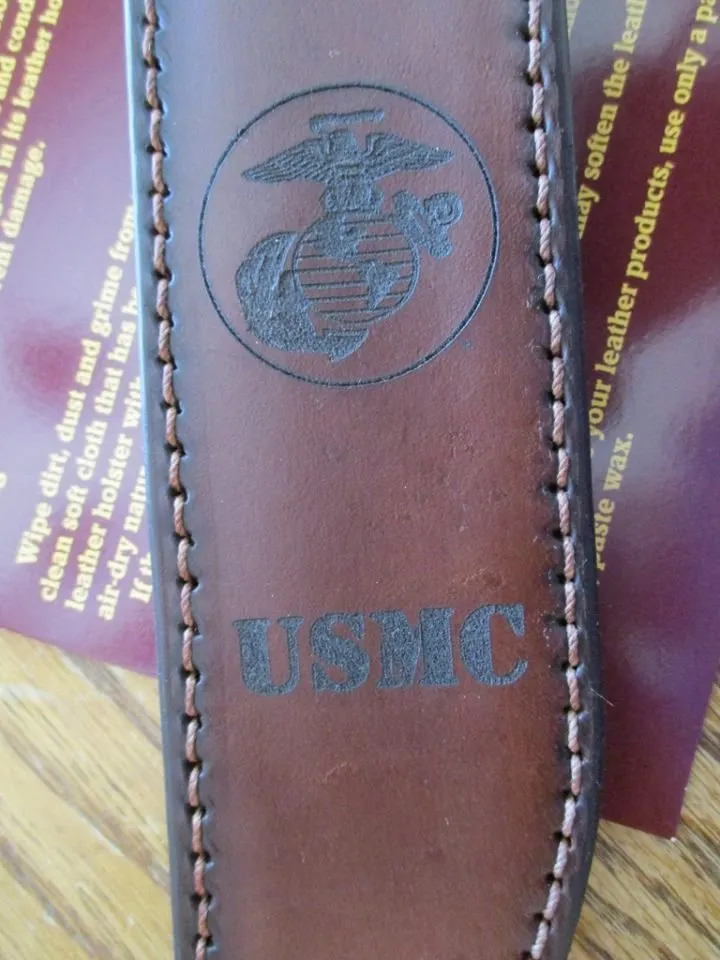

The completed sheath was returned to Chris, who then sent it to my son:


While the work was being done, Levine was compiling what information he could, and reached out to other knife experts through this web page.
What I've learned
I would like to express my gratitude to Bernard Levine, without whose expertise I'd know next to nothing about this knife. The first thing he told me was that it was not a Mark 1, but rather a Parkerized KA-BAR Commando, a knife sold through commercial outlets:
"I have no information on the Ka-Bar other then what is already published like Coles III where he quotes a letter stating over 500,000 were made during WW II. Also in Cole III he shows what appears to be a post war ad on Pg 85 with both versions. They kept no records I have ever found on anything."--Frank Trzaska
Frank has scoured the National Archives for military knife contracts, and provided great detail on military ISSUE knives, including quantities, shipping dates, destinations, etc. for various issue patterns, including details of contractors.
But there is nothing in the archives pertaining to commercial knives, except indirectly, such as regulations regarding limiting pattern variety and restricting use of materials.
For some other contractors, such as Camillus, factory records added detail to the archive records -- Camillus had all the Specification cards for all the knives they made for the government, starting even before the war. But Ka-Bar evidently did not keep this material, and the 4 ownership changes since 1951 erased most memory of earlier times.
So all I can say about your knife is that it was almost certainly made during WWII (1944-45, because of the guard marking). It was possibly made later, up to perhaps 1951, but this is unlikely.
There has been much speculation as to why contractors switched from blade marking to guard marking in 1944. For example, small dies are cheaper, and the guard metal is softer than the blade, so the dies would last longer. Some have speculated that stamping the blade weakened it, but I have seen no evidence of this. The most likely explanation is that by 1944, large numbers of blades were forged by outside contractors, who did not mark their blades. For example, I knew a gent ... in San Francisco CA, a tool mfr., who made 1000s of unmarked blades for Ka-Bar during WWII.--Bernard Levine
References:
Arcadian Craftsman Leatherworks, Facebook: http://tinyurl.com/ArcadianCraftsman
Arcadian Craftsman Leatherworks, Etsy: http://tinyurl.com/hkkmgxo
Bernard Levine: http://preview.tinyurl.com/ztokzuc
KA-BAR: https://www.kabar.com/
Lasting Impressions: http://www.atlantalaserengraving.com
Frank Trzaska: http://www.usmilitaryknives.com
Wikipedia (KA-BAR): https://en.wikipedia.org/wiki/Ka-Bar
Wikipedia (Neatsfoot Oil): https://en.wikipedia.org/wiki/Neatsfoot_oil
Wikipedia (Parkerizing): https://en.wikipedia.org/wiki/Parkerizing

|
Certified Curmudgeon |

|