This post is about the first project I did as an independent designer using natural and reclaimed materials to landscape a school yard.
Picking up my story where I left off, I returned to my hometown after my experience at Hamsah Farm. I didn't have a job or apartment to go back to, so returned home to stay with family, nearly 7 years after leaving for college. For the initial month or so, I revelled in being surrounded by mom's cooking and not having any major responsibilities. Eventually, I had to figure out what I could do other than lounge around and be useless.
One of the paths that I was considering was pursuing a master's degree in environmental design. A relatively new course that seemed ideal and appealing but would also mean shifting countries and large tuition fees. I was midway through writing application essays when I got a call from a college friend asking if I'd like to work on a project that was happening in my hometown. He's a metal artist that goes by the name of Mechanimal who was approached by a school to construct a play structure for them. They needed the rest of the space landscaped and having worked on designEARTH projects together, he suggested I work on the landscaping for them.
I thought this would be a great opportunity to use my design methodologies developed through Hamsah and designEARTH in a real life context. After a few brief interviews with our clients, we were all set to start around March of 2016.
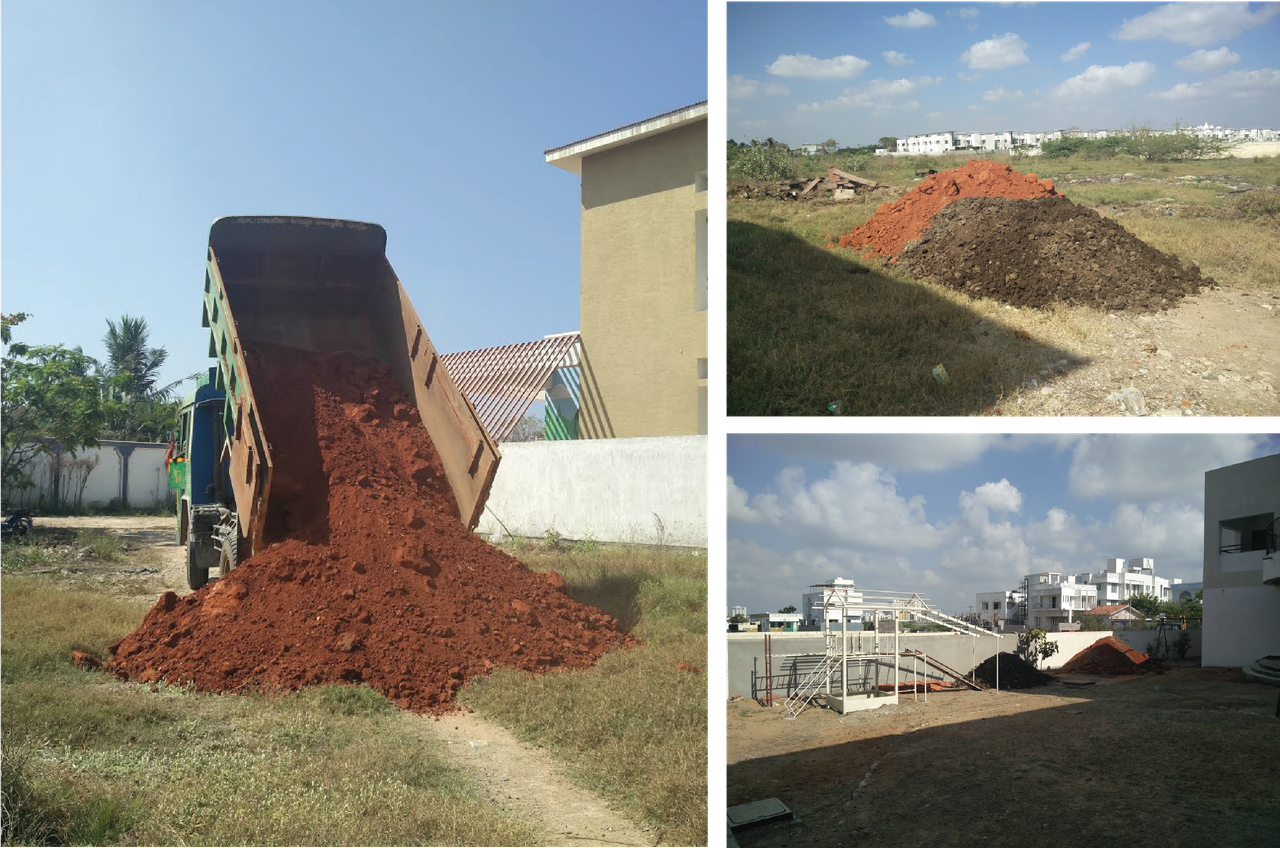
The initial space to work on.
The clients were open minded about how the space could be designed. We figured we'd use techniques and materials from designEARTH to landscape the space. Mechanimal had other projects to work on and would be visiting around twice a month to work on his play structure and consult with me on the progress of the landscape. One of the cargo van drivers he found to transport his materials also turned out to be an all around handyman and was able to act as a contractor and a liason for the labour needed for the project.
Marking out paths.
We started off by marking out paths roughly where we wanted them, to separate and connect what would be the play structure, sand pit, lawns, decorative gardens and amphitheatre floor seating.
Our contractor named Sadiq was able to organize the purchase of mud, cow dung and sand which were the primary materials we used for this project.
Laying out mud for the floor seating of the amphitheatre.
The school building featured a curved section that opened up into the yard. They wanted to use it as a performance space or stage. We thought we'd provide a mud floor seating for the audience, following the curve of the stage. After the initial mud layer is laid out, we add lime, cow dung and water and work on smoothing it out.
The same flooring was continued along the edges of the building. We had a lot of extra mud, so we decided to lay some down as the base for the sandpit. This turned out to not be a great idea because the mud was so fertile, even the sandpit needed weeding. The division between the sandpit and the rest of the space was done using ferro-cement. We needed this division, as we needed more sand for children to be able to jump in safely.
The next step, after filling the sand pit was to add decorative elements. We chose a Mango tree as a center piece, that would eventually grow to provide shade to the area. We then constructed a circle to sit on around it, and added complimentary flower circles as well.
The next step was to connect everything through path ways. We made paths using sawdust/mud and terracotta tiles. The tiles also are arranged in a hop-scotch formation in one part for children to have something extra to play on.
Sawdust when watered develops an extremely soft texture and is really pleasing to walk on barefoot.
The last step was growing the lawn. The space is meant for play, and a lawn seemed appropriate as it offered a different texture. I would've loved to grow vegetables or functional plants in this space but decided to leave them out as the primary purpose is the sensory exploration for the thousands of footsteps of kids playing in it. We grew the grass by individually planting blades instead of rolling out pre-made lawns. This seemed more appropriate considering the shapes weren't very linear.
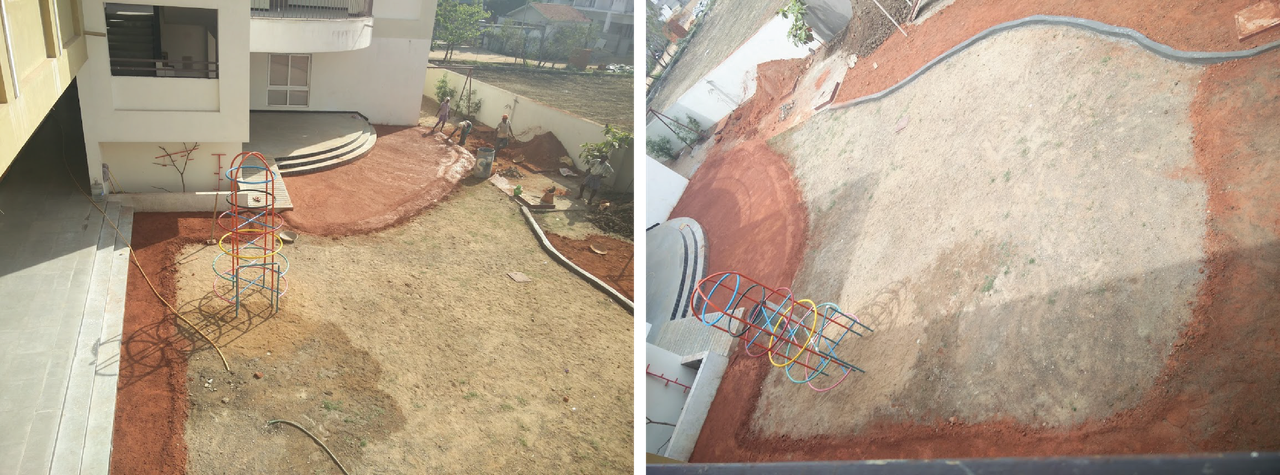
After the grass grew out, this is what we ended up with. The mud floor is held together with the fiber from the cow dung and didn't crack too much. It did however experience some weathering by heavy rain. You can also see Mechanimal's finished play structure.
This project took around 4 months to finish. We had anticipated on it taking only 2, but it's hard to find anything that works linearly here. You have to circumvent the whole alphabet before going from point A to B. This was also the first time I found myself almost entirely in charge of a project. It was a learning experience to organize everything from scratch. I had help through the contractor who organized the team of labourers, but being my first project there were certain factors I overlooked.
One such factor was maintenance. To keep the space looking the way it does in the last photograph takes a lot of effort, which I had to organize in addition to getting the work done. We also had a few nonseasonal rains that destroyed previous work. This seems to be a recurring theme. I have to keep in mind that any cobb or mudd construction should be covered while working on it. My profit margin grew smaller as the time and effort needed to implement my design increased. I did get regular payments though, and our clients were really amazing to work with. It also helped that I was staying with family and cycling to the school which was only 4 kilometers away from our house. I found a productive use of my time and was able to keep myself engaged. Most importantly, I discovered that my skill sets could be put to use in a professional context, and also provided a valuable addition to my portfolio. That did a lot to grow my confidence in using eco design and alternate ways of living away from the mainstream.
The clients liked my work and so asked me to do something for another branch of the school with less space. I thought the perfect project would be to make vertical gardens, which I did from recycled material.
One of my first posts was on how I made these, which you can find here.