
Zitronenfalter ■ Common brimstone
Gonepteryx rhamni (Linnaeus, 1758)
Der Zitronenfalter ist ein Tagfalter aus der Familie der Weißlinge (Pieridae). Mit einem Jahr, lebt kein Tagfalter länger als er. Im Winter lässt er sich ohne Schutz in der Natur an einer Hecke oder aber auch gerne Efeu einfrieren. Durch seinen Frostschutz macht ihm die Kälte nichts aus. In den ersten warmen Tagen im Winter kann er schon auftauen und fliegen. Gerne fliegt er dann an Waldrändern entlang, oder geniest am Boden sitzend, die wärmenden Sonnenstrahlen. Wenn der Faulbaum (Frangula alnus) die ersten Blattknospen austreibt, beginnt das Weibchen mit der Eiablage in der Nähe der Blattaustriebe. Dort findet man die zirka einen Millimeter kleinen gelben Eier.
The common brimstone is a butterfly of the family Pieridae. With one year no butterfly lives longer than it. In the winter it can be frozen without protection in the nature at a hedge or in addition, gladly under ivy. Due to its frost protection it does not mind the cold. In the first warm days of winter it can already thaw and fly. He enjoys flying along forest edges or sneezing on the ground, the warming sunrays. When the alder buckthorn (Frangula alnus) sprouts its first leaf buds, the female begins to lay eggs near the leaf shoots. There you can find the approximately one millimeter small yellow eggs.
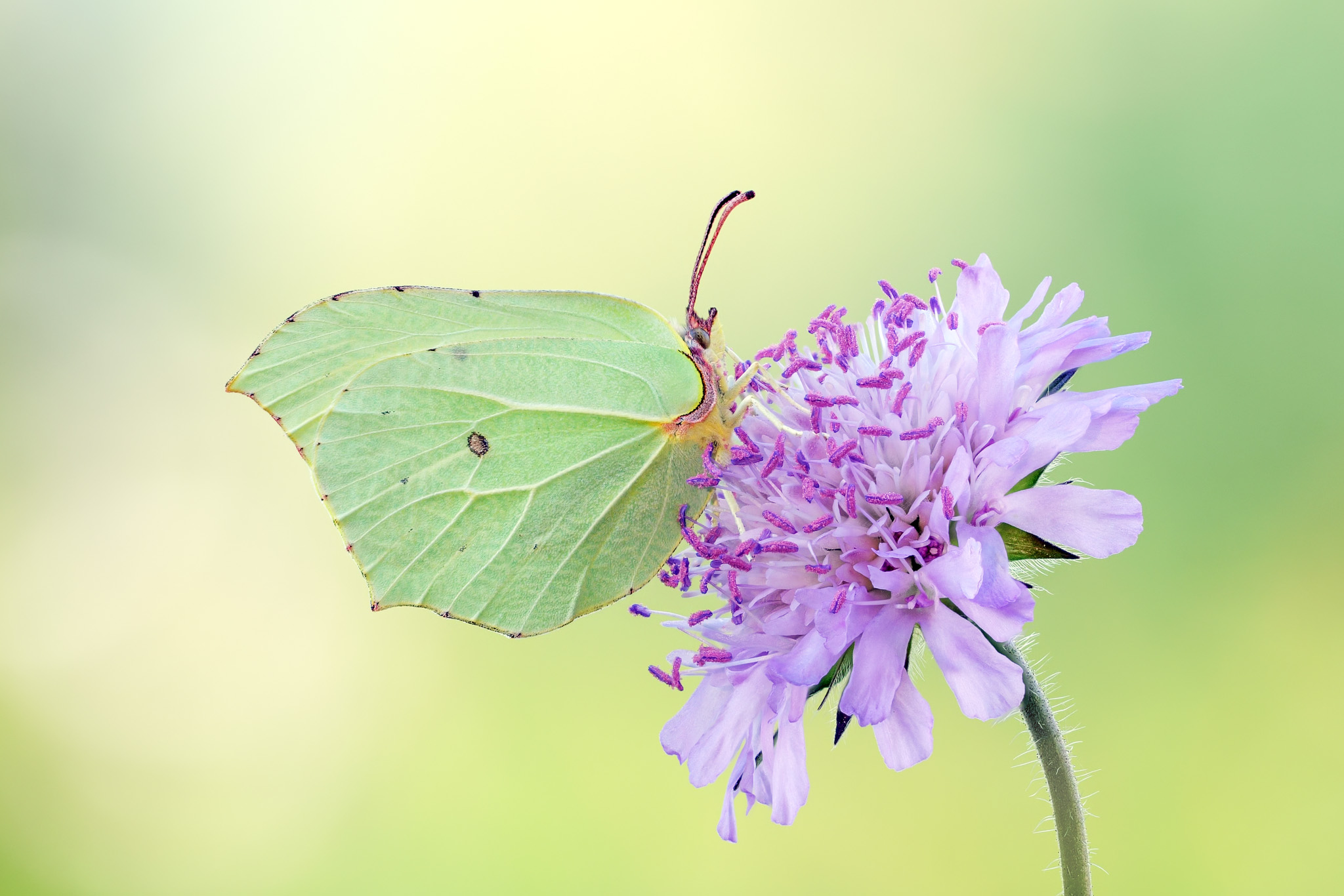
▲ Click on the image for full resolution ▲

▲ Click on the image for full resolution ▲
Nach wenigen Tagen schlüpft aus dem Ei die Raupe und frisst zuerst die Eihülle. In dieser findet das kleine Räupchen Proteine, um sich zu stärken. Nach einer kurzen Pause, beginnt die Raupe an den jungen Blättern zu fressen.
After a few days the caterpillar hatches out of the egg and eats the egg shell first. The small caterpillar finds proteins in the egg shell to strengthen itself. After a short break, the caterpillar begins to eat the young leaves.
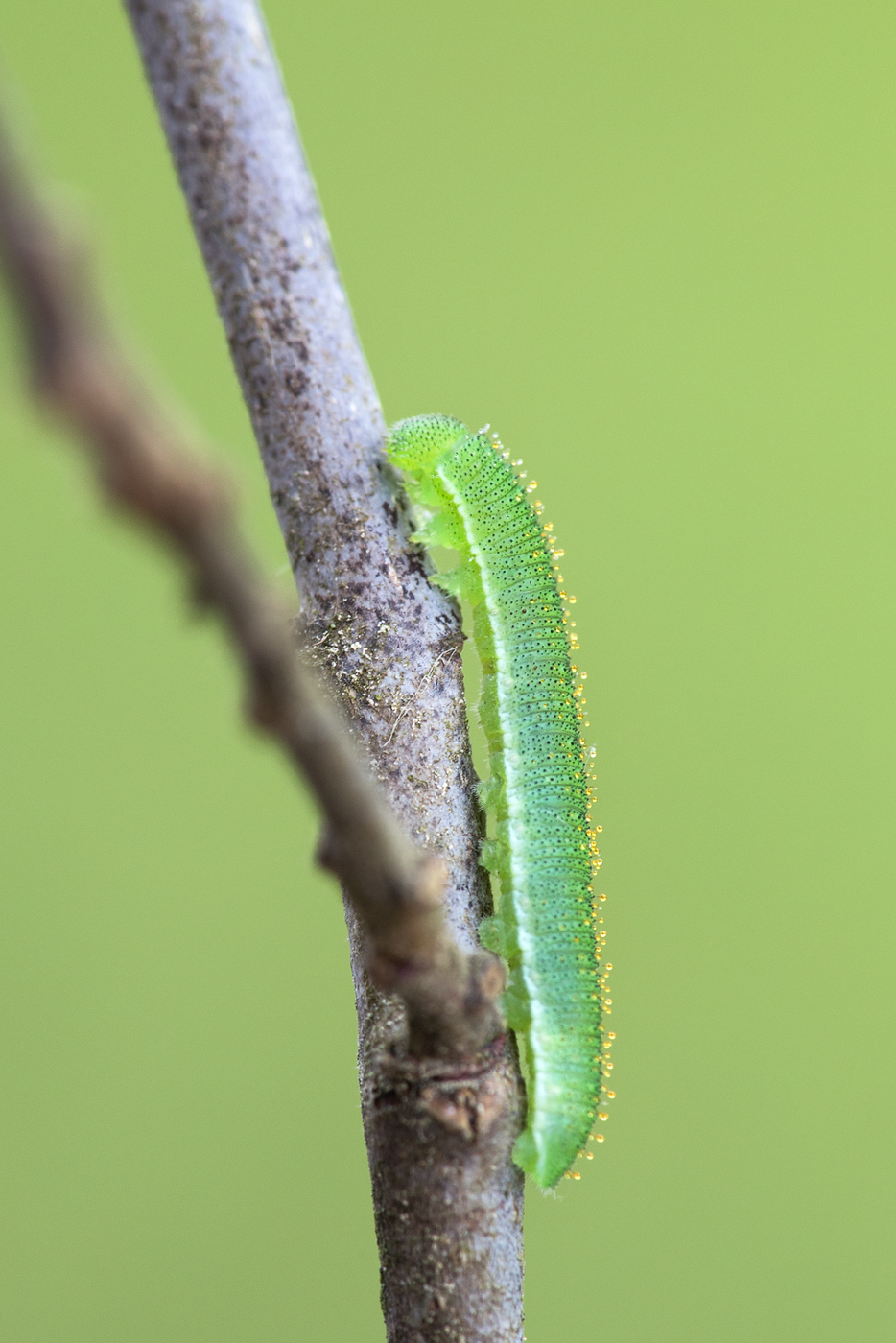
▲ Click on the image for full resolution ▲
Nach mehreren Häutungen ist die Raupe mit einer Länge von zirka vierzig Millimeter erwachsen. Selbst mit dieser Größe, ist sie auf den Blättern des Faulbaum bestens getarnt und nur mit geübtem Auge zu erkennen. Sie stellt nun die Nahrungsaufnahme ein und sucht sich einen geeigneten Platz für ihre Verpuppung.
After several moults, the caterpillar has grown to a length of about forty millimetres. Even with this size, it is well camouflaged on the leaves of the foul tree and can only be seen with a trained eye. It now stops eating and finds a suitable place for its pupation.
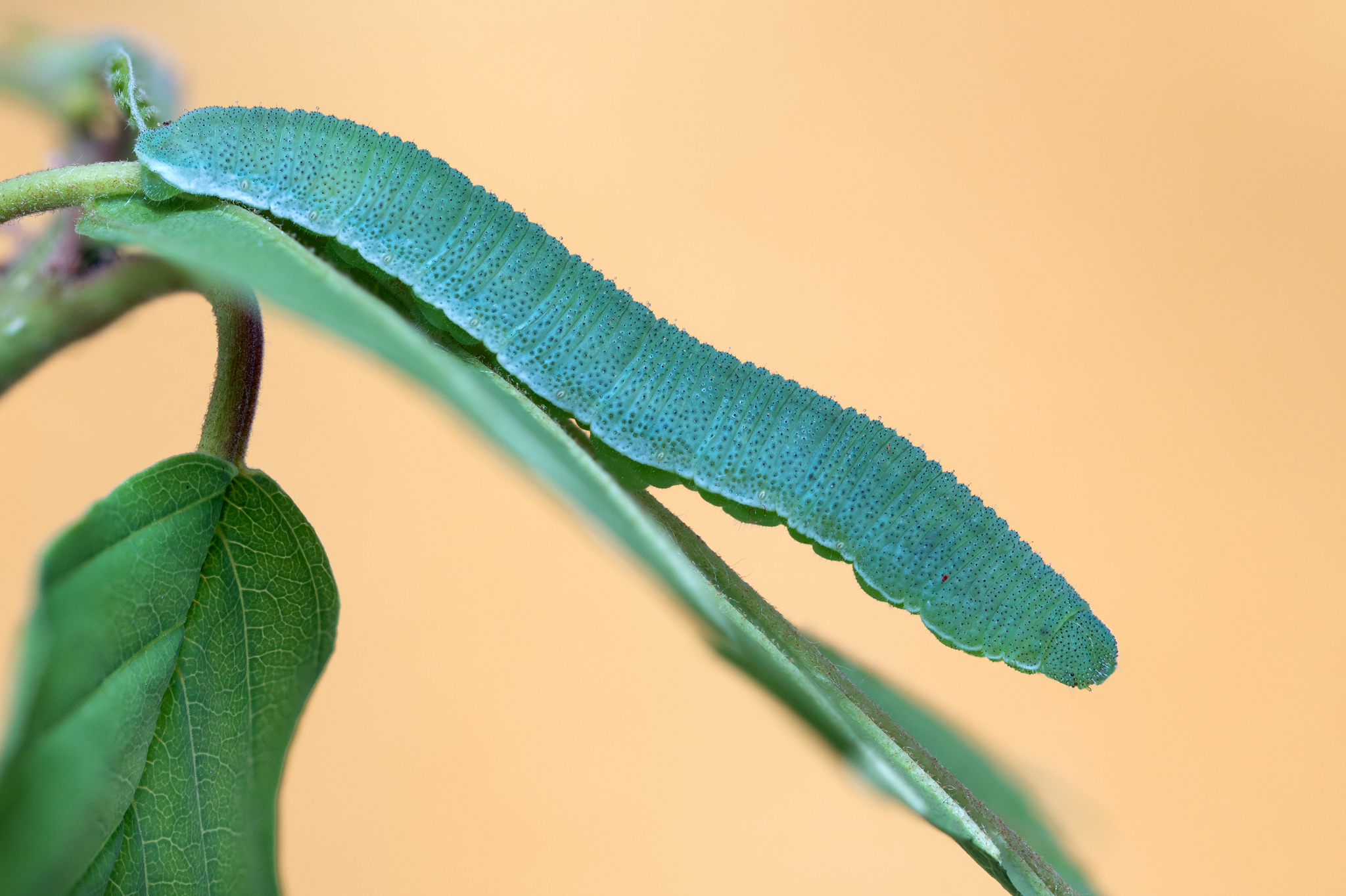
▲ Click on the image for full resolution ▲
Die Raupe spinnt ein feines Geflecht von Fäden um ein Ästchen. Dieses bietet optimalen Halt, um als Gürtelpuppe die wundervolle Verwandlung (Metamorphose) zu einem Schmetterling zu vollziehen. Die nachfolgende Aufnahme zeige die frische Puppe direkt nach der Verwandlung. Doch der Prozess der Metamorphose ist noch nicht beendet.
The caterpillar spins a fine web of threads around a small branch. This offers optimal hold to perform the wonderful transformation (metamorphosis) to a butterfly as a belt pupa. The following photo shows the fresh doll immediately after the transformation. But the process of metamorphosis is not over yet.
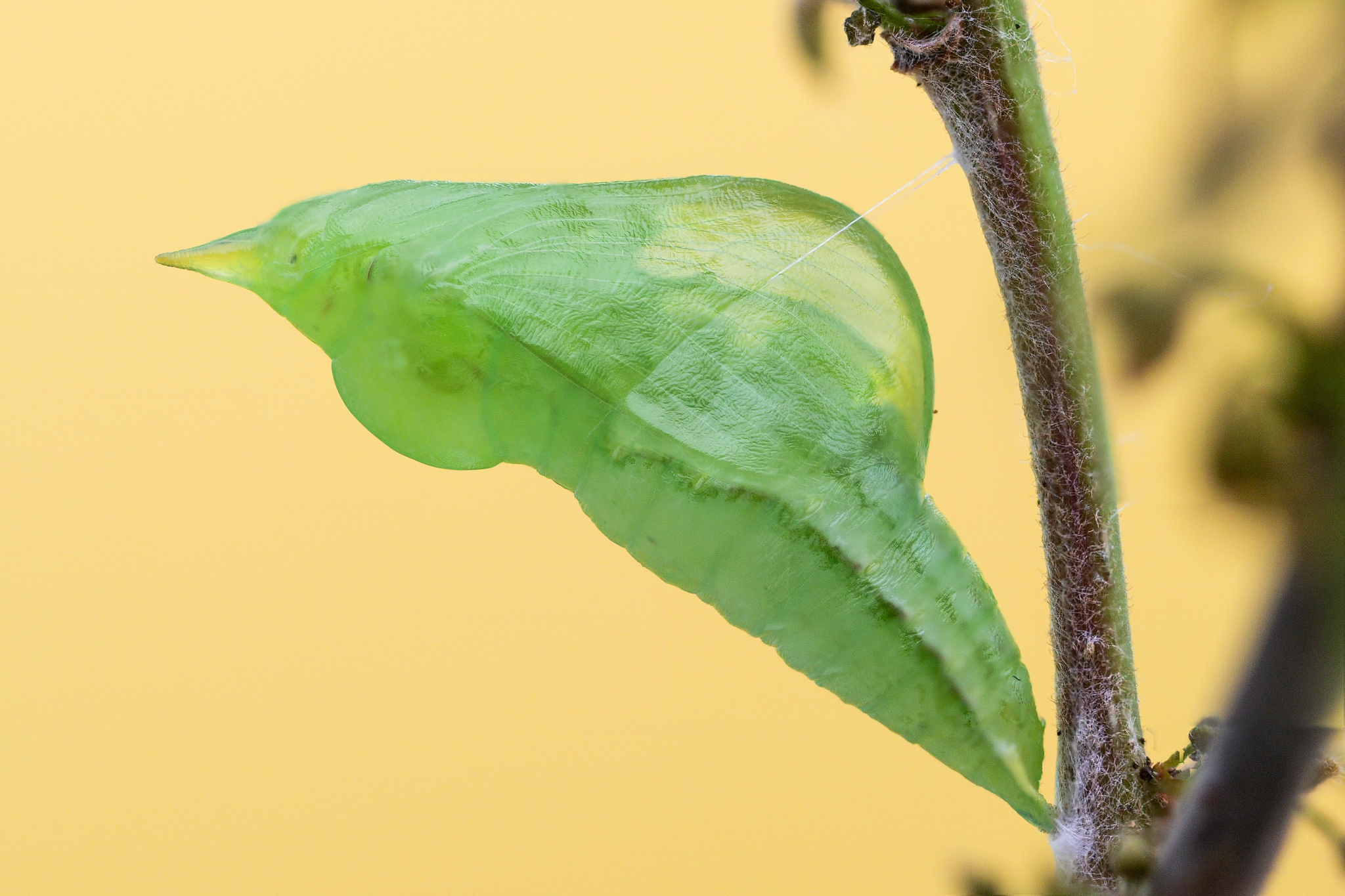
▲ Click on the image for full resolution ▲
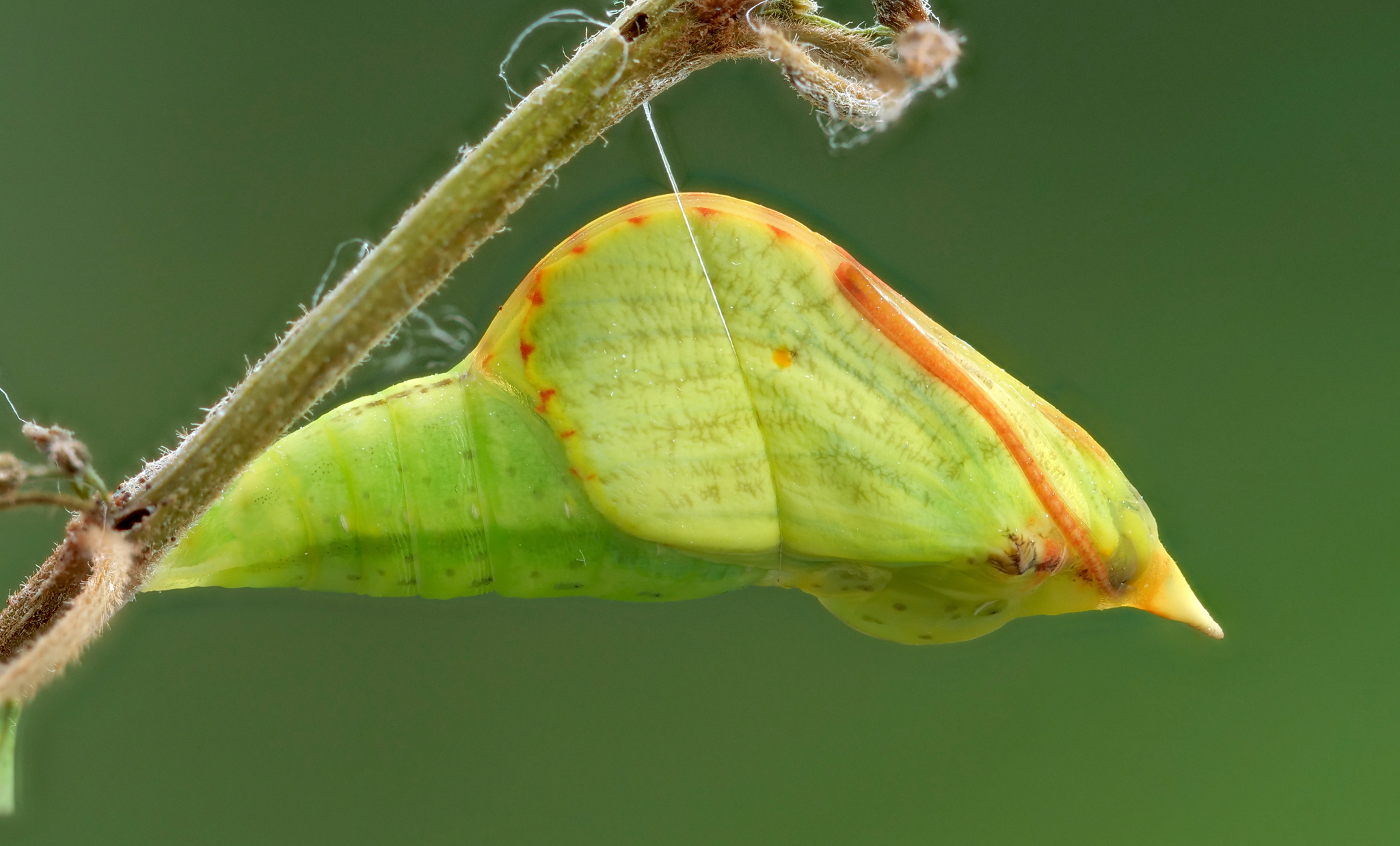
Nun ist es so weit, die Verwandlung zum Schmetterling ist fast abgeschlossen. Fühler, Augen und die Flügel kann man schon deutlich erkennen. Ein eindeutiges Zeichen, dass aus der Puppe ein neuer Zitronenfalter erwacht. Bald wird aus der Puppe ein Zitronenfalter schlüpfen. Mit etwas Glück wird er dann ein Jahr lang leben und ich kann ihm nächstes Jahr wieder begegnen.
Now it is so far the transformation to butterfly is almost complete. Feelers, eyes and wings can already be seen clearly. A clear sign that a new common brimstone is awakening from the pupa. Soon a new butterfly will hatch out of the pupa. With a little luck he will live for a year and I can meet him again next year.
▲ Click on the image for full resolution ▲

▲ Click on the image for full resolution ▲
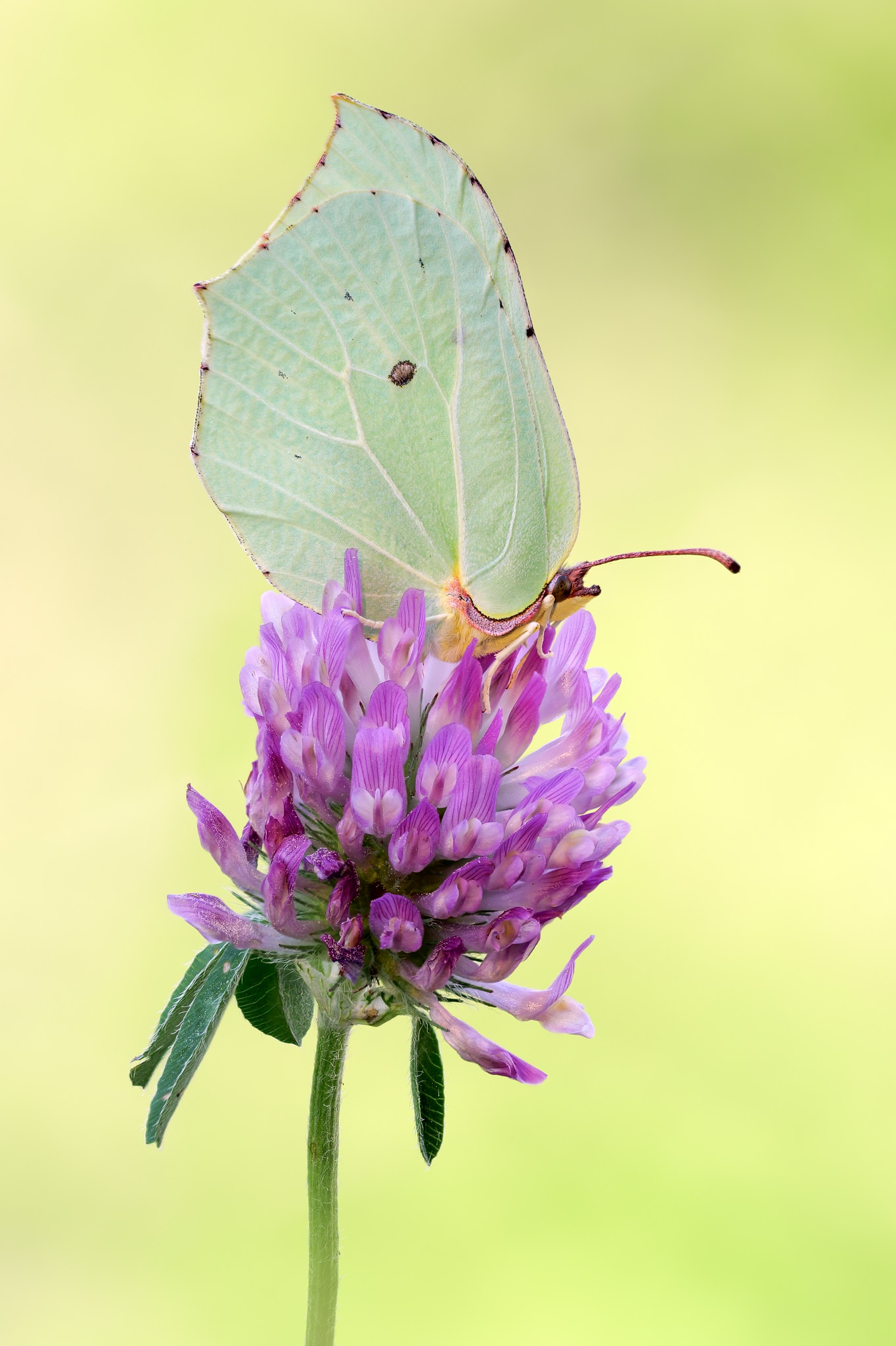
Über die heißen Sommermonate fliegt der Zitronenfalter nicht. Er legt nun eine sogenannte Diapause ein, in der er nicht fliegt. Zu dieser Jahreszeit ist es ihm einfach zu warm. Erst im Herbst ist er dann wieder unterwegs. Wenn die Nächte frostig werden, beginnt die Überwinterung. Er fliegt erst wieder, wenn die wärmende Sonne zurück kommt. Unter optimalen Bedingungen wird dieser Zitronenfalter ein Jahr leben. Das schafft kein anderer Tagfalter.
The common brimstone does not fly during the hot summer months. It now takes a so-called diapause in which it does not fly. At this time of year it is simply too warm for him. Only in autumn he is on his way again. When the nights become frosty, the wintering begins. He only flies again when the warming sun comes back. Under optimal conditions this common brimstone will live one year. No other butterfly can do that.
▲ Click on the image for full resolution ▲
Zum ersten Mal ist es mir gelungen den Lebenszyklus dieses Schmetterlings von der Eiablage bis zum neuen Schmetterling zu dokumentieren. Auch bei schlechtem Wetter, immer frisches Futter zu beschaffen war nicht immer einfach. Der Zuchtbehälter musste täglich gereinigt werden, um optimale Voraussetzungen für eine erfolgreiche Zucht zu schaffen. Alle Aufnahmen wurden von mir im Frühjahr 2019 fotografiert.
For the first time I was able to document the life cycle of this butterfly from egg deposition to the new butterfly. Even in bad weather it was not always easy to get fresh food. The breeding container had to be cleaned daily in order to create optimal conditions for successful breeding. All photos were taken by me in spring 2019.
| Category | Macro |
| Camera | Canon 5D Mark IV - Panasonic Lumix DC-G9 |
| Lens | Canon EF 100 mm 1:2.8L Macro IS USM |
| Location | Germany, Bavaria, Lower Franconia, Kreuzwertheim |
Wenn dir mein Beitrag gefällt, freue ich mich über deine Nachricht.
Herzlichen Dank und viele Grüße vom 
If you like my contribution, I am looking forward to your message.
Many thanks and greetings from Germany 🦋