
Having a bit of fun with yesterday's Face in the Plank got me thinking about all the times I've almost learned about how we recognise faces, and how this is so integral to being human. I worked with a man who couldn't really recognise faces, but self-absorbed twenty-something, I didn't think much of it at the time. He was indeed human, but had a few quirks to cope with his condition, as I'll explain shortly. Researching this piece sent me in scientific, literary and artistic directions which I'm bemused to report seem to have completely intertwined, which somehow seems metaphorical.
Let me start with the literary perspective, then wander through the artistic and scientific viewpoints as they mingle and merge with each other.
Looking "literarily"
The book that woke me to the phenomenon of not being able to recognise faces was "The Man Who Mistook His Wife for a Hat and Other Clinical Tales", by the neurologist Oliver Sacks.
Fans of Dr Sacks will know how compassionately he presented his patients' cases of strange neurological/neuropsychiatric phenomena. One of his best-known stories, the title case study in this book, is of a man who could not recognise faces, not even that of his wife. This might sound bizarre, but Sacks' telling of the man's experience is empathetic and humanising, as is his telling of his other patients' strange and unique lives.
You probably know who Oliver Sacks was. Some of you may remember him from the movie Awakenings, in which Robin Williams played him and Robert de Niro played one of the patients he brought back from catatonia. True story, sensitively told and brilliantly played by two of the best actors of our time. Oliver Sacks wrote the book Awakenings on which the film is based. Awakenings and The Man Who Mistook His Wife for a Hat are just two of the many brilliant books which Oliver Sacks gave us over the years, many helping us to explore the links between how our brains work, how we perceive our world, and how we relate to the people in our lives.
Now an artistic detour
The paperback cover of The Man Who Mistook His Wife for a Hat was striking.

That text means "This is my wife."
For those of us who can see and recognise faces just fine, this idea of thinking a hat is a woman simply does not compute. Yet there are people who to some degree cannot distinguish between faces, or even between faces and objects, such as a hat.
But there was more to this cover illustration. So clever. A floating bowler hat, with a few words underneath. If you're an aficionado of René Magritte's work, and/or liked my post https://steemit.com/travel/@kiligirl/ceci-n-est-pas-un-tournevis-with-apologies-to-magritte, you'll have picked up on the modified-Magritte theme.
It plays on the images of faceless, or face-obscured, men which Magritte painted quite often. It was rare that a hat, if painted, was completely sans human. However, he did this on occasion, and so did the illustrator (darn, I would really have liked to have found out who that was). And in the case of the book cover, the illustrator wrote "Ceci est ma femme." Definitive. This is my wife, as opposed to "Ceci n'est pas une pipe" - this is not a pipe. Quite a profound piece of artwork in its own right, considering the book's title and related story.

I suspect The Son of Man and The Pilgrim were prime inspirations for the cover image.
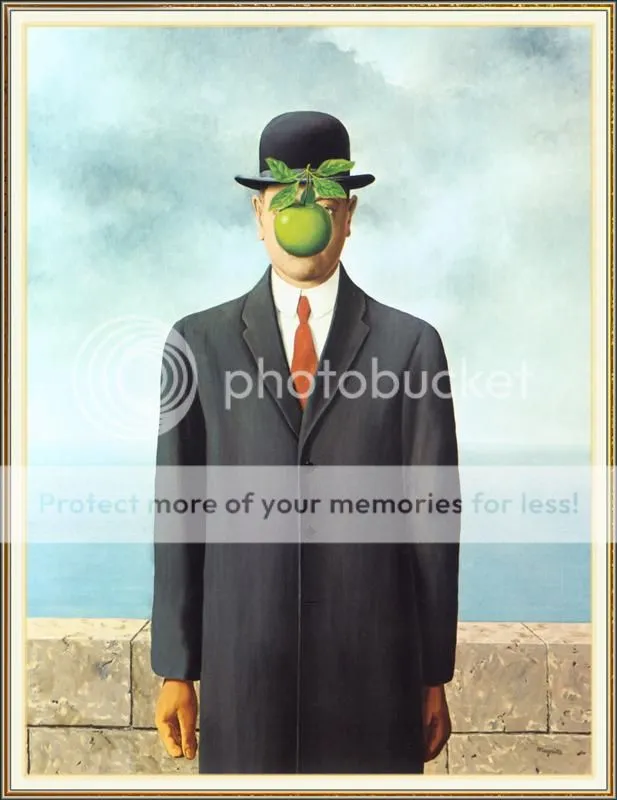

You can peruse Magritte's surrealist paintings at leisure here and here and draw your own conclusions.
We were on a literary tack, so back to the books
I did warn you the perspectives would mingle. I took you down an artistic rabbit hole; now it's time for a different kind of hole - Harry Hole (not even pronounced hole, but you'll have to chase down the Norwegian pronunciation yourselves).
Fans of detective novels have probably come across the Harry Hole series written by the dark, so dark Jo Nesbø. These novels give me a heckuva segue into the science part of this musing, as one of the main characters in the detective's team, Beate Lønn, has (well, had) a hyper-developed fusiform gyrus, which gave her an uncanny ability to remember faces. Forever. Which is ultimately the main reason for her demise (whoops, spoiler alert).
...and finally "sciencely"
So where does this capability to recognise and remember faces come from?
The Fusiform Gyrus
There's a part of our brain which processes faces. Really. You can learn more here and here. The fusiform gyrus is also involved in other perceptual activities, but it shines in the facial recognition department.

The Fusiform Face Area (FFA)
It even has its own sub-department dedicated to faces, the Fusiform Face Area, the light blue bits in the image below.

Honestly, I couldn't make up these names.
But what happens when the Fusi-team doesn't work properly?
Prosopagnosia (wow, heckuva word there...here's a great explanation of where it comes from and what it means), or face blindness, is one of the consequences.
I had a colleague in my early working days who used to tell me he could recognise me by my voice and my clothes that day. It was only after I read the Oliver Sacks book that I realised he also had a version of prosopagnosia....he coped tremendously well with it, and had no trouble sharing his coping mechanism. I regret I didn't pull the pieces together when we were working together, as it would have been really interesting to learn more from him.
And the kicker for me today
I thought I knew a lot about Oliver Sacks, but in this touchingly personal article in the New Yorker magazine, he also speaks candidly about his own lifelong challenges with prosopagnosia. The doctor who helped so many patients cope with face blindness and other neurological conditions which drastically changed the way they could see the world, and the faces around them, was also face blind.