
Cassini - A spacecraft like no other
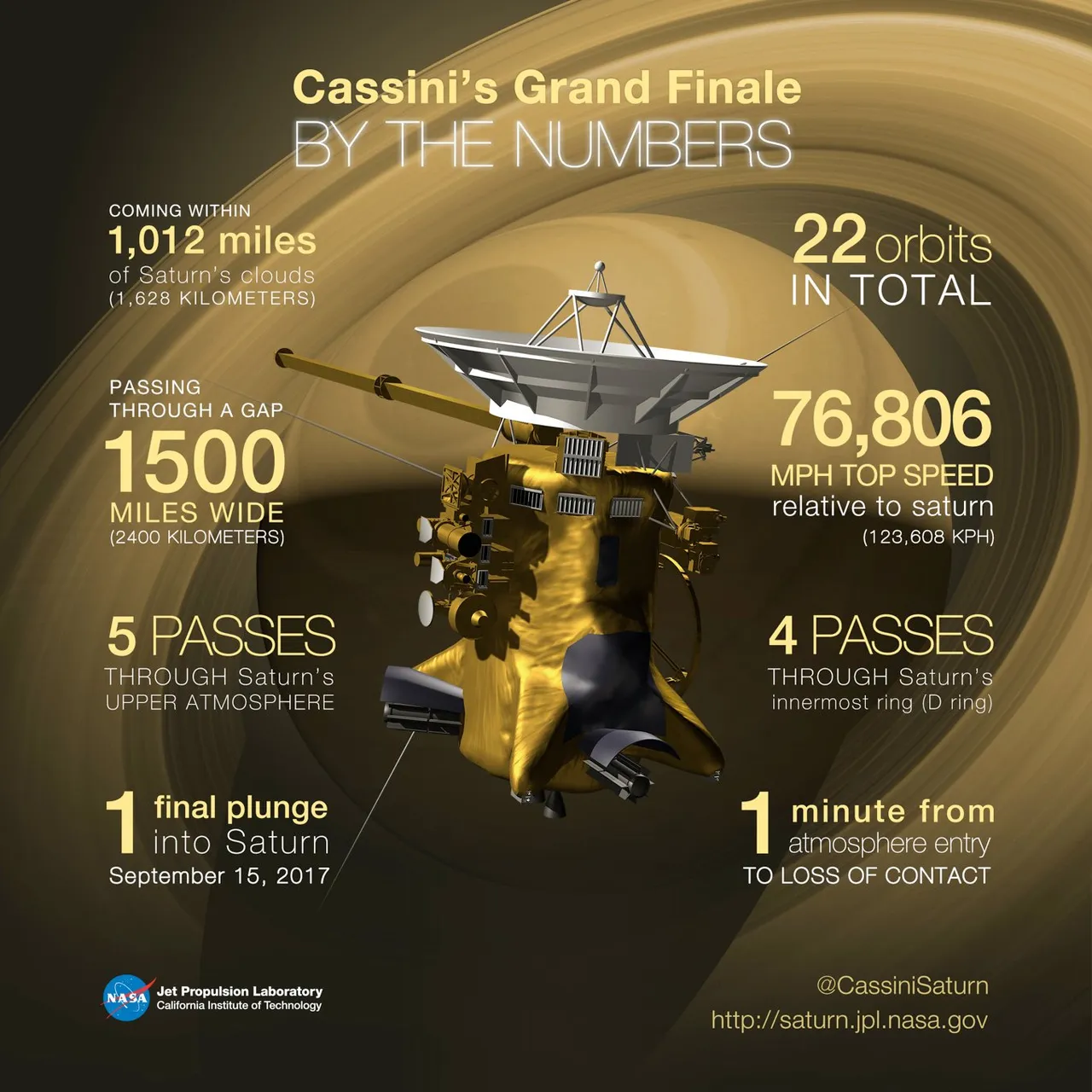
It was just confirmed that on schedule earlier today, 1.2 billion kilometres away, possibly our most productive and definitely most outperforming spacecraft just kamikaze dived into Saturn in it's final death throes exploration of the Solar System. It was a necessary scuttling of the ship, so as not to leave any debris behind. Cassini was the size of a school bus and had been weaving around Saturn and it's Moon for many years since it arrived there when some people reading this were just a twinkle in their fathers eye. If you're a teenager, that's you !

Groundbreaking Science
Cassini outlived it's scheduled mission and has been in orbit around Saturn for 20 years, studying it's many mysteries, discovering and imaging new moons in unprecedented detail, studying perhaps the most likely place to find life (in the OUTER SOLAR SYSTEM) where the light from the sun is far less than our plentiful supply. It is not the Goldilocks zone but on one of Saturn's moon's, (Enceladus) an ice crust and a saltwater ocean, with massive geysers and fed with energy by thermal vents, life could be lurking. I imagine huge sea monkeys the size of football pitches, floating in eternal dimness, sonar clicking their way around the upper oceans. We'll probably hear them next time we go.

Unlocking The Mystery of The Rings
The rings of Saturn have been an iconic feature of space and a mystery for years. The most prominent rings in the solar system and visible from Earth with a small telescope, they have enchanted humanity for many years. Cassini unlocked their secrets by getting up very close and personal. It learned that they are composed mostly of ice boulders, gently colliding in orbit with a bit of dust and traces of rock here and there. The thin layers of the rings are in places as thin as ten metres and in other places protude out from the surface s high as a mountain range. The B ring is 25km wide, while the outermost Roche Division is only a couple of thousand metres.

The Grand Finale
Cassini made the most of every opportunity it had and the scientists who have spent some, most or all of their careers so far remotely working on the mission, re-directing it's movements, interpreting the 635gb of data it sent back will now be twiddling their thumbs and wondering what to do next. Not quite, as there's plenty of mission data to wade through and excitingly there are new, even better space missions to plan.
Huygens probe
Which ten years ago dropped onto the surface of titan, revealing methane weathered rocks among hydrocarbon lakes, giving hope and (showing) for the first time that humans can explore the outer solar system by actually landing and could one day reach the stars. Huygens was built and Operated the European Space Agency. The Cassini project was a successful, international and multi-agency project. The scientists still have months and years worth of data to interpret and Saturn's secrets may turn up incredible finding's long after it's gone. I will be very interested to see what the final descent sheds light on. Who knows what the data will turn up ?

Images to inspire
The sheer quality and majesty of Cassini's unprecedented view of Saturn, it's moon and it's rings have provided ample inspiration for a whole new generation of space scientists and if I was a boy right now, I'd be writing letters to NASA asking for a job, as I'm sure many children do. Here is a selection of some breathtaking imagery. If I'd taken my maths and physics a bit more seriously, I might have been sitting at ESA watching Cassini plunge into Saturn's atmosphere this morning.
Dione a moon of Saturn discovered by Cassini himself in 1684 and name after the Greek Titaness

From Cassini's first Grand Finale dive in April 201 these unfiltered images give the closest ever view of Saturn's Atmosphere from 3,000km

peering through Titan's haze, it's the closest we've seen yet of somewhere that looks like Earth and it's tempting to think someone or something is alive down there 1.2bn miles away

Hyperion, Saturn's spongey moon seen here in unprecedented detail looking every bit like a piece of coral skeleton

CLICK HERE FOR THE CASSINI HALL OF FAME IMAGES FROM NASA / JPL