

Image Source
Introduction
You may be familiar with the Hydra in Greek mythology - a multi-headed monster which Hercules had to slay for his "second labor".
There is another type of creature with the same name that may have interesting secrets to reveal to us when it comes to ageing.

According to Wikipedia the Hydra is:
"a genus of small, fresh-water animals of the phylum Cnidaria and class Hydrozoa, native to the temperate and tropical regions. Biologists are especially interested in Hydra because of their regenerative ability – they appear not to age or die of old age."
Hydra are metazoans which are closely related to protozoa the main difference being that they are multicellular i.e. they are composed of multiple cells.
The Martinez Study 1998

The idea that Hydra may age very slowly or not at all has existed for some time but is closely associated in modern times with a paper by Martinez.
In the paper Martinez studied Hydra Vulgaris over a period of 4 years and found extremely low rates of mortality and high preservation of reproductive capability with little to no signs of what is known as senescence (cellular ageing).
By comparing the results to a number of animals and looking at factors that relate to ageing (e.g. age of first reproduction vs. maximum longevity) the authors were able to infer that Hydra have virtually unlimited lifespans.
"evolutionary theory predicts a positive correlation between age of first reproduction and maximum lifespan, so that animals that start reproducing soon after birth have shorter lifespans. The average or maximum lifespan of hydra are not known......For a species with a prereproductive period of only 5 to 10 days, hydra clearly reaches ages that exceed the expectation from the age of first reproduction-longevity after age of first reproduction plot.

So the closer the time after birth that an animal starts reproducing the shorter the animal's lifespan seems to be. The reasons for this are complex but it seems that the only known animal that goes against this is the Hydra.
This is not absolute proof but does seem consistent with other research on these amazing creatures:
"It could be argued that four years is not long enough, and that if hydra were maintained for, say, 10 more years, one might witness senescence. However, theoretical and comparative considerations suggest that four years is an adequate period of observation."
I would certainly be interested in the opinion of an evolutionary biologist or statistician on this point. Further studies seem to have backed up the claim, they have used similar methods of statistical extrapolation.
I suppose this is for obvious reasons - human researchers are not immortal and don't possess infinite resources - 4 years is an immense amount of time for this kind of laboratory study to last!
How Does the Hydra Do it?

In a review by Danko et al they suggest a number of factors that may play a role:
Simple body shape. This makes it easy for cells to move around and be eliminated.
Active Elimination of Dysfunctional Cells: Hydra appear to actively eliminate damaged cells by budding (in addition to cell death). In more complex animals misfunctioning cells are removed mainly by cell death (programmed vs unprogrammed which doesn't always work). The retention of misfunctioning cells is thought to be one of the factors that causes ageing. The simple shape may help with this.
Stem Cell Load: Hydra are made up almost entirely of stem cells with very little differentiation (specialisation). This is the opposite of complex organisms which only have small amounts of stem cells. According to the authors this would be almost impossible to achieve in more complex organisms.
In essence it appears that the shape of the hydra, combined with its massive proportion of stem cells allows it to remain functionally immortal. Dysfunctional cells are quickly removed and replaced by stem cells.
Petralia et al sum it up as:
"the hydra....keeps itself young by having a highly malleable and renewable body and by replacing its cells continuously."
If only we could do the same!
More Amazing Abilities
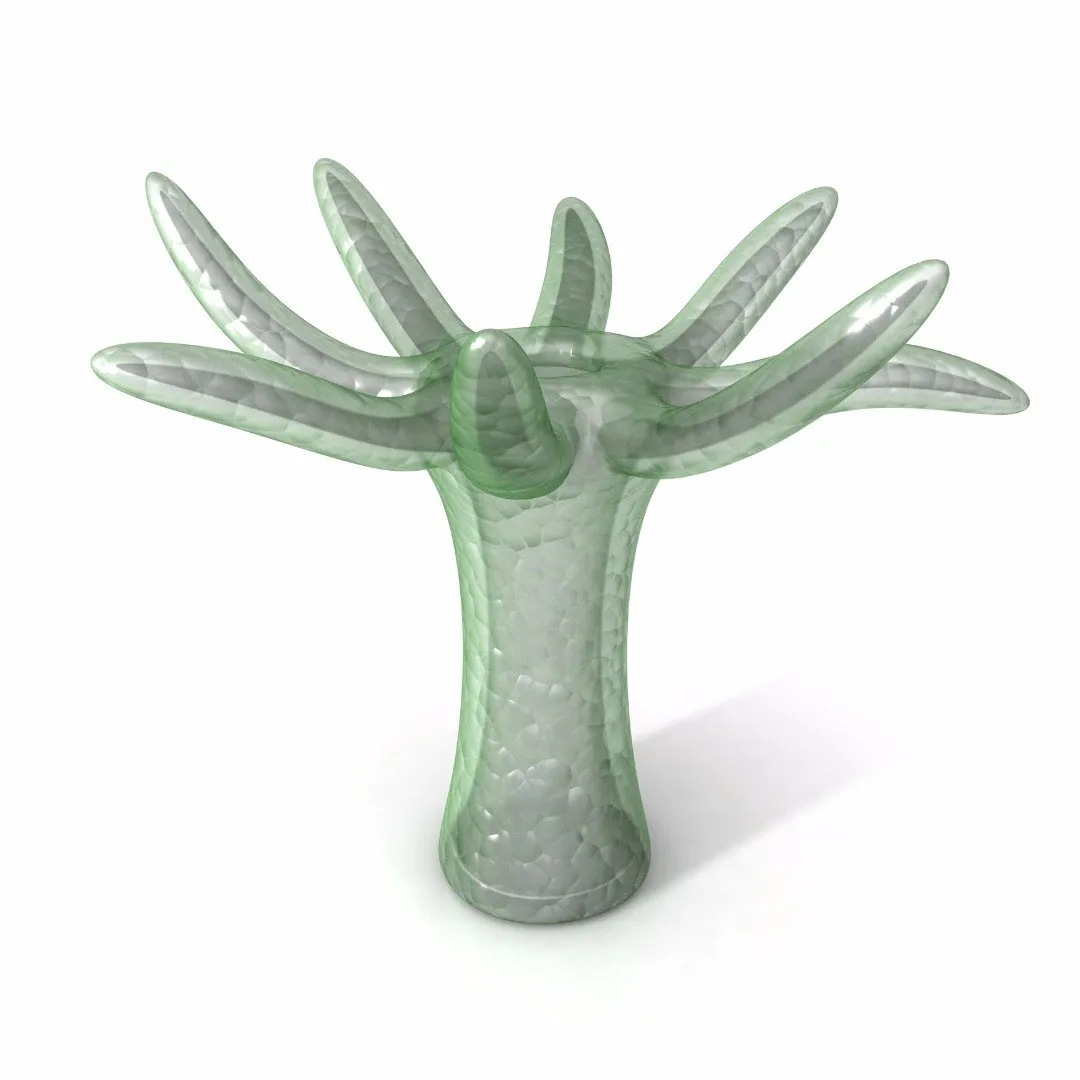
These features may also give Hydra some extra superpowers too. From Petralia et al:
"The rejuvenating (regenerative) powers of hydras are amazing. Dissociated hydra cells can reaggregate and form a new hydra (Gierer et al., 1972; Bosch, 2007), as noted also in the previous sections for some sponges and placozoans."
Amazing is not overstating it. This is akin to chopping someone up and their body parts reassembling!
They also describe another fascinating capability:
"Shimizu et al. (1993) showed that a tiny piece of tissue cut from the trunk of a hydra (Hydra magnipapillata) will reorganize into a 0.2 mm sphere (the animal is about 7 mm long) with only about 270–300 cells, and then finally into a complete mini-hydra less than a mm long."
The exact mechanism by which they do this is not fully understood:
"Many factors are probably involved that help guide the cells to reorganize into the hydra shape. For example, Wnt signaling, important in axial patterning in the vertebrate embryo, induces head formation in the hydra (Lengfeld et al., 2009; Watanabe et al., 2009). Regeneration of hydra into a new animal is mainly due to a reorganization of existing cells rather than via cellular proliferation; this is called morphallaxis (Bosch, 2007)."
So it would appear that it is due to the separated cells reforming into the same shape and NOT new cells due to division.
Does that count as a new animal? It is an interesting philosophical question I think.
Are All Types of Hydra Immortal?

It would seem not. Hydra are able to reproduce both sexually and asexually.
Yoshida et al reported on some interesting research which suggested that sexual reproduction seemed to cause rapid ageing in one particular species of Hydra called H. Oligactis:
"In the degeneration after sexual differentiation in H. oligactis, we found a significant decline in several physiological functions such as capturing food, movements, digestion, and reproduction. More importantly, we discovered an exponential increase in the mortality rate in the population after the induction of sexual phase. Thus, our observations in (oligactis) hydra exactly fit the definition of aging."
This is interesting and fits with the idea that ageing can be accelerated by sexual reproduction.
The ageing in this case seemed to also correspond to a marked decrease in stem cells in these particular hydra. This suggests that in these animals the resource load of reproduction prevented the normal repair mechanisms:
"The drastic change in cell composition, particularly the decrease in interstitial stem cells, suggested that the constant cellular renewal was disrupted during the degeneration in H. oligactis."
"Our analysis of cell composition suggests that the direction of differentiation of the stem cells has changed favoring sexual differentiation, and as a result, the number of somatic cells and the stem cell pool have been greatly reduced. On the basis of these results, we propose a hypothesis that the directional change in differentiation of the stem cells causes the decline in the physiological functions through the decrease in a number of somatic cells, leading to an increase in mortality rate."
This is entirely consistent with certain models of ageing.
Interestingly sexual reproduction appeared to have no effect on another species called H. Magnipapillata:
"On the other hand, H. magnipapillata, one of the closely related species to H. oligactis, does not undergo degeneration even after sexual reproduction.
This is a puzzling finding and there is not yet a satisfactory explanation (in my opinion). Yoshida et al. suggest that this is due to this species continuing to reproduce asexually in addition to sexually.
Conclusion - Can This Help Human Longevity?

Hydra are a fascinating model to study ageing in but from our current understanding of their biology there is not a lot we can do to replicate their anti-ageing tricks in the human body.
We simply can't shift the balance between stem cells and differentiated cells in more complex lifeforms like humans. Not only is it potentially dangerous but those differentiated cells are required in order for our organs to work correctly.
It is one of the prices we pay for complexity.
Indeed even slightly too many stem cells in the wrong place e.g. the brain could play havoc. Cancers are a perfect illustration of this principle.
Unfortunately our bodies are too complicated to simply bud off or separate from malfunctioning cells. Once malfunctioning cells are present they are hard to get rid of and the current repair mechanisms seem to be insufficient.
Whilst I think we will likely get major progress in fighting ageing in the next decade, I think we are just too far removed functionally for it to come directly from Hydra research.
They are still fascinating creatures to study though!
References
Dańko, Maciej J., Jan Kozłowski, and Ralf Schaible. 2015. “Unraveling the Non-Senescence Phenomenon in Hydra.” Journal of Theoretical Biology 382 (October): 137–49.
Petralia, Ronald S., Mark P. Mattson, and Pamela J. Yao. 2014. “Aging and Longevity in the Simplest Animals and the Quest for Immortality.” Ageing Research Reviews 16 (July): 66–82.
Martı́nez, Daniel E. 1998/5. “Mortality Patterns Suggest Lack of Senescence in Hydra.” Experimental Gerontology 33 (3): 217–25.
Wikipedia contributors. 2017. “Hydra (genus).” Wikipedia, The Free Encyclopedia. January 13. https://en.wikipedia.org/w/index.php?title=Hydra_(genus)&oldid=759918199.
Thank you for reading

Before you go have you filled in the Coinbase form to list STEEM? It only takes a few seconds. THIS POST shows you how.
If you like my work please follow me and check out my blog - 
Uncredited Images are taken from my personal Thinkstock Photography account. More information can be provided on request.
Are you new to Steemit and Looking for Answers? - Try:
