
This is the year it finally happens. On August 21, 2017, the United States will experience the greatest opportunity at a total solar eclipse viewing since 1979.

As per Wikipedia, this will be the first eclipse visible to the US since July 11, 1991, which was only actually visible in Hawaii before it arrived at the Baja Peninsula, straight down Central America, across South America, and ending in Brazil.

Prior to that was the eclipse on February 26, 1979, which was visible to the states of Washington, Oregon, Idaho, Montana, and North Dakota before going north into Canada and then finally concluding in Greenland. It drew an enormous number of visitors to the Pacific Northwest because it was the last total solar eclipse that would be visible in the lower 48 states for 38 years.

Fast forward to 2017.
If you live in this country, this is going to be the best opportunity to catch this spectacular natural event, as the view will extend from one coast to the other.
The states it will be visible from include Oregon, Idaho, Montana, Wyoming, Nebraska, Kansas, Iowa, Missouri, Illinois, Kentucky, Tennessee, Georgia, North Carolina, and South Carolina. That's 14 states through which the eclipse's path splits the US nearly right in half. It's the first total eclipse the US has ever had to itself. A couple of European countries will be able to a partial of the same eclipse, but not total.
This is going to be amazing.
As some of you already know, I'm fortunate enough to live not far from the path nearby in Southwest Missouri. I'm planning a 2-day vacation and a 150-mile drive to a spot that lands in the peak area of the path of totality, just south of Carbondale, Illinois. I still need to invest in some mylar-like material to cover my camera lenses for this, in fact.
Another really cool aspect of this eclipse is that 7 years after it happens, another one will occur on April 8, 2024. This time, it begins in Mexico and makes its way north into the states, with visibility in Texas, Arkansas, Missouri, Illinois, Kentucky, Indiana, Ohio, New York, Vermont, and then Canada before ending over the Atlantic.

If you look at the path of the 2024 eclipse, you'll notice of course that it criss-crosses over the path of this year's eclipse. And where does this criss-cross occur?
That's right.... just south of Carbondale, Illinois.

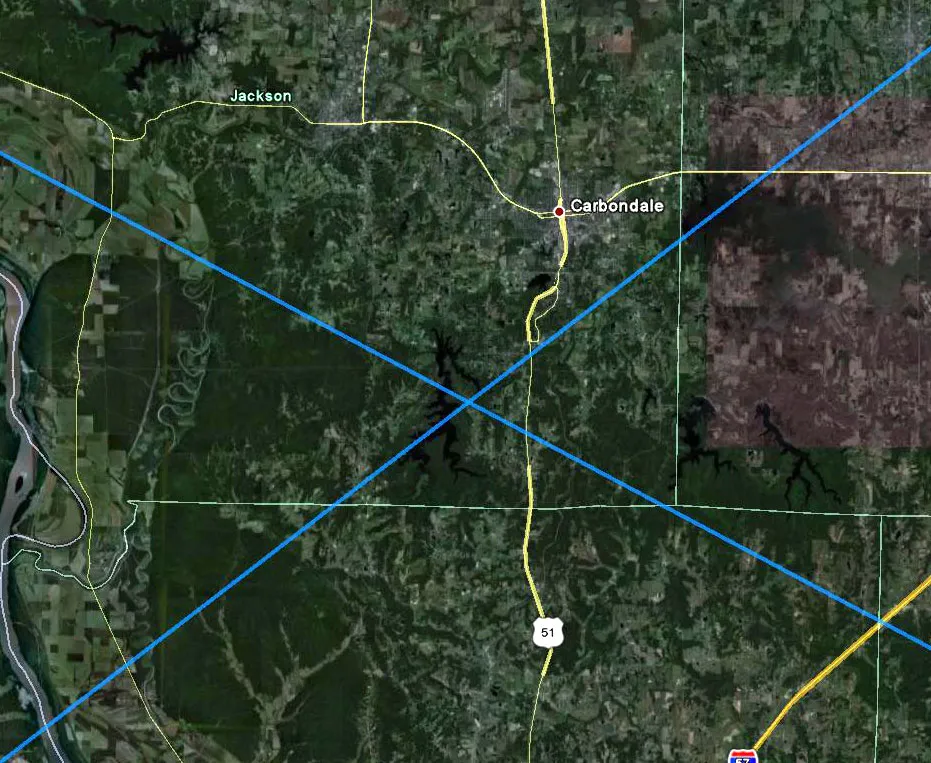
They happen at nearly the same time of day, and occur nearly in the same position in the sky. So, we're going to start with this year's eclipse, and - weather permitting - we're going to stand in the exact same spot in 2024 for another one. Cameras a-blazing for both of them. This is something I've been planning for since I found out about it 4 years ago. My kid will be almost 4 by August, and will be almost 11 for the next one, and I'm sure he'll thoroughly enjoy them.
Here's a larger, more detailed map of the 2017 eclipse's path.

Image Sources in order of appearance:
https://starvalleyquilttrail.com/the-eclipse-of-2017/
https://en.wikipedia.org/wiki/Solar_eclipse_of_July_11,_1991
https://en.wikipedia.org/wiki/Solar_eclipse_of_February_26,_1979
https://upload.wikimedia.org/wikipedia/commons/e/ef/Visualizing_the_2017_All-American_Eclipse.webm
https://en.wikipedia.org/wiki/Solar_eclipse_of_April_8,_2024
http://www.eclipse2017.org/2017/overlap.htm
https://www.greatamericaneclipse.com/desktop-background/


