
Hey dear steemians,
In the phase of the new moon and clear sky the last two nights I was able to collect some photons for my “Cygnus Loop - Veil Nebula” project. Unfortunately, I was not able to capture at least one frame on the first night. After I forgot to install the counterweights, the whole image train turned around the axis due to the gravity and the camera hit against a leg of the tripod, so that it was torn off from the focuser. After fixing this provisionally, it was no longer possible to get into focus. Have I already mentioned that astrophotography can be very frustrating?
Last night was it finally possible for me to capture some images. It took the half day to repair the things that were destroyed on the first night.
I was able to get images of both panels of my mosaic. I got 14 images for each panel before the Veil nebula has disappeared behind the neighbor’s house.
Today I want to show my first “work in progress”, and I want to show the countless stars in our Milky Way.
This image shows the whole mosaic. The white/yellow spots are not noise, this are stars. Many, many, many stars. Hopefully, the stars will not become a problem in the further editing. I also need to capture a lot more images to get more details of the nebula.
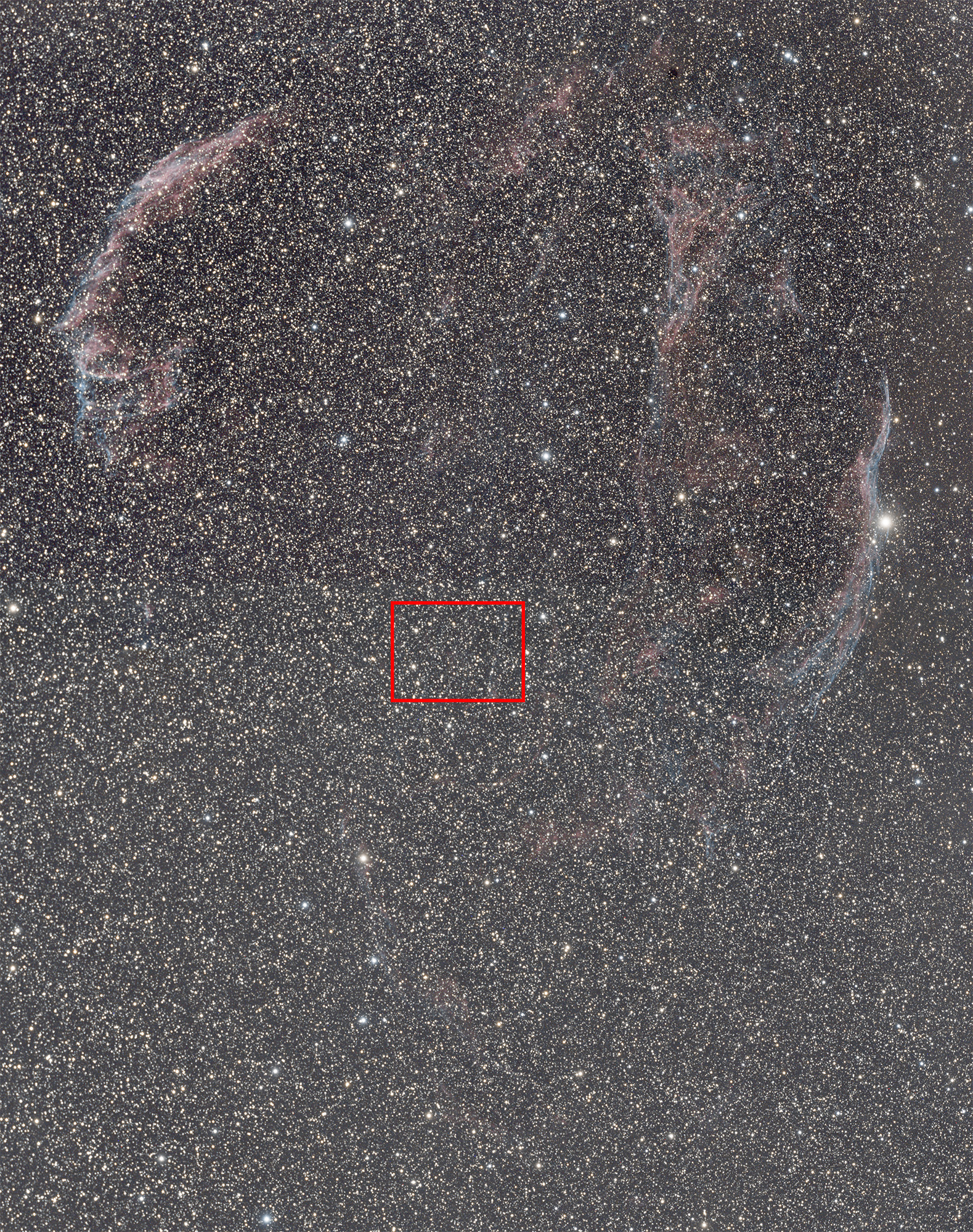
This picture is a cut-out, out of the mosaic. It shows the stars in the red square in a 100% view. Even in such a small area the stars seems to be countless.

A little image analysis at astrometry.net measured the size of 25.2 x 18.9 arcmin for the cut-out region. That’s the equivalent of 0.420 x 0.315 degrees.

If you’re bored, you can even count the stars in the cut-out picture. Gladly you can write me the number in the comments, but do not expect me to recount. :-D

Details of the picture captured by me
The picture was taken from my backyard with the following settings and the following equipment.
Light frames: each panel 14 x 300" @ unity gain
Dark frames: none
Flat frames: none
Bias frames: 256 pcs.
Camera: QHYCCD247C
Scope: TSAPO65Q · 420mm · f6.5
Guide camera: QHY5L-II
Guide scope: TSL60D · 240mm · f4.0
Mount: Skywatcher AZ EQ-6
All is controlled by my Astro-PC over Remote-Desktop and wireless LAN.
Software: Sequence Generator Pro, PixInsight, Photoshop CC
Thank you very much for visiting and reading!
I hope this has been a useful post for you. If you have any questions or suggestions, please don't be afraid to let me know of anything you thought about this post in the comments below!
Yours, @astrophoto.kevin
Many thanks to @remotehorst23!
Whose Astrophoto-Divider I have used to design this post.
Copyright note for my pictures:
All images, otherwise clearly indicated, in this post are my own work.
You can use it for free if you credit them to @astrophoto.kevin.