
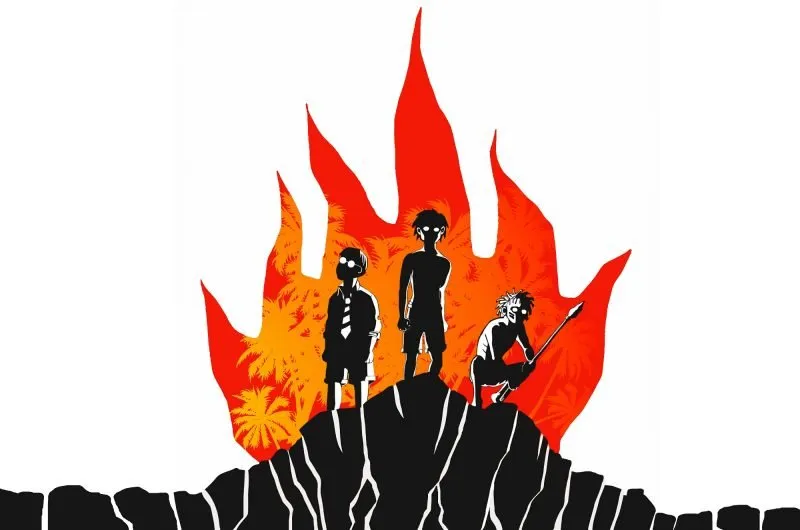
The system of government in LOTF is similar to a dictatorship because power is without regards to rules or rights. One thing all dictatorships include is “Elimination or substantial restriction of civil liberties”. This means the power is focused on one person, and the rest of the people don’t get their human rights fully respected, including the right to life. In Jack’s (attempt at a) government, he is given unlimited and total power. Jack doesn't care for human rights, considering there were two murders that he never even gave considerable thought to. In addition, Jack doesn’t give others the right to have an opposing opinion.
“‘So you shut up.”
“I got the conch in my hand.”’
This dialogue in LOTF is exchanged between Jack and Piggy when Piggy is supposed to get to speak, but Jack doesn’t listen. Jack does not give anyone right to have an opinion besides himself.
In Lord Of The Flies and in dictatorships, fear of chaos results in one person being invested with absolute authority. “In ancient Rome, an official known as a dictator (meaning commander) was appointed as magistrate by the Senate in times of emergency or crisis and invested with absolute authority.”
A dictatorship often occurs in times of emergency or crisis. In desperation, dictators are invested with absolute authority. In Lord Of The Flies, midst all of the chaos, Jack takes power from Ralph. Ralph was originally chosen in times of ‘peace’, where everyone had more hope of rescue. Jack's face swam near him. "And you shut up! Who are you, anyway? Sitting there telling people what to do. You can't hunt, you can't sing—"
"I'm chief. I was chosen."
"Why should choosing make any difference? Just giving orders that don't make any sense—"
This dialogue in LOTF illustrates that, now in the midst of crisis, Jack is ready to take over the power that Ralph had.
You can see the relation between dictatorships and the government in Lord Of The Flies now. But how about Jack and Hitler?
When things did not go Hitler or Jack’s way, they isolated them self and blamed others people as forms of coping. “In the last days of the Third Reich, with the Russian troops in the suburbs of Berlin, Hitler entered into a last stage of desperation in his underground bunker in Berlin. He ordered Germany destroyed since it was not worthy of him; he expelled his trusted lieutenants Himmler and Göring from the party; and made a last, theatrical appeal to the German nation. Adolf Hitler committed suicide on April 30, 1945”
When Hitler’s plans did not go how he desired, he blamed the entirety of Germany and lieutenants. He then committed suicide to avoid blame and the reality of his failure.
“Who thinks Ralph oughtn’t to be chief?”
He looked expectantly at the boys ranged around, who had frozen. Under the palms there was deadly silence.
“Hands up?” said Jack strongly, “whoever wants Ralph not to be chief?”
The silence continued, breathless and heavy and full of shame. Slowly the red drained from Jack’s cheeks, then came back with a painful rush. He licked his lips and turned his head at an angle, so that his gaze avoided the embarrassment of linking with another’s eye.
“How many think –”
His voice trailed off. The hands that held the conch shook. He cleared his throat, and spoke loudly.
“All right then.”
He laid the conch with great care in the grass at his feet. The humiliating tears were running from the corner of each eye.
“I’m not going to play any longer. Not with you”
Jack expects the boys to side with him, and when they don’t, Jack gets upset and leaves the group without apology.
Jack is similar to Hitler because they both used fear and intimidation to rise to power. “[Hitler was] Playing on. . . the general fear of war”
Hitler used fear of war to get what we wanted: allies.
Jack used fear of the beast.
“'Quiet!' shouted Jack. 'You, listen. The beast is sitting up there, whatever it is--' [...] 'Hunting,' said Jack. He remembered his age-old tremors in the forest. 'Yes, the beast is a hunter'" For Jack, the beast is an opportunity to make himself appear strong and brave.
Does Golding prove his point???
I believe Golding proves his point quite well. Despite Ralph’s government being the (probable) best, it didn’t last long. The society among the boys held deep fear and Jack used the fear to gain power. If thought logically through, Ralph’s government would have stayed, or a better one could have been proposed. However, human nature is selfish and not exactly clinging to ‘logic’, so fear won and Jack’s dictatorship overpowered Ralph’s democracy. It was not the system of government at fault, it was the boys’ human nature. Even if the government was perfect, it would not have succeeded because the boys were young and selfish.
ANNOTATED BIBLIO COS I AINT GONNA PLAGARIZE NOSIREE ;'D
"Dictatorship." International Encyclopedia of the Social Sciences, edited by David L. Sills, vol.
4, Macmillan, 1968, pp. 161-169. Gale Virtual Reference Library, go.galegroup.com/ psi.do? p=GPS&sw=w&u=j220908005&v=2.1&id=GALE%7CCX3045000303&it=r&asid=417 2ddf035f0fb83f559ff1517daae8b. Accessed 9 Oct. 2017.
A dictatorship, by definition, is unrestricted domination of the state by an individual, a clique, or a small group. Dictatorships can also be called names such as: tyranny, despotism, autocracy, Caesarism, Fuhrerstaat , authoritarianism, and totalitarianism. However, the point of dictatorships is that it gives those in power exclusivity and unlimitedness with the abandonment or loosening of the juridical bonds of political power and removal or extreme restriction of civil liberties. Dictatorships are often characterized by a mostly violent, impulsive form of decision making and political and social control. Some examples of dictators include the postconstitutional Caesarist dictatorship of the Roman Empire, Peron in Argentina, and Franco in Spain. Dictatorships achieve successes by methods like deception, dishonesty, and social rewards, they demand respect and loyalty; propaganda sees to it that they obtain them.
Similarly, in Lord Of The Flies, power is uncontrolled and without regards to rules or rights. In Jack’s (attempt at a) government, he is given unlimited and total power. Dictatorships often have aggressive and violent forms of decision making, just like Jack. Which, in turn, makes Jack a good hunter, not a good political leader. He also demanded admiration and he used fear to get members to join him.
Magid, Alvin. "Dictatorship." Governments of the World: A Global Guide to Citizens' Rights and Responsibilities, edited by C. Neal Tate, vol. 1, Macmillan Reference USA, 2006, pp. 314-320. World History in Context, link.galegroup.com/apps/doc/ CX3447400087/UHIC?u=j220908005&xid=3dbd1eb4. Accessed 9 Oct. 2017.
The term “dictatorship" derived from the word "dictate," which means to command expressly; to impose or give orders with authority; to give orders or instructions arbitrarily. A dictatorship often occurs in times of emergency or crisis and, in desperation, dictators are invested with absolute authority. A dictator is a ruler who has an absolute power and unlimited authority. Dictatorships operate free of the kind of constitutional limits seen in democratic societies; this means their powers are unchecked by formal rules, public opinion, or by sensibilities having to do with human rights. Some major instances of dictatorship include the Soviet Union, dominated for a quarter of a century by Russian leader Joseph Stalin; Nazi Germany, ruled by dictator Adolf Hitler; Juan Perón, in Argentina; and Kwame Nkrumah in Ghana, formerly the British Gold Coast colony.
In Lord Of The Flies, Jack would constantly give orders, like in a dictatorship, even if to just get him a drink. Being stuck on the island, they cannot be limited by a constitution. Technically, all powers are absolute, it just depends who decides to take them, which is mainly by Ralph and Jack. Jack also doesn't care for human rights, considering there were two murders, that he never gave considerable thought to.
ROFE, J. SIMON. "Dictatorship." Encyclopedia of the Great Depression, edited by Robert S. McElvaine, vol. 1, Macmillan Reference USA, 2004, pp. 236-237. Gale Virtual Reference Library, go.galegroup.com/ps/i.do? p=GPS&sw=w&u=j220908005&v=2.1&id=GALE%7CCX3404500139&it=r&asid=99b c8ec8c50708197194844d90e46783. Accessed 9 Oct. 2017.
In a dictatorship, power is in the hands of a ‘single leader, a one-party system with mass membership, a secret police prepared to use terror as a tool of policy, and a control of the popular media to promote the regime's doctrine. Dictators don't have to win national elections or have a popular majority, which is why it is truly remarkable that they can have such strong physical and intellectual control over their own populations.
In Lord Of The Flies, Jack is a dictator, and his group represents a dictatorship. Like a secret police in dictatorships, he uses the kids’ fear to get his desired power and respect. His use of fear and power makes him seem, slowly, as a good role model to the helpless children, thrown into chaos. Using this fear, like in a dictatorship, he gains quite remarkable control over the kids.
Adolf Hitler "Adolf Hitler." Encyclopedia of World Biography, Gale,
- World History in Context, link.galegroup.com/apps/doc/K1631003062/UHIC? u=j220908005&xid=abc2d229. Accessed 8 Oct. 2017.
German dictator Adolf Hitler (1889-1945) led the extreme nationalist and racist Nazi party and served as chancellor-president of Germany from 1933 to 1945. He was Born on April 20, 1889, in the small Austrian town of Braunau. In his school days, Adolf was rebellious, and failed often. He left formal education altogether in 1905 and, refusing to bow to the discipline of a regular job, began his long years of being a dabbler of sorts, living an aimless existence, reading, painting, wandering in the woods, and dreaming of becoming a famous artist. May 1913, apparently in an attempt to avoid enlistment into the Austrian military, Hitler slipped across the German border, but he was arrested and turned over to the Austrian police. However, after the outbreak of World War I a year later, he volunteered for action in the German army. During the war, he fought on Germany's Western front. Hitler greatly enjoyed his war experience and looked back fondly upon it. When President Hindenburg died in August 1934, it cleared the way for the elimination of the presidential title by vote. Hitler became officially Führer of Germany, thereby head of state, as well as commander in chief of the armed forces. Firstly, Hitler began preparing Germany's resources for military conquest and racial domination. He put Germany's 6 million unemployed to work and assured himself of the loyalty of his army. On Sept. 1, 1939, Hitler began World War II--which he hoped would lead to his control of most of the Eurasian heartland. When Germany began losing, Hitler withdrew from the public; his orders became increasingly random and perfectionistic; and he ignored his military counselors. He ordered Germany ‘destroyed’ since it was not worthy of him, blaming everyone but himself. Adolf Hitler committed suicide on April 30, 1945, leaving administration to non-Nazi Adm. Karl Doenitz.
Adolf Hitler is a lot like Jack from Lord Of The Flies, he had quite theatrical appeals, and was power-hungry. Like Hitler, Jack would have to assure himself of the loyalty of the army. Also, when people wouldn’t conform to his standards or give him control, he eliminated them, the way Hitler did with the fire in the Reichstag building. When Hitler took over, Germany wasn't in the best of places, but he only gained popular appeal and political power in the widespread panic and mass psychosis. Jack also was rebellious, similar to Hitler in his school days, when he refused to bow to discipline. When Hitler wasn't accepted into a desired school, he went into a period of deep depression and seclusion from his friends, the way Jack did when he finally left the group when things weren't going his way. Like Hitler, Jack also used fear as a weapon of propaganda and persuasion. Jack was also very willing to fight when he felt strongly about something. If Ralph had decided they were going to ‘fight off’ anyone who doubted Ralph’s power, Jack wouldn't have fought (like when Hitler tried to avoid induction into the Austrian military service and slipped across the German border to Munich). However, when Jack felt passionately about killing Ralph, he fought greatly, similarly to when Hitler volunteered for action in the German army. Jack was brave, and Hitler had won several awards for bravery. They both would look back fondly upon war experience. They also would regard their self as a significant force. When Jack’s power was doubted, he withdrew from the group, and started a new one. If Jack’s power was lost again, I believe his reactions would be similar to Hitler’s, in which he withdrew almost entirely from the public; his orders became increasingly erratic and pedantic; refused to listen to advice and order Germany destroyed since it was not worthy of him (blame the other boys).
Hancock, M. "Adolf Hitler." Governments of the World: A Global Guide to Citizens' Rights and Responsibilities, edited by C. Neal Tate, Macmillan Reference USA, 2006. Biography in Context, link.galegroup.com/apps/doc/K3447400152/BIC1? u=j220908005&xid=aa7f3281. Accessed 9 Oct. 2017.
Hitler was born on April 20, 1889, in eastern Austria, and lived a pampered childhood and adolescence. Hitler resigned from the military to join the German Workers Party, a radical right group formed in Munich to oppose postwar Germany's fledgling democratic regime (the Weimar Republic). He quickly became the party’s leader (führer), changed the party's name to the German National Socialist Workers Party (NSDAP), and initiated a Putsch (attempted seizure of power) against the Bavarian government in November 1923. Hitler was arrested, tried for treason, and sentenced to five years in prison, during which time he wrote Mein Kampf, an inflammatory autobiography. He debated politics on a daily basis, and developed exceptional skills as an impassioned orator. He desired to have politics as his career—as a means for gaining power. Upon Hindenburg's death in 1934, Hitler combined the offices of chancellor and president into his personal role as absolute führer. When the Western powers subsequently balked at his demands to seize Polish territory on Germany's eastern border, Hitler launched World War II on September 1, 1939. Nearing the end of the war, April 30, 1945, Germany at disadvantage, he shot himself in an underground bunker in Berlin. Hitler is undoubtedly one of the modern world's most ruthless and maniacal political figures.
Jack from Lord Of The Flies resembles Hitler because they both were skillful orators. They had an unhealthy desire and need for power. Jack also becomes like an ‘absolute ruler’, the way Hitler does upon Hindenburg’s death in 1934. Hitler and Jack both used violent means to get what they wanted. Hitler launches a full fledged World War, and Jack made his group hunt and murder their friends. When things were not going their way, they left. Hitler committed suicide and Jack abandoned Ralph’s group.
Weinberg, Gerhard. "Adolf Hitler." Encyclopaedia Judaica, edited by Michael Berenbaum and Fred Skolnik, 2nd ed., Macmillan Reference USA, 2007. Biography in Context, link.galegroup.com/apps/doc/K2587509058/BIC1?u=j220908005&xid=e9340006. Accessed 9 Oct. 2017.
Hitler was the man who planned the extermination of the Jews, took the total decision, created the required organizations, and followed passionately its implementation. As a young boy Hitler clearly did not get on well with his father, primarily because he neither applied himself to his schoolwork nor aspired to a substantial career as his father had. However, he very much loved his mother. She died of cancer in spite of the efforts of her Jewish doctor to whom Hitler always remained extremely grateful for the care he had provided. As a youngster he moved to Vienna, living with a friend who was studying seriously. Hitler was denied entrance to the arts academy, refused to admit this failure to his family, and lived on the pension from his deceased father and funds provided by family members. As his money ran out, he moved into cheaper housing and in part supported himself by painting local buildings and scenes for sale to tourists. During the years in Vienna he evidently began to absorb some of the racist and antisemitic ideas that would dominate his subsequent elaboration of and dedication to them. Perhaps equally important, he observed the electoral politics of the time. In doing so, he simultaneously developed an understanding of how to appeal to masses of people, a passionate aversion to democratic procedures, and a hatred of Slavic peoples. These people were represented in the Vienna of his time primarily by Czech. In May 1913 Hitler left Vienna for Munich to escape service in the Austrian army. Obliged to return, he was found physically incapable of military service. This did not keep him from volunteering for the German army in August 1914, and being accepted. Hitler desired a purified Germany with only one party led by the man who understood these ideas, himself, would be guaranteed to win a series of wars. He believed the Germans could dominate – and inhabit – the globe. By the late 1920s Hitler allied his party with the other parties opposed to the Weimar Republic and attained an increasing audience and following, and in 1930, Hitler's party received the largest share of the country's votes, and the coterie around President Paul von Hindenburg persuaded the latter to appoint him as chancellor on January 30, 1933. Hitler had numerous people murdered as a sign of his total control. Before committing suicide, he blamed the war and all disasters on the Jews and called on the German people to continue his racial policies in the future.
Jack is similar to Hitler because they both can appeal to masses of people and have a hate for democratic procedures. They desired a new government, where their country (or group) could be supreme and rule everything, through the violence and fear of war. Hitler’s party slowly gained popularity, the way Jack’s did, and even became the most popular party. When things did not go the way Hitler desired, he killed himself and blamed the war and all disasters on the Jews. When things did not go the way Jack desired, he abandoned the team and blamed everything on the ‘logical thinkers’ like Ralph and Piggy.