There is a lot of speculations surrounding Weed companies. It's similar to the tech boom back in 2001. Companies with no profits or solid foundation are going public and people are buying into them simply because they are associated with what's hot right now:

WEED!
There are a lot of investors out there in the Steemit community and other places as well. I felt as though I had to bring you all value by finding a quality company within this space. This value derived from fundamental business value, and technical value in it's price and chart.
There are different types of companies in the market place you can invest in.
Biotech companies trying to create the next THC/CBD derived cure for diseases. These companies are tricky to invest in, as very few biotech companies succeed, there is a ton of federal regulations, and profit margins are razor thin without success.
Sin Companies are companies that are commonly tobacco or alcohol companies like Heineken and Coors. These companies are already behemoths and it is hard to imagine them having massive growth already, as large companies become sluggish as they have more liabilities and moving pieces, though may be the safest bet in the space.
Brand Companies are simply retail companies that profit from in store purchases of product. They typically partner with big producers and sell their product at retail prices and create a brand to sell to the public through clothing. These companies typically have astronomically high marketing costs and really only have one source of revenue, the consumer.
Production and Cultivation Companies are the companies I am keeping my eye on. These companies are right in the sweet spot of things, in my opinion. They have the potential to make income off of the retail brand companies, the biotech companies, the Sin companies, and even the consumer. No matter what happens in the weed space, people will need product.
Whether the majority of that product is for medical cures, or retail and recreation, SOMEONE MUST GROW THE WEED.
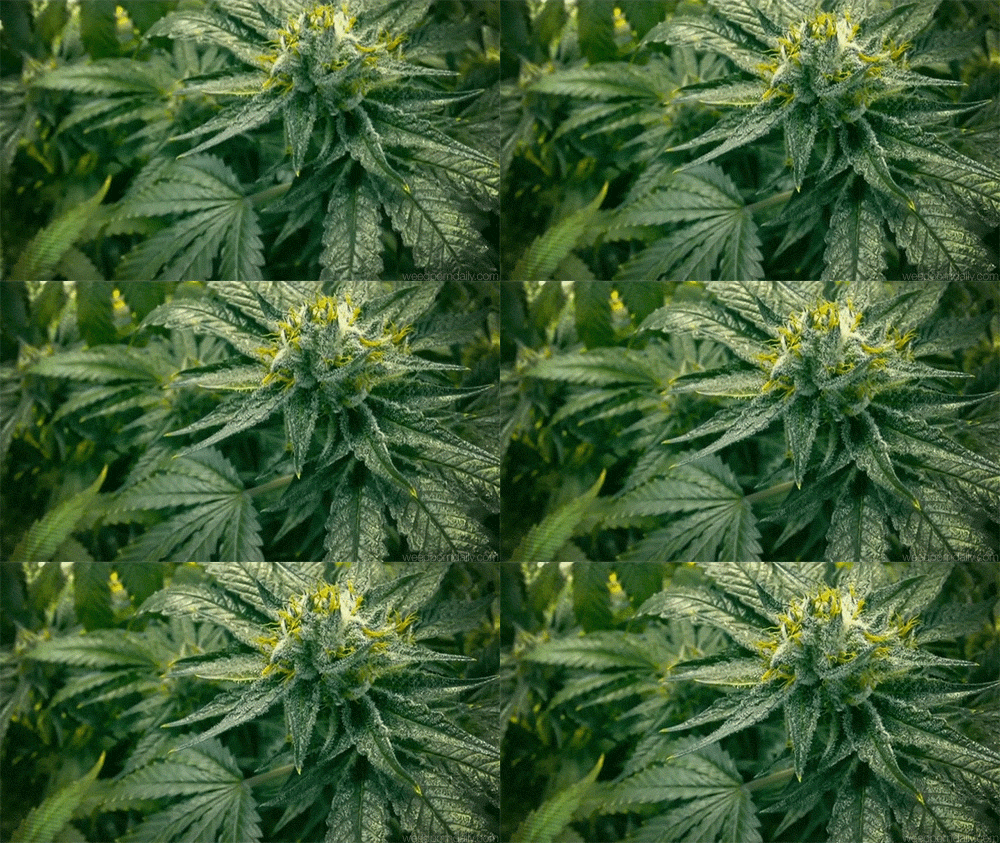
So for me, the choice of sector within the marijuana is easy: The producers.
I found one producer that has a lot of upside for growth, is at a relatively "cheap price" compared to the price of its competitors shares, and looks healthy financially from a fundamental perspective.
Aurora Cannabis, $7.30, NYSE

This is where I get into a bit more of the technical side of my analysis for the company, so if you don't speak "financial-ese" skip down towards the bottom and I'll have a simplified summary for you.
Let's dive in.
The Fundamentals
I was doing a bit of digging through cannabis producers by looking at their financial statements. Aurora really caught my eye. It has a clean and growing balance sheet, and an increasing income and profit. Most cannabis producers are not yet profitable.
One thing to note on these statements is that something like $50,000 would actually represent $50,000,000.
Income Statement

A crucial part of the producers business is obviously revenue from sales of goods and service.
Here we see Auroras revenue increasing by 305%. Notably, Aurora is receiving a decent amount of income from good and service. They seem to have a diversification in their sources of revenue, which is healthy for a growing company. Also, both types of income increased at about 300% YOY.
While revenue increased by 305%, the cost of those sales increased by only 242% YOY. This means that every $1 Aurora spent on revenue-based activities, they received $1.58. This is a huge incentive for Aurora to spend more on the sales side of things, but may be dangerous as sales might plateau for a number of years until more states in the US legalize. Nothing that worries me however.

It worries me a bit that Aurora isn't profiting before "other expenses." However, It is promising seeing that they have more than tripled their spending on research and development. A company working on new solutions and ways to tap their market is wise at that. Their loss before other expenses has accelerated to 9 times greater than the year before, though this is a growing company.

The other expenses category can be somewhat hairy. Sure, its income for the company, but it is impossible to know if most of this income can continue. If you look at the bottom, Aurora profited $166 million on derivatives. Derivatives are essentially financial products that have price movements based on other assets. These are hardly stable investments.
But, I must say, the things Aurora is doing on the investment side of things is crafty and is giving them an edge over their competition by keeping a slim profit while expanding. Most producers are not currently profitable.

It is very encouraging to see this company pull a profit after a year of a net loss. However, we have to see this kind of success sustained for it to mean anything.
Balance Sheet

Aurora's accounts receivable are increasing. This basically means that there are individuals or companies that owe them money on product that was given to them. Similar to when you have an account at your local hardware store. You can buy when you don't have cash, but you are expected to make payments every month. This will provide some stable income for Aurora down the road.
Aurora also has a huge increase of biological assets. These are the actual cannabis plants. These cash crops provide product for them to harvest and sell. The more plants they have, the more income they will have down the road, assuming they can make continued sales at a profit.
Overall, Aurora assets have increased by 592%. This increase brings value to the shareholder which is what you should be looking for in good companies along with relatively low debt and growing profits.

Here's the kicker about these statements: over the past year Aurora has increased shareholder equity by 711%. This essentially means they are acquiring more assets than liabilities, increasing the fundamental value of the company.
Ratios:
P/E Ratio: 48.6
High for traditional companies, but low for the industry. Most companies don't even have PE ratios because they don't have a profit yet.
Book Value: $1.23
This means that if it were priced out at the value of it's equity, it would be $1.23 per share.
Debt/Equity: 0.13
This means that they only have 13% debt against their total assets. A very strong indicator of financial health.
The Technicals
Now let's look at the chart of ACB to get an idea of where its price is at.

On the weekly chart, ACB looks like it's gaining momentum to the downside. RSI is dropping, and it is testing its 100 day MA. If it breaks this it could head towards its 200 day MA near $5.00.

On the daily chart we can see that the RSI for this company is reaching oversold as it is holding support at its 200 day MA. IF it breaks this range it is likely to head for $6.00 or so. there are a few trendlines that it may find support at during a decline in price.
Overview
Overall, Aurora proves to be making smart moves financially as a company. It is acquiring more assets, increasing profit for shareholders, and keeping low debt relative to its assets.
Aurora is relatively cheap compared to its competitors at $7.30.
I will continue to watch this company and see how it performs over the final quarter of 2018. I'm hoping for it to get down towards the $5.00 level but we will see.
Thanks for taking the time to read. I hope to see you again soon!
Disclaimer:
The information in this article is meant only as educational content, expressed opinion, and not investment advice. Investing your money in openly traded companies is risky and can result in the loss of principle. Investing in commodities is more risky than trading company stock as commodities are open to more risk since they are traded on the global market. This means that the ETFs of the underlying commodities (GLD and SLV) are at risk to having big movements in price while the US markets are closed. Cryptocurrency carry a great amount of risk as well. Only invest what you can afford to lose, and always do your own research.
Recent Posts:
Stocks Have Their Worst Week Since 2008: A Macro Outlook