
The United States recently imposed tariffs on products coming from Mexico. Let's look at the difference between free trade and protectionism (tariffs) and the effect on the consumer.
Produced in MS PowerPoint using Clipart

Watermelon
It is spring time in North America and a time for picnics. A favorite at any picnic is watermelon (at least it is one of my favorites). When I bought groceries today I checked the price of a seedless watermelon. The cost was $5 for a single seedless watermelon. And this was the cost before tariffs were imposed on products from Mexico.
Since locally grown watermelons are not available yet, the watermelons in the stores come from other areas. The label on the $5 seedless watermelon in the store
says it is a product of Mexico.
Toward the end of summer the locally grown watermelons will be in the stores and the price of watermelons generally goes down.
Free Trade
Produced in MS PowerPoint using Clipart
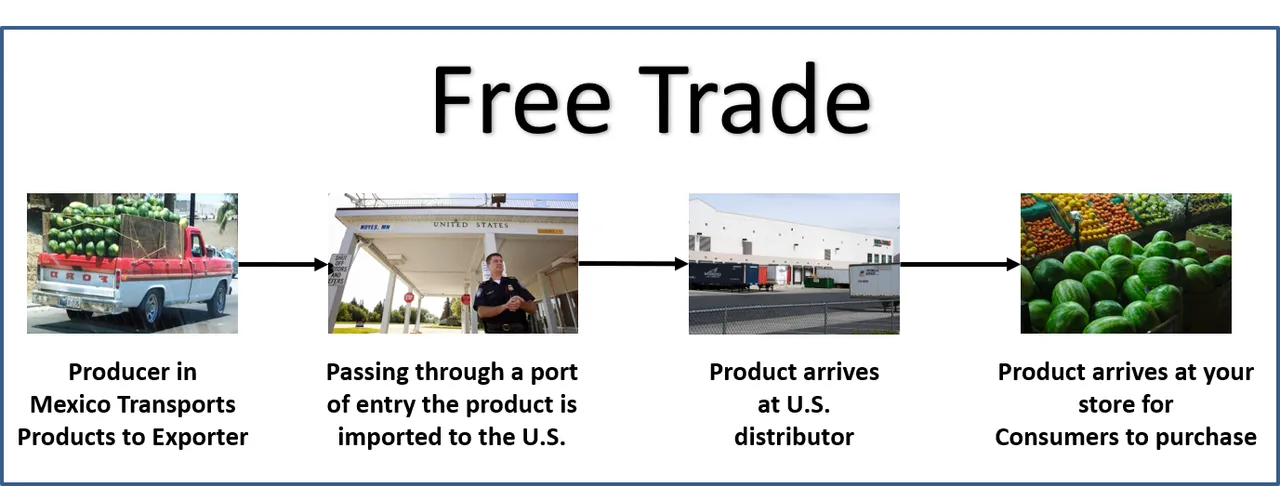
With current trade agreement between Mexico and the United States, the cost of a seedless watermelon in the store is $5.
Tariffs
Produced in MS PowerPoint using Clipart

The United States has now imposed a 5% tariff on all products imported from Mexico. Let's say Mexico exports seedless watermelons to the United States for $2 per seedless watermelon. At the port of entry to the United States, U.S. Customs collects a tariff of $0.10 for every seedless watermelon imported from Mexico. The tariffs collected go into the U.S. Treasury.
The cost of the tariffs is passed through the distribution system and arrives at my local store at an increased cost. So it looks like I will be paying at least 10 cents more ($5.10) for each watermelon I purchase until the locally grown watermelons are in stores.
Thank You!
If you like this post, you can upvote, follow, share, and re-steem this post.
Thank you!