
Since I quit work last year, I’ve been surprised at how much my basic cost of living expenditure is. TBH I’ve struggled to keep it at around £1700/ month, which is about 25% higher than I’d anticipated it being.
Here’s a very rough break down of my monthly expenditure:
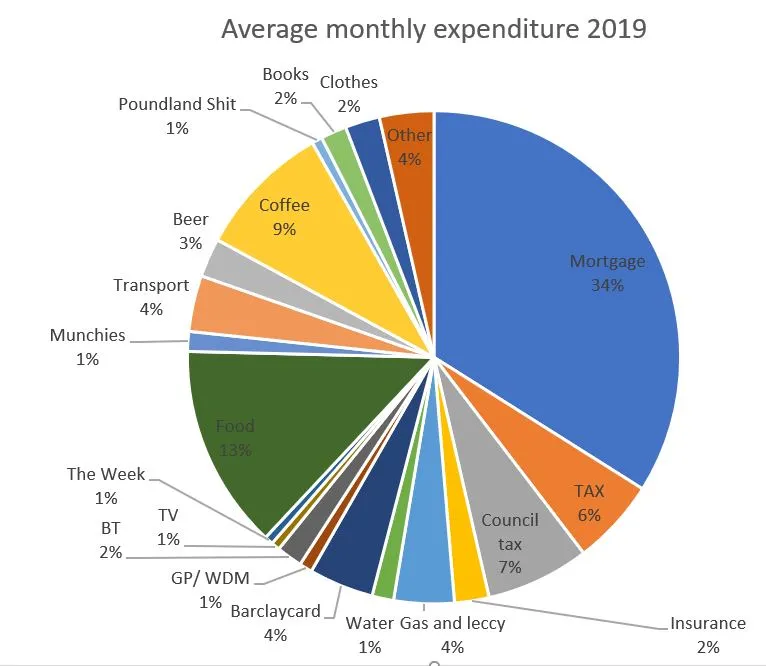
- Mortgage - £600 (34%)
- Food – £230 (13%)
- Coffee - £150 (9%)
- Council tax - £120 (7%)
- Income tax - £100 (6%)
- Transport - £60 (4%)
- Gas and electricity - £60 (4%)
- Credit card repayments - £60 (4%)
- Beer - £50 (3%)
- Subscriptions - £40 (2%)
- Broad Band and phone - £35 (2%)
- Books - £35 (2%)
- Clothes - £35 (2%)
- Water - £25 (1%)
- Poundland shit - £20 (1%)
- Other - £60 (4%).
This is roughly in line with my monthly income, hence why I've called my situation a 'cost of living creep' rather than a 'crisis' as 
TBH I don’t have to even work that many hours to earn £1700 a month, but I still work more hours than I’d like to be working, and around 60-70 % of my income (the online portion) is fragile because it’s dependent on Google’s SEO algorithm.
Hence I’m not satisfied with this situation, so I need to reduce my outgoings drastically so I’m less dependent on $$$ and so I can spend less time doing paid-work, and more time just being.
How I got into this situation
- TBH I’m pretty pleased with my mortgage repayments, given that I was paying £1000 a month two years ago, and this is on a nine years to go repayment plan, so I could pay less. I also pay £30 a month buildings insurance on top, which is in ‘other’, a requirement to get the mortgage!
- Food – some of that is lunches out and take-out, which is mostly during and after my work away days. Not too bad here.
- Coffee remains a daily addiction – that’s not so much about the coffee, more about the only social interaction I have some days, an excuse to get out of the house for something other than a run or gym session.
- Council tax and income tax I can’t avoid. NB the income tax will be double for next year, it was last year because I paid so much from full time job.
- Transport – the car – I don’t really need one, but if I’m going to transition to a low impact off-grid lifestyle, I will need one (ironically) so I can’t really get rid.
- The credit card payments aren’t ‘real’ outgoings – I got a decent transfer deal, less than my returns on other investments – I’ll just kill that debt by the end of 2020, but I have to maintain it for now.
- Gas and electricity – not too large a percentage of my monthly outgoings – I’m quite please with this – my house is small, so it helps – but an off-grid lifestyle would still help here.
As I see it, everything above, except for the coffee, is stuff I can’t avoid paying out or expenditure I’m quite happy with given my current settled normal-vanilla living situation.
Everything else plus the coffee – the other 30% or so are various things I could mostly live without, but I’ve drifted into a fragmentary expenditure mainly because I live on my own and I’ve just got into bad habits.
So let’s say 65% system, 35% habit is why I’ve got a relatively high cost of living ATM.
A drastic plan to radically reduce my cost of living…
It doesn’t take a genius to figure out what I need to prioritise in order to lower my outgoings – housing, food, coffee and tax are around 60% of my outgoings, so they are the priorities.
IMO my best strategy for dealing with all of these AT THE SAME TIME would be to pursue a low impact living strategy. This would also deal with several other items in the breakdown above, such as many of the utilities.
In a nutshell, or at least a list, a few aspects of what my ideal low-impact living situation would look like…
- Finding a bunch of other people into low impact living – and working with them. People are crucial. People to work with and socialise with would kill off many of my negative habitual expenditures at a stroke.
- Living in a yurt or a bender (or any kind of cheap and temporary living accommodation). A couple of grand, or maybe less, could completely kill my mortgage and council tax.
- Replacing the car with a cargo-bike, or maybe two bikes – one regular, and one cargo. Goodbye £60 a month and maybe hello £4-5K if I sold the car.
- Using a wood burning stove for warmth in the winter, preferably a rocket-stove – assuming I can get free wood for fuel, then farewell £30 a month on heating.
- Growing my own fresh fruit and vegetables – being realistic, I could halve my food bill, I’d still need to buy bread and staples – but the working element would help kill my habitual expenditure, this is an important aspect
- Generating my own electricity, solar panels are the obvious option – farewell £20-30 a month on leccy.
- Harvesting my own water, or manually collecting my water from a local stream, which may require some kind of filtration – Not so important for saving money, but necessary obviously!
- Doing my washing by hand – otherwise I’d end up spending a fortune on laundrettes!
- Building a compost toilet to deal with waste – as important as H20.
- Going non-dom so I don’t have to pay tax. I’ve put this last as I think I’d end up earning so little, tax wouldn’t even be necessary.
What’s realistic/ what would I still need to spend money on?
Besides the initial capital costs (of a yurt/ batteries etc.)…
- There would be some maintenance costs associated with building up-keep and growing food - £100 a month?
- Transport – being realistic I’d probably have to keep the car, maybe even spend more on it - £100 a month?
- There’d have to be some sanity trips away to town every now and then - £100 a month?
- Communications (phone)/ computing upgrades - £100 a month?
- Other – I’m bound to have forgotten something - £100 a month?
- Buying in food – £50 a month
- Insurance - £50 a month, probably wouldn’t want to do without that?
So if I could get by on £600 a month, I’d be happy with that.

Low-impact Living, it’s not just about the money
It’s also about sticking it to the man. Living with less money means less money supporting sub-optimal banking systems (to put it mildly).
It’s about being resilient – less reliant on a broken system to meet one’s needs – self-sufficiency is inflation resistant for example.
It’s also about enhancing one’s own creativity and DIY skills through self-sufficiency – finding creative ways of using what’s around you to meet your own needs.
It’s also been a life-long ambition of mine – skilling up to be more self-reliant.
Bonus picture
My barber really got my latest beard trim spot on, so I just I'd stick this here rather than doing a naff appics post....

Whatever my living situation, this is £10 a month well spent!