
Hello, steemit! I just got my account today and I'm quite excited to start sharing content here. As a professional writer, I'm always looking for new opportunities to expand my horizons and find new outlets. I'll be writing an "introduceyourself" post at some point soon, but for now, here is a short post about some intriguing similarities between the crystal fox creatures seen in Star Wars Episode VIII: The Last Jedi and some amazing sculptures made by Polish artist Marta Klonowska. It should be essentially spoiler-free (except for the origins of two animal species seen in the film). I hope you enjoy it! - Claire
Did The Last Jedi steal its crystal foxes from a Polish sculpture artist?
Although Neal Scanlan's shop created over 180 new creatures for The Last Jedi, two in particular captured the imagination of fans: the adorable Porgs of Ahch-To and the crystal "vulptex" species native to Crait. According to Scanlan, he and his design team took inspiration for the foxes from "crystal glass chandeliers and the sort of luminosity and elements of refraction" they make. Industrial Light & Magic's visual effects art director Aaron McBride is credited with creating the final vulptex design.
Credit: ILM/© 2017 Lucasfilm Ltd

However, these amazing crystalline creatures have some distinct similarities to a sculpture created by Polish artist Marta Klonowska more than five years before filming began on Episode VIII. Reddit user aeburnside first pointed out the similarities in a post to the Star Wars subreddit, explaining that he had seen Klonowska's sculptures during a recent trip to the Corning Museum of Glass in Corning, NY. After seeing this post, I decided to dig further into the details of Marta's sculptures and compare them to the vulptices seen in The Last Jedi.
Credit: Christopher Jobson/Colossal

According to the entry for the piece on the Corning Museum's online collection guide, Klonowska's "Lynx After a Sketchbook Page by Albrecht Dürer" was made in 2009 and is made of glass shards bonded with glue and paper to a metal and wire armature. As indicated by the sculpture's title, "Lynx" is based on a sketch originally created by famous German artist Albrecht Dürer during a visit to the Brussels royal zoological gardens in 1521.
Along with many other glass animals created by Klonowska, this sculpture was acquired by the Corning Museum in 2011 and has been on public display there continuously since at least 2013. Her animals have also been displayed at other installations and galleries around the world. The vulptex creatures in The Last Jedi are supposed to be fox analogues, and there's no question in my mind that the alien animals closely resemble her sculptures. The long pointed ears, tufts of fur under the jaw, and body shape of both creatures are strikingly similar. Since the Corning Museum has also housed a number of famous glass chandeliers, it seems possible that McBride may have seen some of Klonowska's work while doing research for Episode VIII. However, that's just my opinion--here's a side-by-side image to compare them. You be the judge!

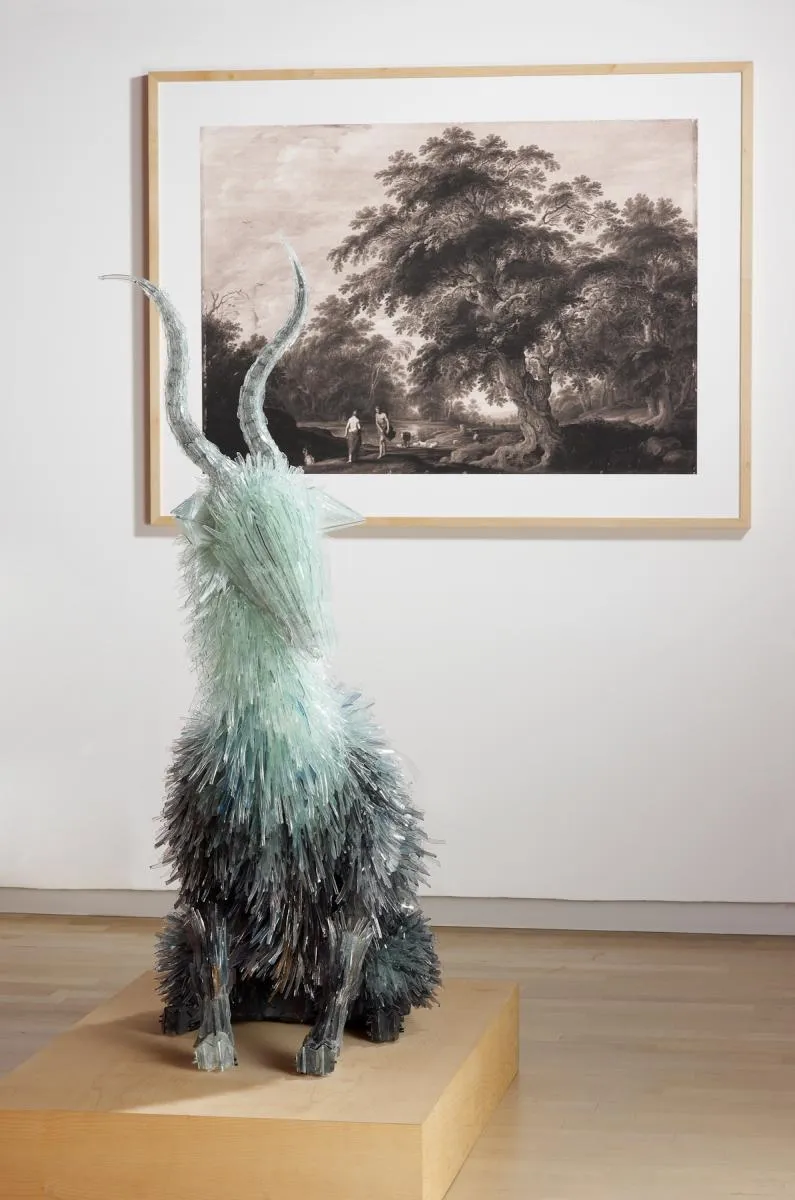
Edit: I wanted to add some more information about the sculpture artist, who really deserves more attention for her works of art. I've also included some additional pictures below of her other glass animal sculptures, including a one of a Fennec Fox which was sold at auction in 2013.
Born in Warsaw in 1964, Marta Klonowska has been working in her primary medium of glass since the mid-1990s. She chooses to focus on the animal, which is often relegated to a secondary role in traditional portrait art forms. Many of her works are inspired by animals that appeared in works by famous artists in previous centuries. According to Klonowska, "I create installations, which should lead the audience into a new universe. My animal figures are part of historical paintings, where they play a secondary role to the sitters. In my art the animals perform as the principal actor. Animals are difficult to understand and it is difficult to communicate with them. My glass animals open therefore a new reality, which is different from ours. The sitters in the painting, the animals and the audience of my art perform in a kind of theatrical stage, where the different levels become indistinct. This clash of realities should make us think about the uncertainties of life."
Credit: Live Auctioneers

Credit: Porta Polonica

Credit: Porta Polonica

Credit: Porta Polonica
Credit: Porta Polonica

Credit: Porta Polonica

Credit: Porta Polonica
