
Yggdrasil, the noblest of trees is a cosmic tree that connects the nine worlds in Norse Mythology. It is an ash tree that stands in the center of the cosmos. Its roots reach into three different worlds while its branches extend far into heavens.
Yggdrasil is holy to both men and gods. The gods assemble at Yggdrasil every day to attend to their daily business. Even the etymology of the name comes from Odin’s sacrifice. Ygg is one of Odin’s names and drasill means horse. “The horse of the hanged” was one of the expressions used to describe gallows; Odin sacrificed himself to himself by hanging himself on Yggdrasil.
nine long nights,
wounded with a spear, dedicated to Odin,
myself to myself,
on that tree of which no man knows
from where its roots run.
Stanza from Hávamál, a poem from the Poetic Edda
Yggdrasil is not only a tree that supports and connects the cosmos. It is also home to many creatures that live within it. The most notable of the creatures that live there are an unnamed eagle and a squirrel; the four stags Dáinn, Dvalinn, Duneyrr and Duraþrór; and the dragon Níðhöggr.

"The Ash Yggdrasil" by Wilhelm Wägner, 1886
The Nine Worlds
In the Old Norse sources, the nine worlds around Yggdrasil are mentioned several times. Although we know there are nine of them, the names and the locations of all of the worlds are never stated outright. There are few worlds that are mentioned by their names and the names of the others can be deduced from various sources. On the other hand, the locations of the worlds remain unclear.
The nine worlds of the Old Norse mythology are:
Asgard – The home of the Æsir
Álfheimr/Ljósálfheimr – The home of the Ljósálfar (the Light Elves)
Niðavellir/Svartálfaheimr – The home of the Dwarves
Midgard – Earth, home of humans
Jötunheimr – The home of the Frost Giants
Vanaheimr – The home of the Vanir
Nilfheim – World of the primordial frost
Muspelheim – World of primordial fire
Hel – The home of the dishonorable dead, ruled by the goddess Hel
One of the Yggdrasil’s roots extends into the spring Mímisbrunnr which is located in Jötunheimr, the world of the frost giants. Mímisbrunnr is the spring which contains wisdom and intelligence. The master of the spring is Mimir, who is full of knowledge and wisdom because he drinks from the well every day. Mímisbrunnr is also a resting place of Odin’s eye. Odin placed it there as a pledge to be allowed to drink a single sip of the water from Mímisbrunnr.

A depiction of the Odin drinking from the Mímisbrunnr while Mimir watches him by Adolf Lange, 1903
Another of the three primary roots of Yggdrasil extends through Hel and all the way to Hvergelmir. Hverglermir is the spring located in Nilfheim the realm of the primordial frost. It is the spring from which all the waters came. The frozen rivers which were necessary for the creation of the world come from Hverglemir.
The well is mentioned in another place in the Poetic Edda, the poem Grímnismál. The poem describes the stag Eikthyrnir. The stag stands on top of Valhalla and eats leaves of Yggdrasil. Liquid flows from its antlers all the way to Hverglemir and in turn feed one of the roots of Yggdrasil.

The stag Eikþyrnir and the goat Heiðrún on top of Valhalla, artwork from 17th-century Icelandic manuscript
The third root that supports Yggdrasil extends to the holy well of Urðarbrunnr. The well is associated with the trio of Norns (maidens) Urðr, Verðandi, and Skuld who laid the laws of the men and shape the lives of mankind. Urðarbrunnr is said to be located in the heavens among the Æsir; from that, we can deduce that it is located somewhere in Asgard, the fortress of the gods.
Not much is known of the connection of the other worlds with Yggdrasil, the sources only agree that Yggdrasil connects them all.
The Creatures of Yggdrasil
Níðhöggr is a dragon who lives in Hvergelmir with countless other serpents. He gnaws at the root of Yggdrasil from below. It is believed that those who committed the worst possible crimes are located in the bottom of the root that extends to Hvergelmir. Níðhöggr role is to chew their corpses together with the root.
On the other side of the world, on top of the Yggdrasill is an eagle with a hawk Veðrfölnir sitting between his eyes. Eagle has can see the realms below with his sharp eyes and has knowledge of many things. A squirrel Ratatösk runs up and down the tree and tells slanderous gossip provoking the eagle and Níðhöggr
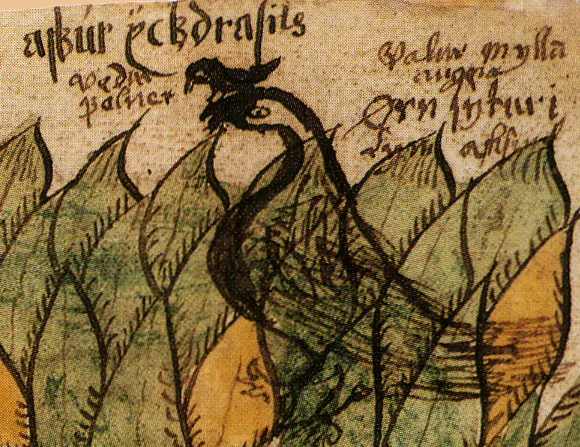
Veðrfölnir on top of the eagle on the top of Yggdrasill
Four stags stand on the highest boughs of Yggdrasil. They crane their necks upward and chomp at the branches eating Yggdrasil. The names of the stags are Dáinn, Dvalinn, Duneyrr, and Duraþrór. There are two interpretations of the meaning behind the stags. Early theories interpret them as the symbol for the four seasons. A later theory by Finnur Magnússon suggests that the stags represent winds and that their biting of the leaves represents winds tearing at clouds.
There are many other creatures living on and within the tree, but these are the only ones we know by the names. If you are interested in Norse Mythology, check out my earlier post about the creation of the world in Norse mythology.
Sources
- The Poetic Edda
- The Prose Edda - Snorri Sturluson
- Wikipedia