
It's not that myth means lies, but rather that it lacks the distinction between truth and lies. Word mythos means story in Greek (μῦθος).
I traffic in fiction, I do not traffic in lies, although I'll admit the distinction is a nice one...
~ Alan Moore
Then there's superstition, but I ain't got time for superstition tonight.
Older words tend to mean bigger things, and so stories are made by authors, and myths are ancient, hundred-times folded stories, stories made by authors over authors over authors.
Funny enough, mythos (μῦθος) and logos (λόγος) are quite happily married in the word mythology. Mythology prof. Campbell put it simply that the dream is the personalized myth, and myth the depersonalized dream; both myth and dream are symbolic in the same general way of the dynamics of the psyche.
If you dream that you die, you likely won't die, but if you dream demons, then they're likely present. Come to think of it, this story from The Hero with a Thousand Faces is quite applicable to Steemit. 3 min read (bye.. take care..)

If you know the story, read slower :)
The story is told, for example, of the great Minos, king of the island empire of Crete in the period of its commercial supremacy. [...]

[ continues to story of Theseus who slays the Minotaur, end of text ]
Enjoy some wall decoration from Knossos, where the story took place:


The story of Minos is well known. Turn your eyes towards the interpretation of what myth is though. Myth touches on what people do not want to touch, or cannot reach, the other side of ourselves, the one that is not, the repressed, the Shadow. Campbell was very influenced by two famous psychologists Freud and Jung. Freud was interested in the other part of a person's psyche (the repressed), and Jung of people's psyhce (the Shadow).
This is all highly subjective of course, and such is the reality. People are scared of cliffs because they can fall off is kind of backwards: first you see a jumping off place, then it is filled in as a cliff. Everything we see is only the desktop of the computer. The levels below, switches, electricity, that all acts in unison with what is perceived with concepts such as cliff. You don't actually pump your blood. (Aha, I see what you did there!)
There cannot exist an objective reason as why to divide the density of molecules at precisely that level to get a cliff, the source for a division must be subjective. Microbes and humans quite literally do not exist in the same dimension.
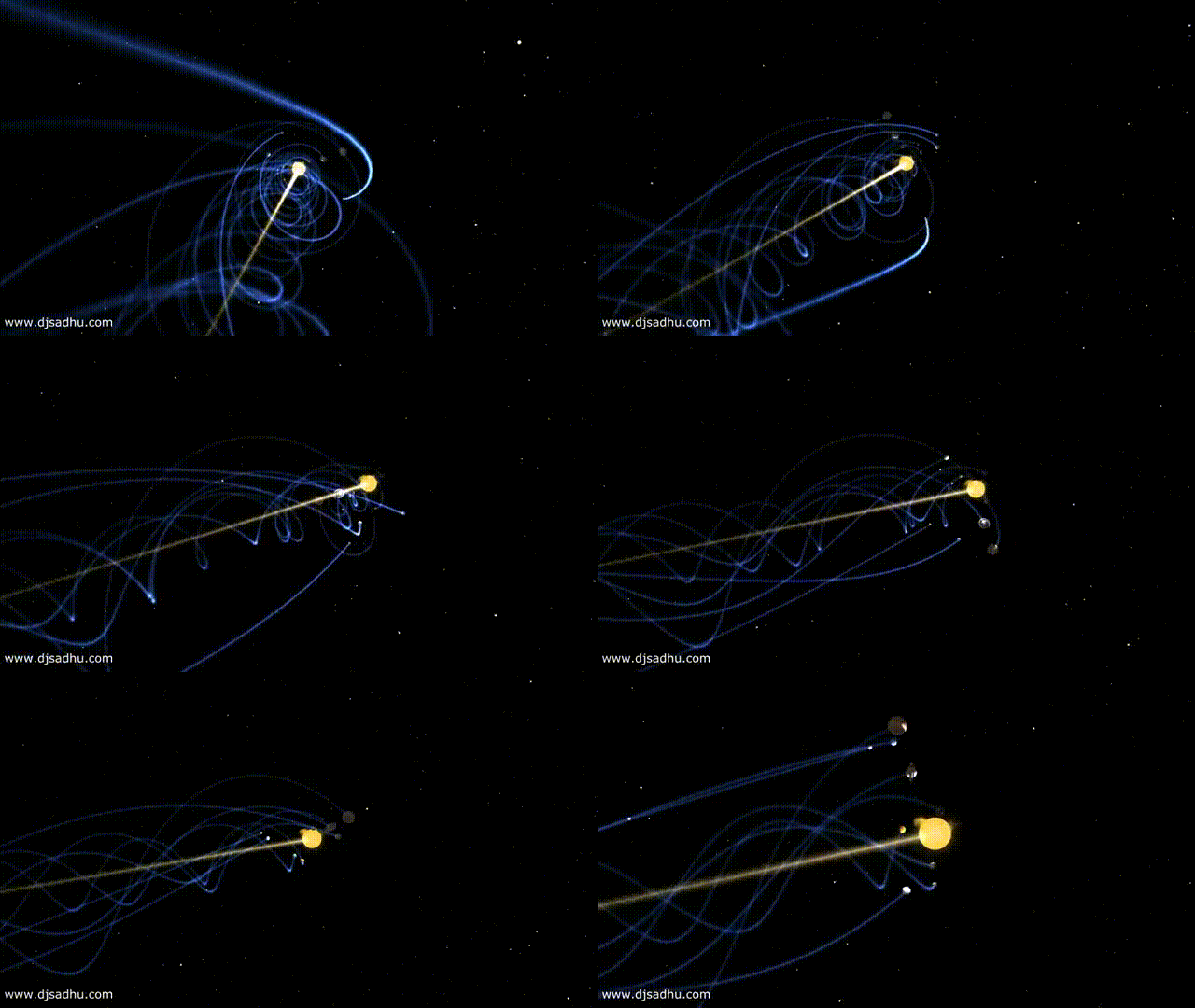
If myth can do that, you can call it true even if it never happened. Functionally speaking (in prezime sense), myth is a description of otherworldly. Descriptions sound kinda like this: Light is the conscience that pierces darkness. Light and darkness need each other for existance to happen, for if there is only but nothing, there isn't anything. The light reveals and chooses, makes, for in it objects exist and are given shape and color and time and every thing. This is the connection of symbols of the eye, light, spark, brilliance, yin-yang, day-night, angel-demons, etc. Often cited rule goes kind of like this: Any light pierces any deep darkness, and darkness encompasses the light. Light travels through darkness. Etc.
Naturally, there are quite many otherworldly places, and characters and whatnot, besides the topic of isness. If a myth, or a story can describe it so that it gives you a key, it becomes true on a different level of "did it ever actually happen" "did Minotaur ever exist." Finely crafted stories, intricate, with deep storytelling -- that's all a lie unless its craft, intricacy, or depth provides a key or a map or some value.
Here's an inflection for you.
Labyrinth is generally synonymous with maze. However, many scholars observe a distinction between the two. Due to the long history of representation of the mythological labyrinth, the specialized usage of the word maze refers to a complex of branching paths (maze is multicursal), while the word labyrinth came to mean a single path to the center (unicursal). This doesn't mean though that the labyrinth presents no navigational challenge, even though it has an unambiguous route connecting its beginning and end.
Try to solve this labyrinth while staying out of it, i.e. tracing the way only with your eyes. Pretty tough if you're jittery, eh? :D

Sources:
— Joseph Campbell, mythologist, 1904 - 1987
— Sigmund Freud, psychologist, 1856 - 1939
— Carl Gustav Jung, psychologist, 1875 - 1961
Image sources:
— Knossos palace, Greece, c. 1400 BC
— Labyrinth: Cathedral of Our Lady of Chartres, France, c. 1200 AD
— Minotaur eye-cup ceramic, c. 515 BC, btw they're called eye-cups because they look like this on the outside.

ramble
1 — to move aimlessly from place to place, to explore idly
2 — to move without a plan, in a long-winded wandering fashion
3 — to grow or extend irregularly