
Millions of bats flying in the late afternoon sky. Or at least that's what we thought we were seeing. It turns out this flock numbered just under 200,000, according to research (Niamien, C., et al. "Données préliminaires sur l’écologie des chauves-souris frugivores de la commune du Plateau (Abidjan, Côte d’Ivoire)." ) Sciences & Nature 7.1 (2010)) carried out in 2005-6.
And thanks to the research and subsequent papers prepared by Messrs Niamien et al, I've learned quite a bit about the rather appealing looking eidolon helvum, or straw-coloured fruit bat.

I was in Abidjan, the commercial capital of the West African country Côte d’Ivoire, for a few days in November 2015, participating in the inaugural "PIDA Week", or the first week dedicated to bringing together public and private sector players to tackle the meaty challenge of the Programme for Infrastructure Development in Africa (PIDA), hosted by the African Development Bank at their headquarters in the city.
After serious days of deliberation on how to crack Africa's lack of cross-border regional infrastructure, we would head outside to get to our various evening engagements - and inevitably the eyes would stray upwards in wonder at the spectacle of these bats. They fly fast and are extremely difficult to photograph - particularly with a little Samsung S5 like mine at the time, and especially when the photographer herself had so little skill...which is why the best photo I managed to get of the flock looks like this.

As you can imagine, while we were a group eminently capable of talking about solving Africa's infrastructure challenges, none of us was that clued up on the bats of Abidjan. We wondered if they were insect eaters, as we couldn't figure out how there could possibly be so much food in an urban environment to support what we thought were millions of animals. But if they were insect eaters, why were there so many blasted bugs? And clearly they weren't vampire bats, or people would be shooting them down from the sky. Like the bats, we engaged in a few flights of fancy ourselves.
So when guesswork fails, look it up.
Fast facts I've since gleaned about Abidjan's Commune du Plateau bat colony residents:
- they're fruit eaters ("frugivores", in French - a lovely word), mostly eating mangoes
- they roost in colonies in a couple of different kinds of trees, having a marked preference for a specific type of mango tree
- they're vulnerable to poaching by the locals - apparently people like to eat them
- a favourite hunting method is the simple slingshot
- in response, they cluster close to the Police headquarters, the National Assembly and certain high-security private houses where the likelihood of being poached is lower
- they were (probably) falsely accused in 2014 of being a vector for the Ebola virus to reach humans - mostly I suspect it's just gross if you're walking under a mango tree and one or more decides it's a good time to evacuate the bat bowels onto your head or shoulders - but that did make people bats--t crazy scared at the time, if you get my drift
- It makes sense for them to live close by their food source, as their flying is energy-intensive
- they have a rare bat cousin, the hammer-headed bat or delightfully Latin named Hypsignathus monstrosus (sounds a bit unfair, don't you think?), living with them in the Commune du Plateau.
Some closeup views by more expert photographers follow.
This view highlights their lustrous straw colouring.

Attribution:
By Konrad Bidziński (Own work) [CC BY-SA 4.0 (http://creativecommons.org/licenses/by-sa/4.0)], via Wikimedia Commons
Here you can clearly see their feet:

Attribution:
By Fritz Geller-Grimm (Own work) [CC BY-SA 2.5 (http://creativecommons.org/licenses/by-sa/2.5) or CC BY-SA 2.5 (http://creativecommons.org/licenses/by-sa/2.5)], via Wikimedia Commons
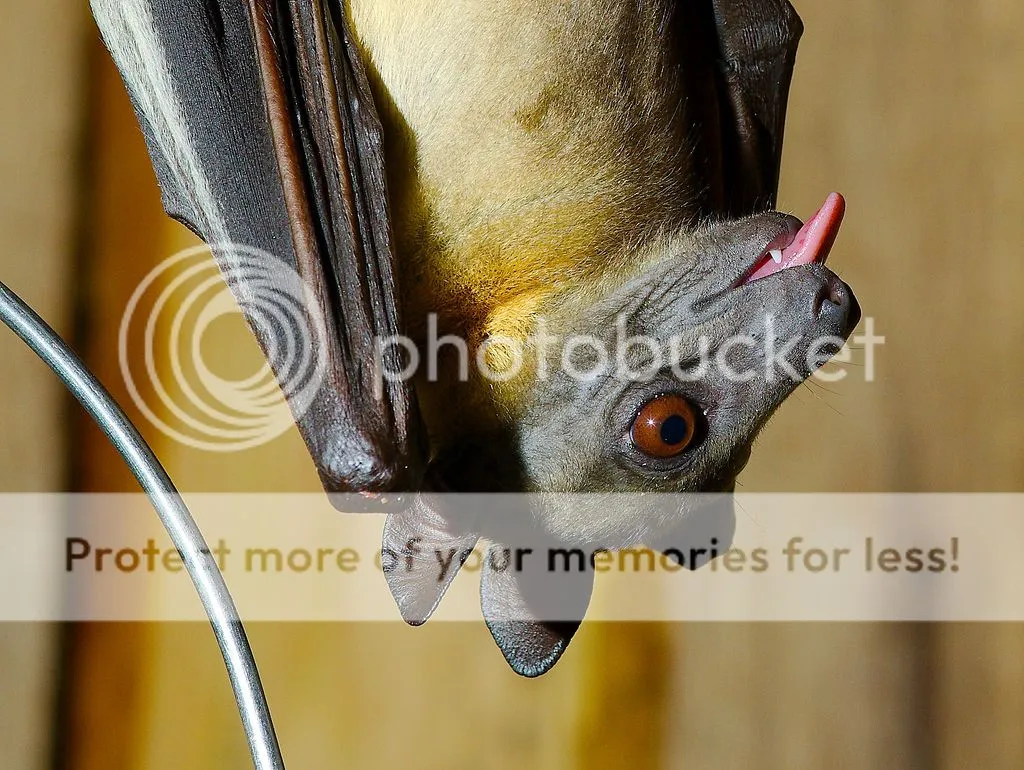
And here's a terrific close-up shot of an individual hanging in its roost:
Their range in Africa is impressive - I didn't realise they were native to South Africa as well:

Attribution:
IUCN Red List of Threatened Species, species assessors and the authors of the spatial data. [CC BY-SA 3.0 (http://creativecommons.org/licenses/by-sa/3.0)], via Wikimedia Commons
So I went to Abidjan to talk infrastructure and learned some unexpected bat facts. Serendipity!