
view over lake ladora

This post is part two of an eventful Sunday day trip i took with fellow steemian 
one of the man made beaches. the sand was lovely to scrunch toes in..

My first visit to Rocky Mountain Arsenal was soon after I first came to live in CO in 2014. The area so impressed me that I've visited several times since then, since it is fairly close by and free to the general public.
this wild grass is incredibly soft and fluffy

Parking is plentiful and free, and activities can range from fishing, hiking or playing in the sand, to simply driving thru the park on the miles of paved roads.
a homemade pool (or dunny) complete with colored sparklies.. made by invisible munchkins

The Rocky Mountain Arsenal is a 17 thousand acre urban wildlife refuge built upon the remains of an old chemical weapons and military arsenal.
view of the coming storm

The area used to be farmland until it was taken over by the government during WW2, and after the war was scooped up by Shell Oil to create agricultural chemicals.
driftwood on the shoreline where we found the crawdaddy shells

The toxic clean-up and rebuild, which began in the mid 1980s after nesting bald eagles were discovered, took over a decade to complete. This included groundwater treatment, dismantling abandoned buildings, closing polluted deep injection wells, and rebuilding the soil layer in order to contain contaminated debri.
looking across the prarie

In 1992, Congress passed an act designating RMA as a future refuge site for endangered and native wildlife. Past recovery has included creating and stocking several small lakes and ponds, and re-introducing certain species back into the habitat.
rocks along the shoreline and elevated path between the lakes

The present site holds a small visitors center, with tactile exhibits, auditorium, kids discovery center and an historical museum that holds something of interest for any visitor. The real gem, however, is outside in the drive around preserve, which holds abundant wildlife such as coyote, bison and deer, plus several species of avian, reptile and aquatic life - this in a natural habitat full of trees, plants and local weeds.
a funny part of a dead tree

I was disappointed to find out that the Lake Mary loop, a marshy aquatic and avian refuge and the smallest of the three lakes in RMA, was under construction and closed to the public. I wanted to include a previous photo of the lake for comparison to the one taken here, but I've run out of my daily upload allotment. bird poop.
looking over lake mary marshlands

We walked part way around the upper lake, Ladora, stopping several times to discover the Crawdaddy shells on a man made sandy beach line, the beauty of the Cottonwood trees and the termite bark, the tall grasses and thorny wildflowers hidden along the dirt paths.

crawdaddy pincers littered the beach with their bright blue shells
(

My companion was incredibly patient with my need to photograph and inspect the wondrous aspects of nature, despite the strong winds and lightning over the mountains and a beep beep warning us of an imminent severe thunder storm.
flowers, bugs and leaves


Below is a version of an old folk song, "Home on the Range", with the original lyrics written back in 1872. Things we learn on the way to understanding the future from the past. Or visa versa...

After we arrived back at the car, I took a little side trip to see if we could find the bison grazing in a field. They are usually hidden far back in the fields.
bison approaching the gate

Most people will know these creatures by the name of buffalo, an historic american icon, but also a misnomer. The American "Buffalo" are technically bison, and not to be confused with the African or Asian water buffalo.
the herd slowly crosses the road

And here is where the amazing part occurred. We stumbled across a huge herd (about 120?) of bison crossing the road at dusk, most likely a daily migration or activity, since several cars were parked along the road to witness the same thing.

Some of the herd scratched their backs along a fence post, then wondered over into the next field, while a good portion hung out along the roadway, as if posing for the silly tourists.


Not only did the herd stop to lick the dirt (something they do to obtain salt since their diet is lacking), but they did so with little fear, surrounding our cars for a good 45 minutes, accompanied by babies frolicking next to adults.


We learned how difficult it is to get a decent shot of a moving bison at dusk, sitting in a car.
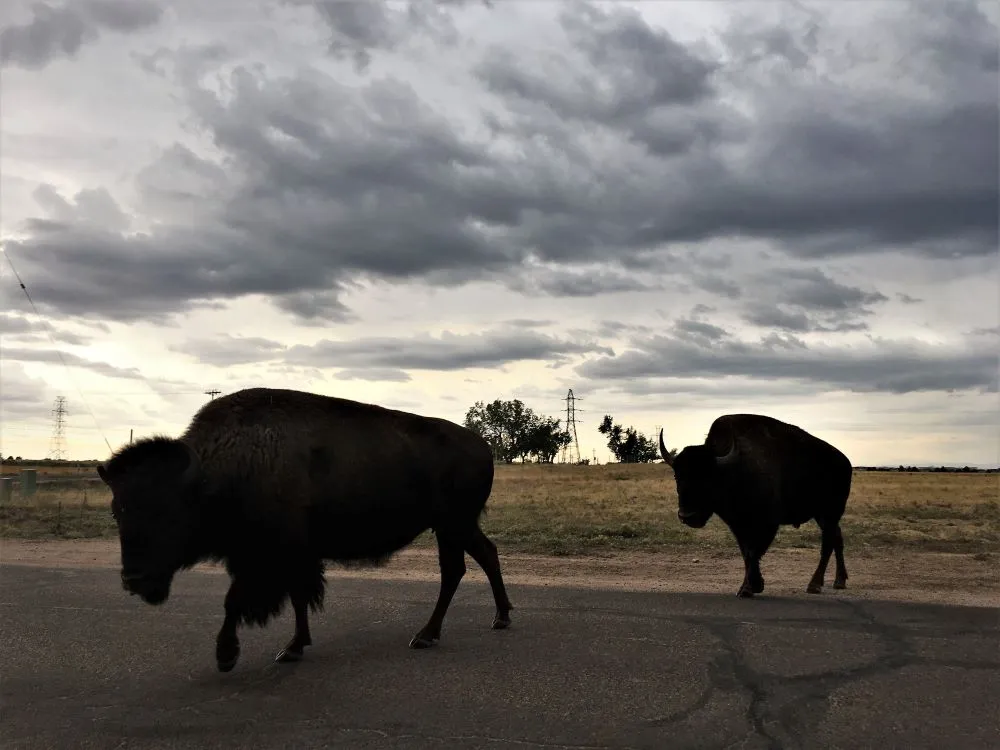
Signs warned us to stay in our car as the bison are unpredictable, and I didnt want to have to call State Farm if a 2000 pound beast took a liking to me or my vehicle.

I learned what a bison tongue looks like, how to tell the males from the females, and that even the youngest ones seem to have tiny horns. The youngsters werent at all shy, and I think if I had food, would have stuck their heads in my window.
adopted baby or mixed breed cow-bison calf


Eventually it grew quite dark and the promised rain started, so we drove home exalted with our good luck while driving home through a torrential downpour. Quite the adventure!
references:
the legend of the american buffalo
