
When one thinks of formal transport what comes to mind? Trains, busses, private taxi services (uber and bolt), etc. What about informal transport? See I used to think that informal transport was revered to non-motorized options such as bicycles or walking. The idea that motorized transport can be informal is confusing to some, for how can automobile transport be anything but formal? How can informal transport be anything other than donkey carts and bicycles?

Informal non-motorized transport in a small town (Warden) in South Africa. Just to be clear, this type of transport is hardly seen anymore.
Source: Unknown Author, Available at https://mapio.net/pic/p-4273661/
What is formal transport?
Formal transport refers to transport systems that are managed through policies and legislation. These systems provide more comfort, higher satisfaction levels, and a safer travel environment than informal transport. The use of formal public transport can assist in relieving issues such as high accident rates and congestion in urban areas. These systems can promote the sustainable development of urban areas. However, it has been noted that services such as busses are unable to serve all residential areas. Areas with narrow pathways or entryways are excluded from bus services, while poor railway infrastructure hinders the movement of trains.
The demand for transport has increased over the year due to the growing population. The inner cities have increased in density, while the outskirts of urban areas have also expanded. These areas emphasize the need for efficient public transport services. In many cases, the government is unable to meet the needs of residents. Consequently, informal small-scale operators emerge to fill the gaps in the market and service communities that are poorly serviced by formal public transport systems.

Bus system in Bangkok, Thailand. Bus services are seen as formal transport and many countries have started to improve their bus systems by introducing Bus Rapid Transit.
Source: Wongta, Kobchaisawat, and Chalidabhongse, 2016.
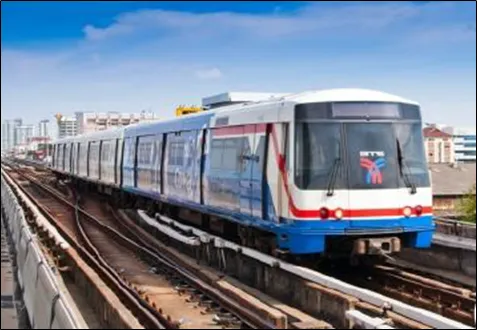
The BTS Sky Train in Bangkok. This is another example of formal transport. Train systems are expensive to build and maintain, but an excellent transport system that can transport large groups at once at a reasonable travel time.
Source: Permana and Petchsasithon, 2020
What is informal transport?
Informal operators around the world make use of three-wheelers, motorcycles, meter taxis, station wagons, etc. While it is hard to rationalize the use of these vehicles from a policy perspective, these modes still provide an important service. Informal transport caters to larger parts of urban areas and can navigate narrow routes and difficult terrain. These types of services operate with limited governmental involvement and no official enforcement. Operators usually do not have registration papers, driving licenses, or vehicle registration. Since standards for vehicles are not endorsed, operators make use of old, low-performing, and unsafe vehicles. According to the World Bank informal transport is supplied outside the traditional transport regulatory system.

Typical informal transport in India. Informal transport usually attracts tourists, since it's something "new" and "different". Informal transport can also be a lot cheaper if you plan on sightseeing.
Source: Priye and Manoj, 2020
The industry provides job opportunities to unskilled residents and is structured around many independent operators. Operators may join cooperatives that operate on specific. Informal operates usually have highly personalized relationships with their clients, and follow social norms and codes of appropriate behavior amongst cooperatives. However, associations may function as a cartel, setting high prices to compete with other operators.

The famous minibus taxis of South Africa! If you ask any South African they will tell you how frustrating taxis can be on the road. In fact, I'm one of the people complaining. However, I understand the need for them. Minibus taxis are used daily by nearly 70% of the South African population.
Source: https://techfinancials.co.za/2019/11/26/sa-taxi-wants-to-use-tech-to-revolutionize-minibus-taxi-industry/
While these pedicabs, three-wheelers, hired motorcycles, and unlicensed mini-bus taxis are unsanctioned and move outside the “laws of the road” they are still not viewed as illegal.
The main differences

While both formal and informal transport make use of automobiles to move residents around in an urban area, many different key characteristics are noted as seen above.
The importance of both
Most first-world countries implement formal public transport on large scales, however, third-world countries are unable to. This is where the importance of informal public transport comes into play. It allows people to move about in their urban areas and partake in economic activities, that in return help grow the urban area. It provides job opportunities to those uneducated and creates communities within the system. In urban areas where both formal and informal transport is present, informal transport complements formal transport, going the extra mile where formal transport routes end. Both formal and informal public transport has their role to play in the mobility of people and growing the economy.
Sources
Please note that I make use of various articles to form my posts. All articles used are listed below. Feel free to download and read them!
Cervero, R. and Golub, A., 2007. Informal transport: A global perspective. Transport policy, 14(6), pp.445-457.
Unknown Author, Available at https://mapio.net/pic/p-4273661/
https://techfinancials.co.za/2019/11/26/sa-taxi-wants-to-use-tech-to-revolutionize-minibus-taxi-industry/Kumar, A. and Barrett, F., 2008. Stuck in traffic: Urban transport in Africa. AICD Background paper, 1.
Kumar, A., Zimmerman, S. and Arroyo Arroyo, F., 2021. Myths and Realities of Informal Public Transport in Developing Countries.
Mbara, T., Dumba, S. and Mukwashi, T., 2014. Multi-stakeholder dialogue on formal and informal forms of public transport in Harare, Zimbabwe: Convergence or divergence perspective. Journal of Transport and Supply Chain Management, 8(1), pp.1-9.
Permana, A.S. and Petchsasithon, A., 2020. Assessing the Seamlessness of Bangkok Metropolitan Public Transport by using Modified Quantitative Gap Analysis. International Journal of Built Environment and Sustainability, 7(1), pp.81-97.
Priye, S. and Manoj, M., 2020. Passengers’ perceptions of safety in paratransit in the context of three-wheeled electric rickshaws in urban India. Safety Science, 124, pp.104591.
Wongta, P., Kobchaisawat, T. and Chalidabhongse, T.H., 2016, July. An automatic bus route number recognition. In 2016 13th International Joint Conference on Computer Science and Software Engineering, pp. 1-6.
World Bank, 2002. Cities on the move: A World Bank urban transport strategy review. The World Bank.
Yatskiv, I., Budilovich, E. and Gromule, V., 2017. Accessibility to Riga public transport services for transit passengers. Procedia Engineering, 187, pp.82-88.


