
Lockdowns and winter have been harsh, and so it's time for another overnight camp out. I'm going to take a full load-out without concern for weight savings. So, I stuffed a bunch of gear into a pack and figured it was conditioning my body to carry loads.
Yes, I am a creature of habit. So I'm taking you to the Kaniwhaniwha campground, which is about an hour's hike from the car park. There are a few other tracks nearby, including the scenic Nikau Walk. The Nikau is an indigenous palm tree common in the northern parts of NZ. Anyway, I'm not looking for too much of a challenge, so let's keep it easy. There will be intermittent light rain, and I'm wild camping with a new tent.

There are quite a few scenic spots along the way. To the right is a stream; to the left is a thin strip of trees and farmland.

It's worth a moment to pause and enjoy the scenery. Too often, I power past places like this to get to the campsite.

And, this is quite typical of the bush around here - supplejack vines, a dense scrub layer, ferns and a nikau palm in the foreground right.

The path is very easy. I have walked this track in darkness a couple of times - once on a moonless night with no headlamp when I relied on the crunch of the path underfoot. I had lights, but it's good to challenge oneself.

And, up a short rise, the breaking skyline signals the campsite is only a few footsteps away.

The first job is to erect the shelter - made a bit more difficult by the passing rains. The tent is a lightweight Chinese three-person tent with ample space for me and my gear. A trekking pole holds up the centre of the tent. My sleep system is an insulated Jerven bag, an Inertia X Lite sleeping pad under a cheap Chinese inflatable pad, a 70/30 wool-nylon blend piece of fabric for a blanket and a Helikon Tek Swagman roll for insulation. Unfortunately, the sleep setup was much too warm, and so I ended up using just the Jerven bag and ejecting the blanket and swagman.
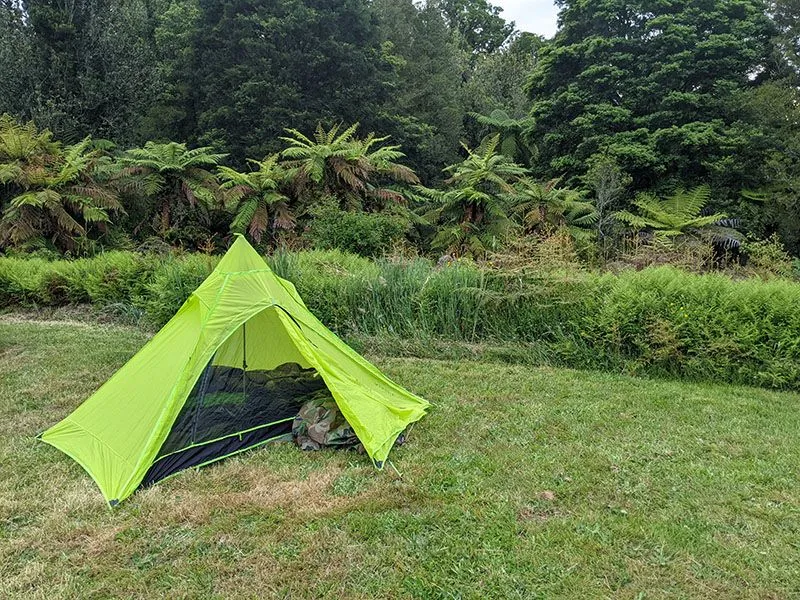
A quick word about the tent: the best feature is that it is lightweight for its size. I have a single person coffin-sized tent that is much heavier. The fabric is Syl-nylon ripstop, and that's about as lightweight as one gets without going to Dyneema/Cuben. Cons - single wall, so the condensation build-up was terrible. Also, the centre pole meant it was difficult for me to find a spot to lay where I wasn't touching a wall. In the end, I gave up and accepted that the Jerven would have to keep me dry-ish because I was touching the walls often. There is bug mesh, though, so I guess such a tent is most useful in dry summery conditions with many biting insects.
Now, it's time to sort out the water. You can probably drink the water in the stream most of the time, but I treat the water anyway. I have a steel bottle for storage, boiling and a night-time hot water bottle if needed. The Grayl Geopress is a convenient way to filter water but is not lightweight. I use a collection bag to get the water from the stream to save journeys. I used both water purification tablets and the filter primarily to get used to the taste of the tablets. Also, time to have a coffee smoothie... these things are probably just a bit too addictive.

And passing showers. When it rains, I wait in the tent until it passes. I have a poncho, but rain is a good excuse to nap and read.

Dinner time! I've begun to like these freeze-dried meals from Radix Nutrition, a local company. Boil some water in the mug, add it to the bag, stir, and wait. Delicious! Radix meals are more expensive but are much tastier than most dehydrated meals. Eight hundred calories is also a good size for me, though they have an extensive range of 600 calorie meals.

After dinner, I spent the evening chatting to a Te Araroa trail through hiker. He started the tramp with his father, but his dad got injured and will rejoin him later in the hike. I gave him almost all of my emergency chocolate and one square meal - which he ate. I've never met a Te Araroa hiker yet who refuses free food. They are burning massive calories and are often on a budget or go a little hungry between towns to save on weight.
Two young women turned up just before dark, but they kept to themselves apart from a friendly hello. That's the thing about the outdoors - we check in on people to make sure they're okay and don't need anything but otherwise respect their desire to stay by themselves. If they wanted to chat, they could come over or not.
The night was rather horrible. I was never cold but always damp due to the condensation in the tent. I woke up frequently and eventually got up for breakfast around 6 am. At least breakfast was effortless: cold water for both the coffee and the Radix Nutrition Berry breakfast. Both are pretty sweet, but I am about to burn off all those calories anyway.

And, here is my bag all packed up. The pack is a New Zealand Defense Force day pack that I bought second hand. The Jerven (mountain camo) is slung underneath the bag. The pack's camo pattern, NZ DPM, is a variant of the British DPM but is no longer used. I wrapped the wet tent in the groundsheet and put it just under the pack's lid because I didn't want a damp tent in the bag. The total weight was about 14 kgs which carried high because the military wore webbing, and this pack would rest comfortably on top of the pouches. I was not wearing webbing, so the carry is strange but easily manageable. The gear still on the table belongs to the through hiker. We said our farewells and left on our separate ways.

A brief stop to enjoy the scenery along the stream.

The track flattens and widens as we near the end. Only a few hundred metres to go!

Overall, I enjoyed this camp. I am on the lookout for a new tent, though! It's good that I can leave in the afternoon and return home by late morning because this increases the number of times I can go into the bush. I look forward to going again camping again soon.