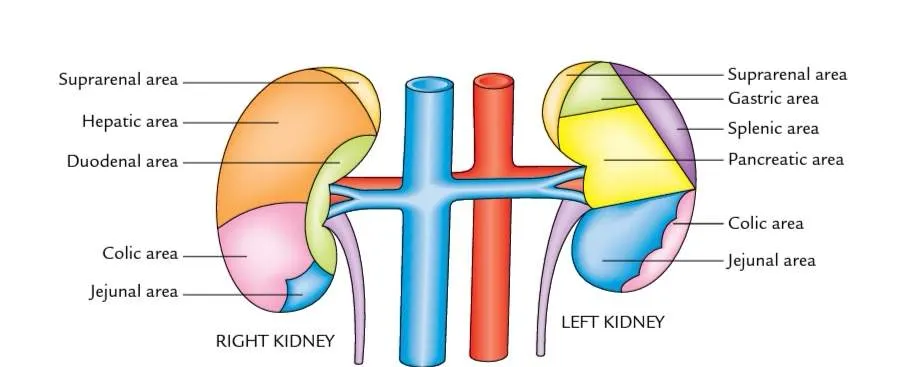
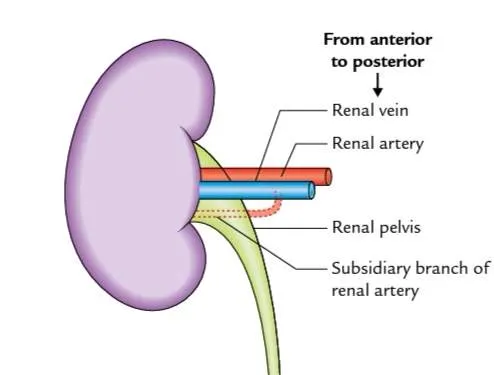
Synonyms: Ren: kidney (in Latin); Nephros: kidney (in Greek). The kidneys are two bean-shaped, reddish-brown organs within the abdomen situated on the posterior abdominal wall.
They are the major excretory organs and remove the waste products of protein metabolism and excess of water and salts from the blood and are thus essential for maintaining the electrolyte and water balance in the tissue fluids of the body, necessary for survival.
LOCATION The kidneys lie on the posterior abdominal wall, one on each side of the vertebral column, behind the peritoneum, opposite 12th thoracic and upper three lumbar (T12–L3) A TPP vertebrae. They occupy epigastric, hypochondriac, lumbar and umbilical regions.
- The right kidney lies at a slightly lower level than the left one due to the presence of liver on the right side.
The left kidney is little nearer to the median plane than the right.
Their long axes are slightly oblique (being directed downward and laterally) so that their upper ends or poles are nearer to each other than the lower poles. The upper poles are 2.5 cm away from the midline, the hilum are 5 cm away from the midline, and the lower poles are 7.5 cm away from the midline .
Both kidneys move downward in vertical direction for 2.5 cm during respiration.
Transpyloric plane passes through the upper part of the hilum of the right kidney and through the lower part of the hilum of the left kidney.