
A Global Sanitation Crisis
The lack of access to safe sanitation is a Global crisis directly affecting over 3 Billion people. It is a greater threat than War and malnutrition and a main cause of communicable and preventable diseases.
Indirectly it affects all of us through Environmental damage and contributing to social dysfunction and prolonged poverty.
EcoRegions and the development of the Demplot site
Please check the Website for information on Ecoregions development
As part of our redevelopment of Indonesian Eco Regions at Tanjung Ringgit, East Lombok and The Eight islands to the North West of West Sumbawa, we have established a permanent demonstration site where we test new appropriate technologies and methods for addressing Environmental and health problems in and around the development area.
This Toilet project follows the training of 30 people from 7 Hamlets in the techniques for Ferro cement water tank construction. The prototype is being built at the 2 Ha Demplot site in a damaged forest area at Tanjung Ringgit

Our two Eco Regions are located in East Lombok (339 Ha) and West Sumbawa (Eight islands), Nusa Tengara province, Indonesia
Toilet customs in Asia
In the West and in Asian, people have become accustomed to flushing away waste. In many Asian countries, the bidet or ladle of water is used to clean oneself after defecation. Toilet paper is only used for drying afterward and is discarded in the wastepaper basket.
After living in Asia for 6 years I find it confronting to use the western toilet paper system again, It's just not clean enough for comfort. I feel unclean like many Asians if all I have available is toilet paper.
Also one needs more water to flush away both toilet paper and waste, and a septic system that can digest it.
Two kinds of septic systems
The Asian septic is most often a rubble pit latrine. a closed top cylinder open at the base, waste flows in and digests with the leachate moving into the groundwater. While this method undoubtedly saves many lives and is preferable to open defecation it is a huge source of bacterial and nutrient pollution to nearby wells, rivers, and coastlines. A short term fix with long term problems.
They cost about $50 in materials and take up only a few square metres.
These systems fare poorly with toilet paper inputs and it significantly shortens their working life
Western off grid sealed septic systems work well and have over 100 years of service worldwide to prove their efficacy. They consist of usually a minimum 1800L anaerobic digestion tank where biosolids undergo anaerobic decomposition and the wastewater that exits is considerably better. The wastewater leads to a designed leach field where it also disperses to the groundwater, a better solution with a longer working life than a rubble pit latrine but still not suitable for heavy soils or nutrient sensitive locations.
They are much more expensive and require much more land area to install.
These systems do accept inputs of toilet paper but it is neither a benefit nor a hindrance
Dry toilets
Modern composting toilets are dry systems. Excreta falls down a chute and is followed by few scoops of carbon-rich organic material such as sawdust that soak up the liquids and balance the Carbon: Nitrogen ratio so that aerobic composting occurs. Toilet paper helps rather than inhibits the process. These systems work very well and generate a compost that recaptures essential nutrients and can be used safely in landscaping.
However, the don't accept wet flushing systems very well. Too much water leads to a stinking anaerobic mess.
It is incompatible with the flush toilet and incompatible with the use of the bidet for cleaning oneself.
Commercial units cost from a few hundred dollars to a few thousand dollars.
The Tiger Toilet
The Tiger Toilet is named for the use of Tiger worms (Eisenia foetida) in the filtration and digestion chamber to decompose biolsolids. It can accommodate a wet toilet system because it has good drainage so it retains the anaerobic function
Biosolids flush to a chamber where they fall onto a bed of organic materials that are bedding for the worms. The liquids drain vertically through charcoal then sand, and the effluent is low in suspended solids.
The worms decompose faeces and toilet paper and they and associated composting microbes consume faecal bacteria and other disease-causing microbes. The effluent can be used for subsurface irrigation in the landscape and provides essential nutrients for ecosystem health.

Islands like this are both sensitive to nutrient inputs via conventional toilets, and yet could benefit in the reforestation efforts by controlled placemnet of Wastewater gardens
Mass production using portable Ferro cement moulds
Current systems use readily available bricks, sand, and cement to create the systems. But these are heavy and difficult to transport,
We wanted to modify this using plywood Ferro cement moulds that can be carried anywhere, into remote villages with only motorbike access or onto desert islands.
Ferro cement technology also uses less sand and cement for a much stronger construction, and it can be repaired easily.
We have modified the system for building water tanks in this way from what our team learnt during their training course at the Bali Appropriate Technology Institute (BATI) under the guidance of Mr. Rus Alit.
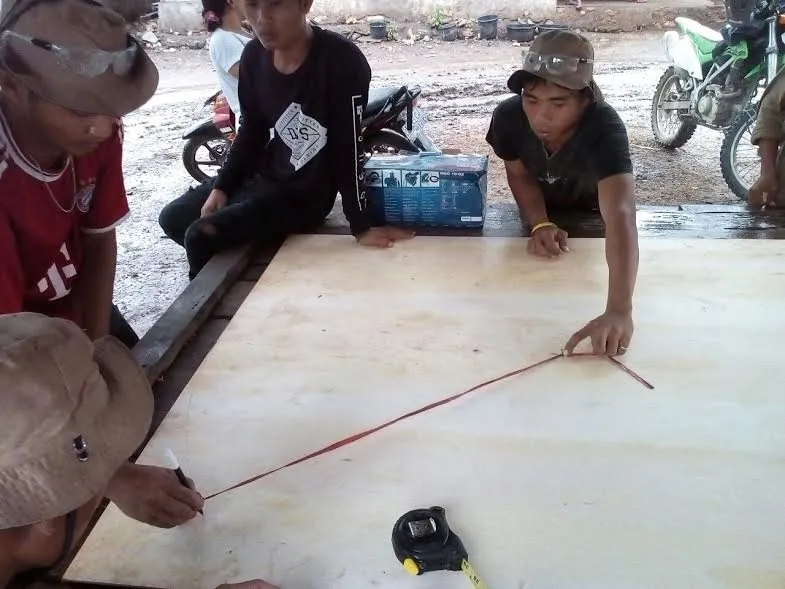
The forms are made of 6mm plywood
The Toilet housing is made using the 5000L water tank moulds and the roof is of Sugar palm fibre thatching

The moulds are made from local Wood used for boat repairs
The worm digester tanks are made using the same technique and are 1.2m in diameter and 1.2m tall.

3mm Plywood treated with oil as a releasing agent are used as the outer layer and if well treated can be used make 10-15 times, while the formwork is long lasting
Design
The prototype will serve at our sustainable agroforestry demonstration site to cater for staff and visitors and because the usage is higher than a household unit we are creating two worm digester chambers so that they can be switched to rest for several months in case they need emptying.

Credit: w.ndtvimg.com/domain/3/2017/05/16133304/tiger-worm-toilet-technology-trichy-tamil-nadu-scope.jpg
The worms in tiger toilets are so effective at digesting solids that preliminary tests show they only need emptying under household conditions every three to five years
Wastewater Gardens - WWG
All the systems discussed earlier do not specifically integrate into their design a way to get benefit from the wastewater from Toilets ( Blackwater) or Showers (Greywater)
Blackwater WWG
This is the water that comes out of the worm digesters and it is rich in nutrients. Some Nitrogen and Phosphorus are trapped in the chamber, either taken up in the worms and microbes bodies or absorbed by evolved humus and the charcoal layer.
The rest are in a liquid solution that flows out of the base of the digester and heads to the WWG.
This Wastewater Gardens' trenches are filled with a thick layer of absorbent organic matter and also inoculated with composting worms.
Surrounding these trenches are species of plant that have a high capacity for luxury nutrient uptake, this refers to the ability to absorb more nutrient than the plant needs to grow. These species can be harvested for mulch or animal fodder as only the roots come in contact with the already treated effluent.
In our tropical area, these plants include Bananas, Canna indica, Vetiver Grass, Elephant grass and clumping Bamboo. In cooler areas, Comfrey and Miscanthus grass are excellent choices.
Mulch harvested from WWG recycles nutrients and enriches gardens with organic matter. This reflective Vietiver mulch is protecting this pumpkin seedling from high surface temperatures.

Greywater WWG
Greywater is water from showers and handwashing. It is only slightly nutrient enriched and in its fresh state contains only moderate amounts of harmful bacteria. It cannot be stored more than 24 hours or else the bacteria bloom and it becomes Blackwater.
Therefore the Greywater exits the wash area and immediately falls into a mulched trench planted in the same manner as the Blackwater system. However, this water can be used for food crops that bear above ground level, including Papaya, Fruit Trees and Vines on a stable trellis above the trench
Please Follow us as we construct the new and improved Tiger Toilet.

please Comment, Upvote, Share or Resteem!