
On one of my walks the other day, I noticed some mining bees along the edges of the path, frantically digging:
Olympus Stylus 1s, 42mm, ISO100, f8, 1/200s
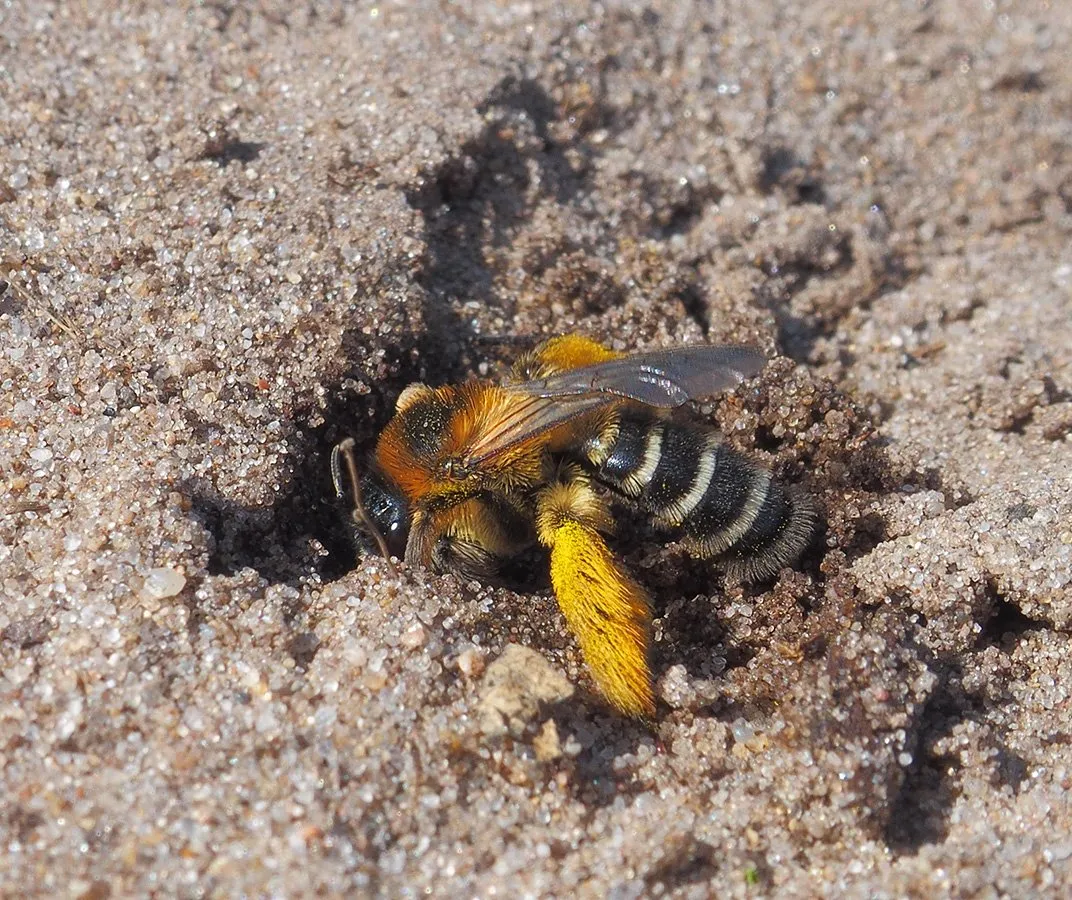
They were hairy-legged mining-bees (Dasypoda hirtipes), pluimvoetbijen in Dutch. These are solitary bees that have nests underground. They live in colonies but in separate families, as every female is fertile; there is no queen or labour specialisation like honey bees have.
Here is another species of mining bee I photographed earlier in the season, a gray-backed mining-bee (Andrena vaga), grijze zandbij in Dutch:
Olympus Stylus 1s, 42mm, ISO200, f5.6, 1/80s

Unfortunately for the mining bees, their sinister-looking archenemy was also hanging around, in large numbers:
Olympus Stylus 1s, 300mm, ISO160, f85.6, 1/500s

This is a parasitoid wasp of the Ichneumonidae family. The females of this wasp lay eggs on the bodies of larvae of solitary bees. On hatching, these larvae will devour grubs and supplies of pollen and nectar of their victims.
This specific species looks like a Gasteruption jaculator, but I'm not sure.
Here is an older photo of such a beast, a female, where you can see the ovipositor at the back, used for laying eggs:
Olympus XZ-1, 28mm, ISO320, f4, 1/80s

The bees may be cute, but they are not among friends here.
Thanks for watching!