
The Human Approach:
Street photography is a difficult discipline to define. To be successful requires one be patient yet audacious, to be continually aware of ones surroundings while searching for a candid moment to capture. As I stated in a previous post, the street photographer is most often a humanist at heart. Where most would perceive a crowded street full of people, a good photographer sees a hundred visual stories waiting to be told.
"Candid" is a word you'll see used over and over in the world of photography. Capturing a candid shot allows us to portray a singular moment while remaining unobserved. It's my belief that, as photographers, we should seek to depict things as they are in their natural, undisturbed state. Being self aware allows us to understand how our presence can affect our subject's behaviour, and maintain distance as a faithful, creative interpretor of events.

A Break in The Rain. Nikon D5200, Nikkor 50mm @ f/1.8, 50mm, 1/1250 sec, ISO 100
This brings to mind a famous instance, wherein a photographer named Kevin Carter was documenting famine in Sudan in the 1990s. He came across a starving child on the brink of death, a vulture waiting in the distance for the inevitable to occur. Carter chose to capture the image as he saw it; he did not come to the aid of the child and many determined that he indirectly contributed to the child's death. He won the Pulitzer Prize for his work, yet he never forgave himself, committing suicide several years later.
One of the key objectives of photography is to use creative imagery to portray a visual narrative. Telling a story through a single picture is incredibly challenging, though invoking questions in the viewer's mind is an effective method with which to achieve this. The photo of the girl with the umbrella for example, she's smiling, why? Something appears to have caught her eye, what is it? It isn't raining yet she's holding an umbrella, why?
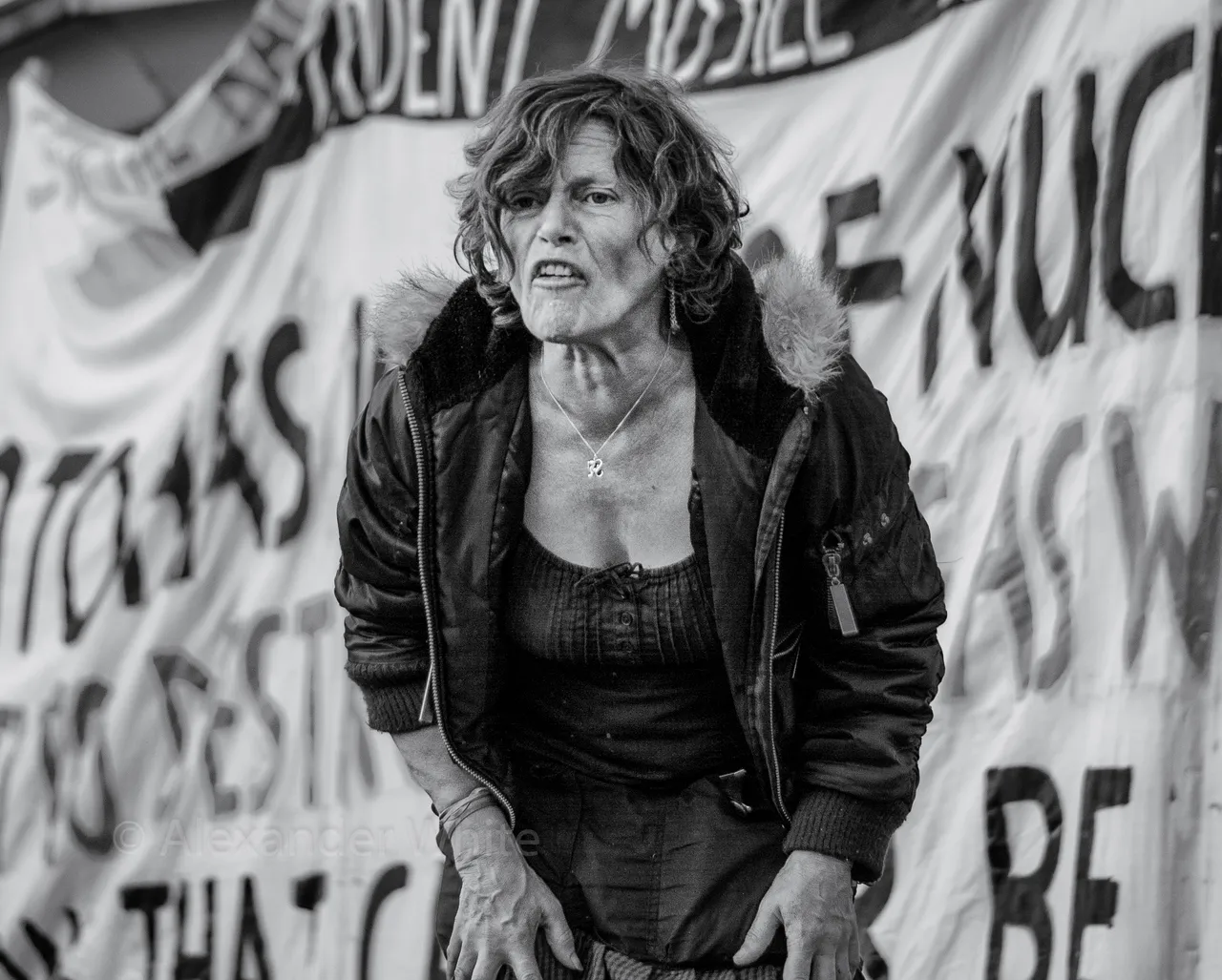
A Woman Scorned. Nikon D5200, Nikkor 50mm @ f/1.8, 50mm, 1/1000 sec, ISO 100
Images that are charged with emotion can be especially engaging. The woman in this image appears to be angry; this emotional conveyance creates a connection with the viewer. A part of us wants to know why she's angry, what is the story behind this image? Media outlets use this innate curiosity to good effect when choosing pictures with which to front their articles.

Candid Portraiture. Nikon D5200, Nikkor 70-300mm @ f/5.3, 220mm, 1/1000 sec, ISO 200
People can make a good centrepiece in street photography; I sometimes think of it as "candid portraiture with context". That is, photographing someone candidly in the context of a public space.
Substance & Form
Good focal lengths for street photography are generally 35mm or 50mm. These two focal lengths best approximate what the human eye sees, and as such they have that "looking through a window" feel. As though what is being portrayed could easily be perceived with your own eyes. 35mm & 50mm lenses are also usually relatively cheap, unobtrusive and lightweight. Perfect for someone on a budget who doesn't want the hassle of carrying around heavy equipment all of the time.

A Sign of the Times. Nikon D5200, Nikkor 50mm @ f/1.8, 50mm, 1/500 sec, ISO 250
You'll notice that all of the images in this article are rendered in black and white. This is not a pre-requisite of good street photography, indeed black and white is an easy medium to misuse. The reason I've chosen to do this is to further convey the point that good photography requires competent composition, clever use of contrasts and a subject of interest, even if it's an abstract. As I've mentioned in a previous post, by draining the colour from things, all we're left with is substance and form.
In this instance, I define the "substance" of an image as being merely what is portrayed, be it a building, a person, or an animal. The "form" is how it's conveyed; the subjects' placement within the image, and how they interact with the other elements in frame.

In Motion. Nikon D750, Sigma 24mm @ f/11, 24mm, 1/5 sec, ISO 50
The substance of this picture is simply a man riding a bike. When I took this shot however, I wanted to convey motion throughout the image. I therefore opted for a very slow shutter speed and used a panning technique often employed by wildlife photographers. This shot was taken handheld, and although there is significant blur in the image, by panning with the cyclist I was able to retain his presence within the frame.

On Call. Nikon D750, Sigma 24mm @ f/9, 24mm, 1/8 sec, ISO 50
The same technique was implemented in the image shown above. I'd recommend using higher shutter speeds while panning and photographing wildlife however; this will help ensure that the subject remains sharp. I believe that there is far more room for creative licence in street photography, such that a soft or blurry image more commonly represents a conscious stylistic choice made by the photographer.
Creative Foresight:
Henri Cartier-Bresson was among the best street photographers who ever lived. His genius was in being able to foresee human events moments before they would occur. He was seemingly able to anticipate his final image before the opportunity to capture it had even arisen. I don't think that this a skill that can be taught, though framing an image and then waiting for your subject to enter the frame is a good starting point.

Waiting at the lights. Nikon D750, Sigma 24mm @ f/8, 24mm, 1/30 sec, ISO 250
I took this photo in Berlin. I happened to be walking past a junction and I saw a cyclist riding towards me. I knew that if I took a photo looking towards the junction, and timed it just right, then she would enter the frame at the opportune moment and complete the image. If I hadn't seen this shot before it occurred, then I would never have been able to envisage the end result. Creative foresight can be key in street photography, and it can be very rewarding when the picture you anticipated comes to fruition.

Composure. Nikon D750, Nikkor 50mm @ f/2.2, 50mm, 1/2500 sec, ISO 64
This image may not appear to be candid as the subject is looking straight into the lens. I had however framed the shot prior to the man turning around. I was in fact waiting for the exact moment when he would face me. I feel that I had released the shutter before he realised that a photographer was standing there, and this was the final result. Perhaps it's not truly candid, but then there are very few unbreakable rules in world of street photography.
Thank you for taking the time to read my article. The subject of street photography really is a difficult one to cover, as it's very taste driven and subjective by nature. I will most likely be covering this again as there was so much that I wasn't able to say here. I hope you enjoyed it anyway : )
If you've found this article useful then please upvote & follow me for similar content in the future. Also please consider resteeming this blog if you believe it deserves to be shared with the wider community. Cheers everybody : )
All images present in this article are © Alexander White