As my primary language is not English, there are probably some mistakes in my translation.
Remember that the person who speaks here is NOT me, Vincent Celier ( Hive account@vcelier), but Marc Allaria (
 Hive account@marc-allaria), a French guy.
MAESHA'S LONG ROAD
CABO VERDE
-DROUGHT-
 Vania Desert - Boa Vista
Maesha has been on the island of Sal in the Cape Archipelago for many months.
Listening to its name, The Cabo Verde Islands, one would tend to imagine green, tropical islands, where dense forest and humidity covers the entire landscape. It is not so. Quite the contrary. We are here in one of the driest places on the planet. The name given to these islands does not come from their appearance but from their geographical position. The Cabo Verde Islands are islands located off a Cape of Senegal called "Le Cap Vert", The Green Cape.
 South Boa Vista Landscape
Here the rainfall is one of the lowest in the world. It varies slightly depending on the islands and the height of the relief. But overall, in Cabo Verde, it does not rain! For information, on the island of Sal where I am currently, I have only experienced about 2h30 of rain in 10 months of presence. This characteristic certainly comes from the geographical position of the archipelago, swept almost all year round by strong and dry trade winds and too high in attitude to take advantage of the monsoons which are nevertheless very near the Gambia.
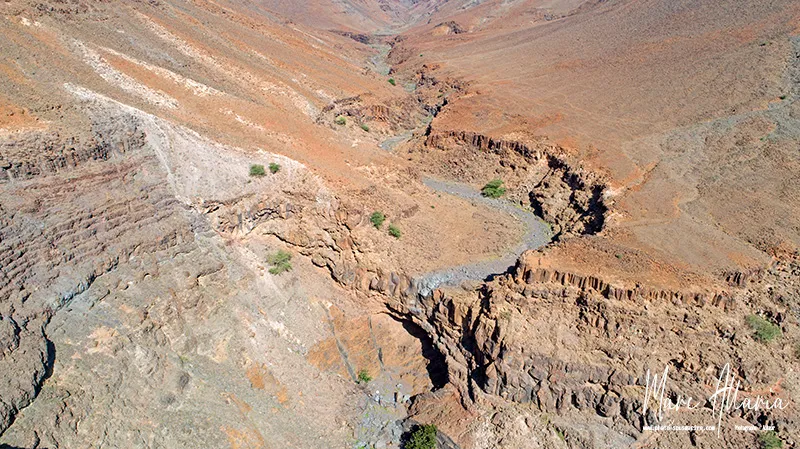 Canyons of São Nicolau
The first major episodes of drought were recorded as early as the XVIII
th century and subsequently intensified. The three biggest episodes of this period made more than 100,000 deaths due to famine following droughts. (Hey, famine as a major cause of death without major international health and economic maneuvers, does that make you make no parallel with the news ?!). Yet to observe the local geology, everything shows here that the water has flowed, and has flowed well. We can no longer count the imprints of waterfalls made in the rock, the evidence of water flow left by the alluvium, and the many canyons that are now dry yet formed by the sheer force of the water. Where did this water go?
 Landscape of the center of Sal island
Today, the drought is still increasing and the population is increasing like everywhere else. Policymakers are trying to provide solutions to provide water to agriculture on which a large part of the population is dependent, and also to tourism in order to fill hotel swimming pools and allow their customers to shower 3 times per day. Several desalination plants have been set up to address this problem. But these stations operate on hydrocarbons making the water very expensive. If this partially solves the economy of tourism, which can afford to pass the purchase price of water on the bill sent to its customers, this is not the case for agriculture, whose future seems very worrying.

Tourist trail on Sal island

Summits of Santa Luzia

