

In late spring 1940, almost half a million allied soldiers were backed into a corner by the might and aggression of the advancing German army. Abandoning tanks and supplies, they were driven to the coast at Dunkirk where the sea halted their retreat.
Under the orders of Adolf Hitler, the encircling Nazi's halted their advance. Hermann Goring's Luftwaffe received the baton, strafing and bombing the trapped allied forces from the air.
The resulting bombardment killed over a thousand civilians in Dunkirk and severely damaged the allied defenses built up around the port.
With the cities' water supply knocked out and fires raging all around, the Fuhrer took advantage of the ensuing chaos and gave the order for the halted tank divisions, surrounding the city to advance into Dunkirk, surely annihilating the remaining forces, including almost the entire British Expeditionary Force.
However, a sixteen hour delay from Hitler's attack order to the eventual mobilising of the mighty Panzer divisions gave the allies a window of hope for a miracle to develop.
Dunkirk Little Ships
Over the next nine days, hundreds of miracles began to appear on the horizon in the English Channel. A flotilla of around 850 small ships accompanied by a handful of British and French destroyers approached the beaches of Dunkirk as RAF Spitfires repelled the Luftwaffe in the skies above.
Crewed by brave civilian fishermen and other volunteers, the lifeboats, trawlers, tug-boats and pleasure craft proceeded to rescue 338,226 British, Canadian, Indian, French, Belgian, Dutch, Polish, Senegalese and Moroccan forces from the inevitable horrors that rumbled towards them.
A total of 243 of the allied ships in attendance were sunk. Those from the BEF killed during the evacuation have no marked grave and are remembered on the Dunkirk Memorial.
Winston Churchill, in his famous 'fight them on the beaches' parliamentary speech, reminded the British public that although the swift actions of the RAF and the selflessness of ordinary people was indeed something to celebrate, "we must be very careful not to assign to this deliverance the attributes of a victory. Wars are not won by evacuations."
The Bollam

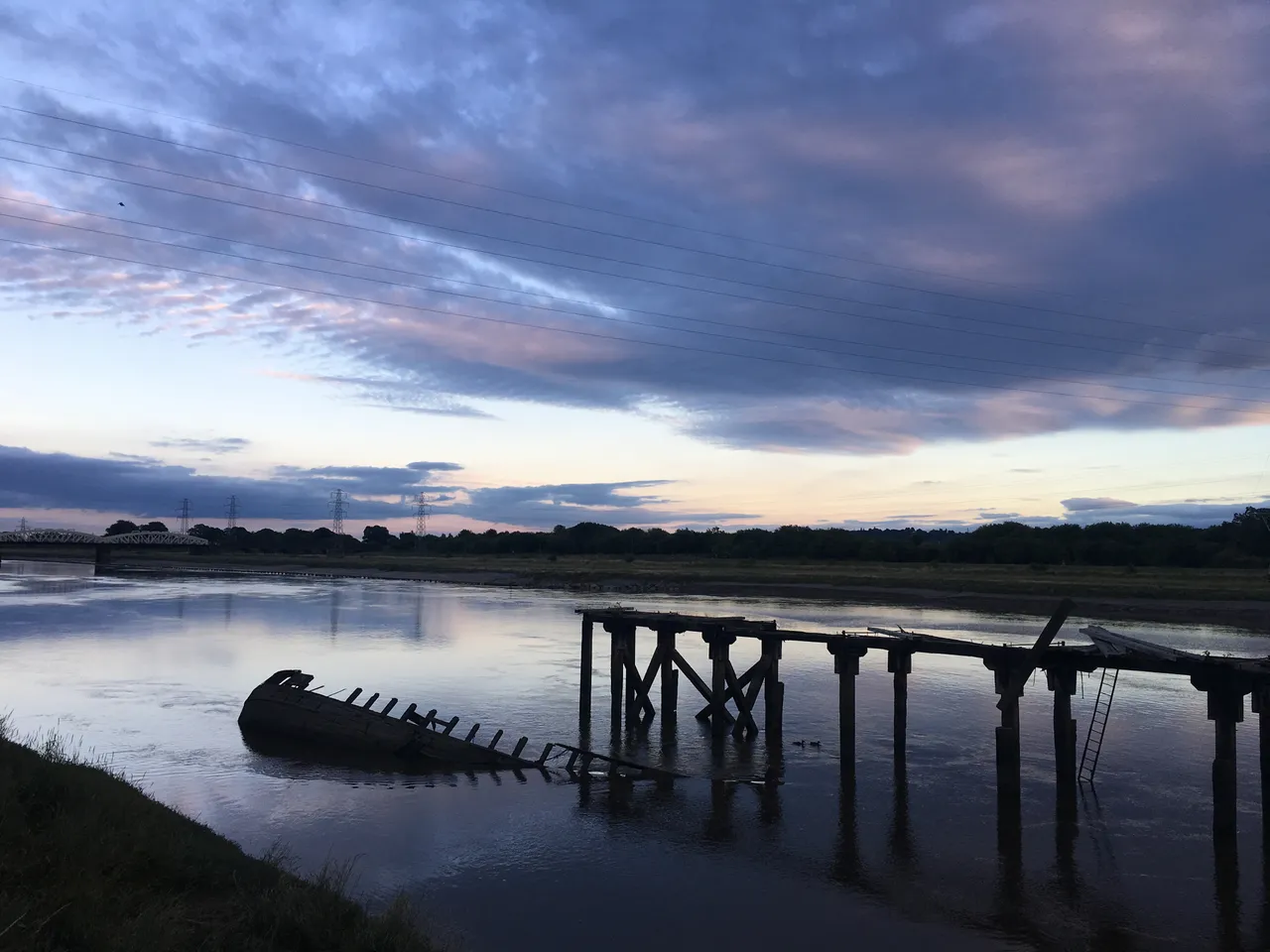
Almost eighty years later, on the silted up banks of the River Dee in North Wales, the rotting hulk of one of these 'miracle craft' can be seen.
The wreck sits on the side of the river that is rarely walked by anyone and most local people don't even know it exists. I have known about it since I was a child and often take a hike to photograph it, gambling on how much of it will be visible above the surface of the water.

At low tide, the old wooden ship can be viewed almost in its entirety. Throwing caution to soft mud and sinking sand, the wreck is also accessible (although not advised) where evidence of electric fittings can be seen.
The rudder is also still in-tact and can be seen from the sand bank.


I think it's a travesty that something that has played such an important part in our national and world history, similar to the river on which it lies, sits in such a state of neglect and decay.
In 1992 concerns were raised that some of these ships were falling into states of disrepair with some being destroyed when owners struggled to foot the bill of restoration. The Association of Dunkirk Little Ships was formed and through charitable donations and voluntary work, they began identifying, extracting and restoring as many of the surviving craft as possible, often removing them from their damaging locations and to dry land, away from the erosion properties of salt water.

The identified ships are then marked with a unique flag; a Saint George cross defaced with the Dunkirk coat of arms - known as the Dunkirk Jack.
The Bollam is not on any of the official lists of ships that took part in the evacuation and I have trawled (pun intended) the internet and local libraries for any hard evidence of it being present during that famous nine day period in 1940, all to no avail.
I promised myself that this year I am going to make further efforts to reveal the story behind the ghost ship known as The Bollam. I plan to inquire with the local fishermen who are aware of its presence with an end goal of seeing the remains removed from the silt and re-positioned on the dock walkway for all to see.
...And of course, with a Dunkirk Jack flapping above its deck.
Wish me luck and thanks for stopping by!