
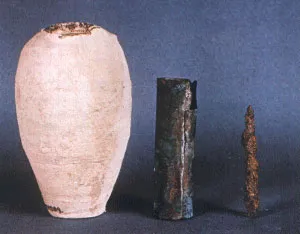
In an ancient tomb southeast of Baghdad, near Khujut Rabu, in 1936 the Baghdad Battery, also known as the Parthian Battery, was discovered. This voltaic device is an excellent illustration of how science questions the findings of operations ancient lost technology.

Estimated to be from around 2500 BCE the artifact was discovered by workers excavating for a modern train track in the region. In 1938, then director of the Baghdad Museum Research lab, German archaeologist Wilhelm Konig stumbled across the peculiar looking device in a box in the museum cellar.
Consisting of a 14cm high egg shaped clay vase with an asphalt bung with an iron rod enveloped by a copper cylinder, when the vessel is filled with acetum or any other electrolytic solution the battery emits between 1.5 and 2.0 volts of electricity. The original use of the battery was theorized to have been for electroplating gold onto silver objects. A later theory was proposed that the battery may have held medicinal applications considering bronze and metal spikes were unearthed adjacent to the Baghdad Battery. However this medicinal use has been called into question as the extremely low voltage of the battery would not have had any affect on anything other than causing very insignificant pain.
Cynics continue to dispute that there is no evidence that the Baghdad Battery ever operated as an electric battery, despite the number of frequent experiments with replicas that demonstrate its feasibility as such. In their eyes an asphalt seal, such as that on the battery, is not ideal for a Galvanic cell, would be ideal as an airtight seal for storage over an extended period of time. Given the lack of similar discoveries to date, the problem now remains whether or not the Baghdad Battery was an isolated invention. Catastrophically, during the war in Iraq in 2003, the Baghdad Battery, together was thousands of additional incalculable ancient artifacts, was plundered from the National Museum.

For those who are skeptical of the electrical battery interpretation, another supported hypothesis, is that the vessel acted as a repository for religious scrolls, conceivably comprising of rituals of some kind inscribed on natural textiles such as Cyperus papyrus or parchment.
Given the limited amount of evidence retrieved from the excavation site, whether or not the Baghdad Battery truly was a piece of lost ancient technology remains a mystery, despite our understandings of the usage and potential of this device. We would be foolish to ignore the intelligence of our ancestors given the fact that the items were discovered next to each other and when combined form a primitive battery. Especially considering other ancient technologies which we are confident of their function and purpose.

Posted from my blog @ Ancient Knowledge