
In the fall of 2012, after astronomers-lovers Vitaly Nevsky and Artem Novichonok first watched the comet ISON, astronomers expected that it would become a "Great comet"? a rare visitor, perhaps the brightest comet of the 21st century.

Alas, seriously shabby during the rapprochement with the Sun in November this year, ISON no longer promises such a brilliant future. With the naked eye from Earth, it will be impossible to see it? but you do not need to lose hope. Somewhere out there, in the dark depths of the cosmos, an unseen comet is surely rushing along, who will deserve everyone's attention and present us with an unforgettable sight. So it was always: Large comets appear about once in a decade, and in each century, one of them became particularly bright.
Comet ISON / ©Depositphotos

I will talk about such "comets of the century", beginning with the XVI century. It is interesting that they arrived, as a rule, in the second half of the century, and on average appeared every 97 years. Given this, it can be considered that if the comet Ikei-Seki (C / 1965 S1) visited Earth in 1965, the next such guest can be expected no earlier than 2029.
However, to predict here anything concrete is impossible: A large comet can appear quite unexpectedly, almost at any time. We can hear a message about it tomorrow.
XVI CENTURY: THE GREAT COMET OF 1577 (C / 1577 V1)
October 27 that year, the comet was at its closest rapprochement with the Sun - 26.9 million km from the star, although the first found mention of it is already on the first of November. A report on an incredibly bright celestial body was found in the reports of the Peruvian colonial administration sent to the European metropolis. The comet was also seen by the inhabitants of Europe itself: according to the surviving evidence, it shone even through the clouds.
On the 8th of November, records of Japanese annals are dated, which report a "star-broom", as bright as the moon, with a long tail. Seen it and the famous astronomer Tycho Brahe, who first noticed the comet on November 13? reflected in the water pond in his garden. The scientist compared its brightness with Venus, and in addition, on her example showed that the comets move beyond the terrestrial atmosphere. Only on January 26 of the following year this Big Comet became invisible.
Big comet 1577 over Prague on November 12 / ©Depositphotos

XVII CENTURY: THE BIG COMET OF 1680 (C / 1680 V1)
The appearance of the comet ISON caused such a commotion due to the fact that the first calculations of its orbit showed that it is surprisingly similar to the C / 1680 V1 orbit. There were speculations that ISON is the same Big Comet that returned, having made a circle in its orbit, or at least its preserved large fragment. Later observations and calculations have refuted these hypotheses? but the C / 1680 V1 is worth a separate story.
It was the first comet for humanity, first seen with the help of a telescope. Honor of the discovery belongs to the German astronomer Gottfried Kirch? then, on November 14, the comet was not yet visible with the naked eye. However, by the beginning of December, it had gained brightness, like the Pole Star, and along with the tail stretching for 15 degrees, it was impossible not to notice it.
One of the reports reports that the comet could be seen even during the day, and its tail stretched already at 70-90 degrees. It began to decline already in January 1681, the comet itself also began to fade away a little? and in February she disappeared.
Big comet of 1680 over Rotterdam / ©Depositphotos

XVIII CENTURY: THE GREAT COMET OF 1744 (C / 1743 X1)
For the first time seen on November 29 as a relatively dull object, the comet quickly approached the Sun and gained brightness. The first about her appearance was reported independently by the German astronomer Dirk Klichenberg and the Swiss physicist Jean Philippe de Chezo. It was observed by the young Charles Monsieur, whom the comet inspired in many ways to astronomy classes? Later he became a great scientist, who himself discovered many new comets, compiled the first ever catalog of star clusters and nebulae.
The comet, by the beginning of February, 1744, shone brighter than Sirius and threw out a long one? up to 15 degrees? curved tail. By February 18, it was already brighter than Venus and formed a second tail. The peak of its visibility came in the last days of the month: many reports indicate that it was visible even in the daytime. But the most remarkable sight appeared to astonished observers on the morning of March 6, when the bright C / 1743 X1 rose in the morning sky with a brilliant fan with six divergent tails.
The Great Comet of 1744 / ©Depositphotos

XIX CENTURY: THE GREAT SEPTEMBER COMET OF 1882 (C / 1882 R1)
The brightest comet of the century before last is, perhaps, the brightest in the last millennium. Today it is attributed to the numerous family of Kreutz comet sunflowers? perhaps, the debris of one huge comet, destroyed many centuries ago.
On September 1, 1882, several observers immediately noticed it, including the crew of an Italian vessel sailing in the southern hemisphere of the Earth. In a matter of days, it gained brightness, and two weeks later it could be seen in the afternoon. But it did not end there: the brightness continued to grow, and in mid-December, when C / 1882 R1 was passing at maximum closeness to the Sun, it sparkled, according to modern estimates, a thousand times brighter than the disk of the full Moon!
It was perfectly visible even in the immediate vicinity of the bright Sun. However, the comet did not experience a rapprochement with the star. According to observers, its core fell into 4-5 parts.
The Great September Comet of 1882 / ©Depositphotos
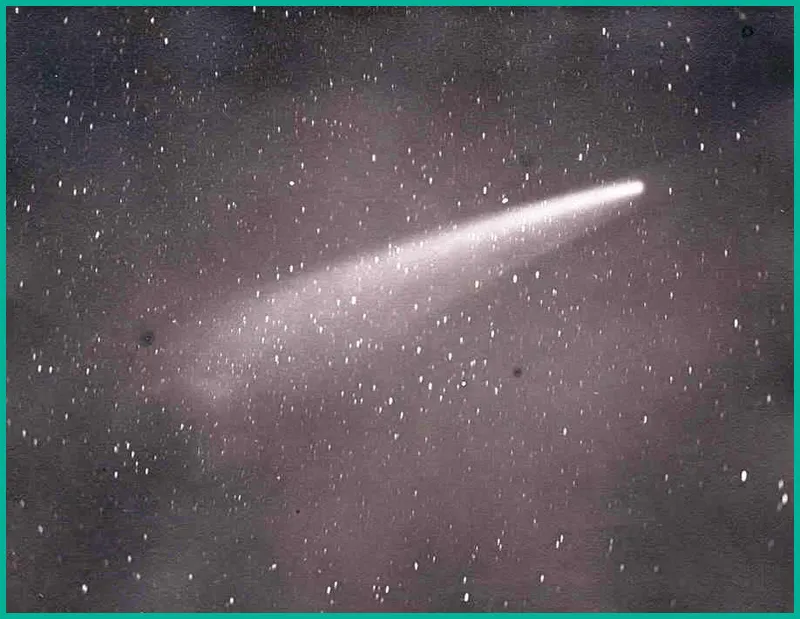
20TH CENTURY: COMET IKEI-SEKI 1965 (C / 1965 S1)
Another representative of the family of Kreutz comet sunset comets, C / 1965 S1, was discovered independently by two Japanese astronomers, after whom they received their name. It was possible to notice it, quickly crossing the firmament, quite late, a month before its closest approach to the Sun (when the comet was 1.2 million kilometers from the center of the star).
Comet Ikei-Seki 1965 / ©Depositphotos

At that moment, a comet could be seen even in the daytime, like a brilliant point near the edge of the solar disk? it was the brightest comet of the last century. Starting from the moment of detection, she gained brightness ten times higher than the full Moon, and astronomers watched as her core fell apart into 2? 3 fragments that began to fly away from the Sun. At that moment the tail began to grow in the comet, and while it itself dimmed, it unfolded in the sky, stretching for 120 million km.
XXI century: waiting.
