

In March 2019, a friend invited me to join a yoga class. I've never done yoga in my life before, and I had no plans of doing it. She told me that the class was a beginner's class and that she would pay for it. I took her offer, and I'm glad I did because I've been doing yoga ever since.
The yoga studio where I did my first class.

In my third class, the teacher told us to do a headstand against the wall. I've never done a headstand before and never dreamt of doing it. But with her guidance, I was able to go upside and lean against the wall while doing a headstand.
Since then, I've played around with the pose, not taking it seriously. There were times when I was out with friends on vacation; we'd do some headstands and fall on our backs or our faces.

 |  |
|---|
When the pandemic hit, I got more serious with my yoga practice. I did a 30-day program by watching online yoga videos on YouTube. I became more aware of the different poses and which ones I could and couldn't do. Handstand was the ultimate dream, but I saw a video saying learning to master the headstand was more accessible and would help me get used to being upside down.
 |  |
|---|

When yoga studios reopened, my friends and I decided to join a Hatha Yoga class. It was my first time doing Hatha. You can watch the video of that class through this 3Speak video. One of the things we had to do was do a headstand at the end of the class.

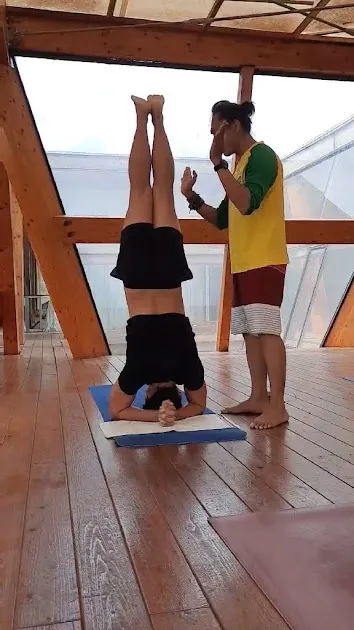
The yoga teacher assisted us in doing a headstand without a wall. I've never successfully done a headstand without a wall. It scares me to lift off without a wall nearby to keep me upright. But the teacher was good, and he gave out cues on how to do the proper form for the headstand. I could only hold it for a second or two, but I did it. You watch the video of it below.
After that class, I was motivated to learn how to do headstands independently. I knew I could improve my form through practice. The goal was to do a headstand without a spotter and a wall. Learning how to do the pose was a way to level up my practice and test my strength training for my shoulders. From my earlier yoga class, the teacher said that doing headstands require peace of mind and can give you clarity. She told us a headstand was a restorative pose, and I was a bit shocked to hear it.
 |  |
|---|
I turned to YouTube to help me learn how to do a headstand. I didn't have a lot of time and money to frequent yoga studios, and for a long time, YouTube videos have helped me with most of my yoga practice. One of the first videos I saw online about learning how to do a headstand was Tina Yong's Learning How To Do Yoga Headstand in 7 Days. I was amazed that she learned how to do a headstand in just seven days. If she could do it, so could I, right? Well, not really.

The two videos that I studied were Yoga With Adriene's Head Stand Yoga Pose - How to Do A Headstand and TappBrother's How to Headstand in 3 Simple Steps. The warm-up and the exercises in the two videos were the ones I did for several days. I was hoping that by day 7, I would be able to do a headstand. But no, seven days was not enough for me.


And so I practiced more. I continued with the warm-up and the exercise. I used to do my headstand training every morning. I also incorporated doing headstands in my yoga practice. I still could not hold a half headstand until about a month. I was so happy that I could lift off my legs and keep them above the air while bent. But I still could not straighten them, and I kept hitting the wall behind me.
It wouldn't take another month before I could straighten my legs, although I would still be hitting the wall to help me. By this time, I was only practicing my headstands at the gym. My practice wasn't as regular as before, but I was still determined to learn. I started moving away from the wall to remove my reliance on it. And then, after a few weeks, I was finally able to do it! Holding a headstand for a second or two without hitting the wall. It was so satisfying to learn how to control my body to do what I wanted it to do. Practicing headstands also helped me work out my shoulders, back, and core.
The final test was doing a headstand without a nearby wall. It wasn't just about the proper form but also about removing the fear of falling without a wall. Finally, about five months, I was able to do a headstand! No spotter, no teacher, no wall. You can watch my progress in the 3Speak video of this post.
I won't be breaking down the pose in detail (you can watch the YouTube videos and listen carefully to what they say), but in the pictures below, the significant steps in the sequence that I follow.
(1) Coming on all fours. Wrists below the shoulders. Knees below the hips.
(2) Pushing the ground away. Rounding the back.
(3) Dropping the elbows below the shoulders.
(4) Adjusting the width by reaching the hands to the elbows.
(5) Clasping the hands together and moving the pinky finger inside.
(6) Resting the head against the hands.
(7) Straightening the legs. Not collapsing on the shoulders.
(8) Moving the feet closer to the head.
(9) Lifting one knee and bending the other.
(10) Lifting the other knee. Pushing with the shoulders and the forearms. Keeping the core engaged.
(11) Slowly straightening the legs and not putting pressure on the head.
(12) Keeping the thighs and the feet together. Breathe.
(13) Bending one knee towards the ground when going down.
(14) Followed by the other knee
(15) Slowly lifting the head up.
 |  |  |
|---|
 |  |  |
|---|
 |  |  |
|---|
 |  |  |
|---|
 |  |  |
|---|
My form still needs to be improved. I tend to lean on the left side when I'm upside down. I will also need to hold the pose for a longer time to get the most of its benefits. And there are days when it's challenging to get into the pose, even though I know I've done it before.
And that's it! This was such a challenging post. I've been keeping it in my draft for more than a week. Things at work are picking up, and I've been trying to squeeze as much time into writing my blogs. I will start a new travel series in my next post. Watch out for that. See you in the next one. Cheers!

▶️ 3Speak