

¡Hola, espero la estés pasando muy bien!
Hi, I hope you are having a great time!
Si bien aprendí crochet a los 9 años (creo), en ese momento no le vi una verdadera utilidad a demás de tejer ropitas para mis muñecos y mascotas. Y cuando leí este concurso, esos recuerdos volvieron a mi mente sin darle importancia.
Luego de varias semanas pensando ¿qué tejer para la cocina?, recordé que algunas veces requiero de unas manoplas o agarraderas de ollas...por lo general uso un trapo para esta labor y evitar quemarme con el vapor caliente.
Although I learned to crochet when I was 9 years old (I think), at that time I didn't see any real use for it other than knitting clothes for my dolls and pets. And when I read this contest, those memories came back to my mind without giving it any importance.
After several weeks of thinking about what to knit for the kitchen, I remembered that sometimes I need some mittens or pot holders... I usually use a cloth for this task to avoid burning myself with the hot steam.
Manos a la obra/ Let's get to work
Elección del material / choice of material

As these are mittens for the kitchen, they must be made of a heat-resistant material, so I used "recycled cotton" yarn. This type of yarn is thicker and more rustic than the 100% cotton ones, which is ideal for this project. I worked it using a 2.5mm crochet hook.
Propotipo del proyecto / Project prototype
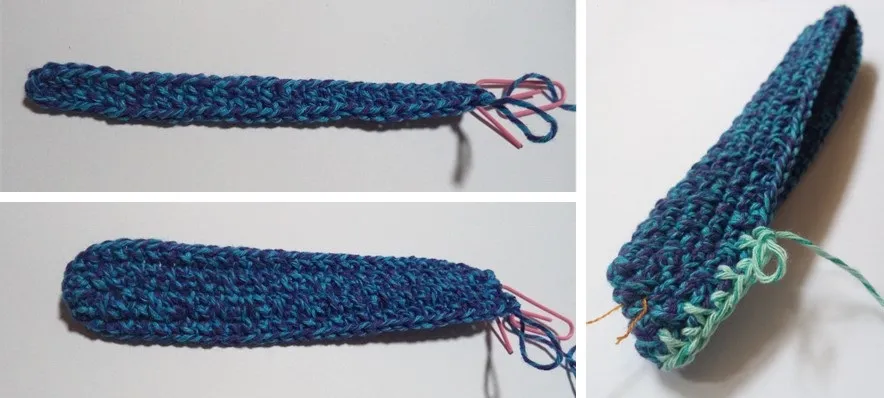
After knitting chain stitches, increases and single crochets, I took the opportunity to practice a stitch I once used when I knitted a miniature basket. It was actually somewhere between the Apache stitch and this stitch. I chose this type of stitch because of the roughness (friction) of the mitten, to hold the pot and/or teapot well.

Then it occurred to me to form figures, for this I played with the sequences at the moment of interchanging the colours. In the end it was very small in terms of height.
Proyecto / Project

Con este conocimiento adquirido, volví a formar figuras azules y rosadas (supuestamente son las arañas de las líneas de Nazca, jaja) y me di cuenta que para que se noten, el tejido debe ser más grande.
Here I corrected mistakes like: the number of chain stitches at the beginning, the sequence to maintain the curved shape of the mitten and the moments where I change stitches.
With this acquired knowledge, I went back to forming blue and pink figures (supposed to be the spiders of the Nazca lines, haha) and realised that for them to be noticeable, the fabric must be bigger.

I used the other mitten to form two-coloured coconuts or diamonds.

Con eso en mente, por curiosidad le pregunté a papá si el abuelo sabía tejer y me dijo que sí...cosa que me parece extraña para la época y por el hecho de ser hombre.
While I was weaving it came to my mind who weave with looms or by hand, be it blankets, rugs, ponchos, jumpers, etc. They must have the figures in mind and know exactly at which stitch to change the colour and achieve the desired landscape. They must have the figures in mind and know exactly in which stitch to change the colour and achieve the landscape they want.
With that in mind, out of curiosity I asked dad if grandpa knew how to weave and he said yes...which seems strange to me for the time and the fact that he was a man.
¡Y eso es todo!
¡…Hasta la próxima!
See you next time!
