
On one of the seven hills of Istanbul, there is a point of peace overlooking the city from the highest, trampling the blue of the Bosphorus: Süleymaniye Mosque. Yesterday, on the 27th day of Ramadan, I had the chance to spend time in the shadow of this magnificent structure. I was going to have iftar with my friends on the university campus in the evening, and this historical place, which was very close to the campus, was the most beautiful stop to wait for iftar time. I left the house around 4 o'clock and found myself in this spiritual atmosphere.

Although there is a strong cold brought by spring outside, the moment you step into the mosque, a completely different world welcomes you. For about two hours, under that enormous dome, I listened to that great story that Mimar Sinan whispered to the stones. Although I had to spend most of my time inside because of the cold outside, I had the opportunity to take a closer look at the architectural subtleties of the building.


Mimar Sinan: Chief Architect of an Empire
In order to understand this magnificent work, it is first necessary to get to know its creator, Koca Sinan. Born in the village of Ağırnas in Kayseri in the 1490s, Sinan came to Istanbul as a devşirme and grew up in the Janissary quarry. In the expeditions he participated in as a military engineer; He built ships on Lake Van, built bridges over rivers and saw architectural techniques in different geographies of the world.


Sinan, who became the "Chief Architect" at the age of 50, remained in this position for about 50 years and left his mark on the brightest period of the Ottoman Empire. For this genius, who left a total of 375 works, architecture is not just putting stone on stone, but a perfect harmony of mathematics, physics and aesthetics. Although he says "my work" for Süleymaniye Mosque, this building is actually one of the highest peaks in the history of world architecture.


Silent Secrets of Süleymaniye
Süleymaniye Mosque is not just a place of worship; it is a huge complex with madrasas, a library, a hospital and a soutehouse. While building this building, Mimar Sinan calculated every detail with the meticulousness of an engineer.


For example, the acoustic system inside the mosque is a miracle in itself. Sinan placed 65 hollow cubes around the main dome, their mouths facing inward, so that the sound could spread evenly to every corner of the mosque. In this way, even a person in the far corner can hear the imam's voice crystal clear.


Another admiring detail is the Is Room. At that time when there was no electricity, the mosque was illuminated with hundreds of lamps. Sinan established a special air flow system inside the mosque so that the work coming out of these lamps would not pollute the walls inside and disturb the community. Thanks to this current, all the work was collected in a small room above the entrance door and the best quality inks of the period were produced from these collected works. Edicts and manuscript works written with these inks have reached the present day intact for centuries.


A Magnificent Symbolism
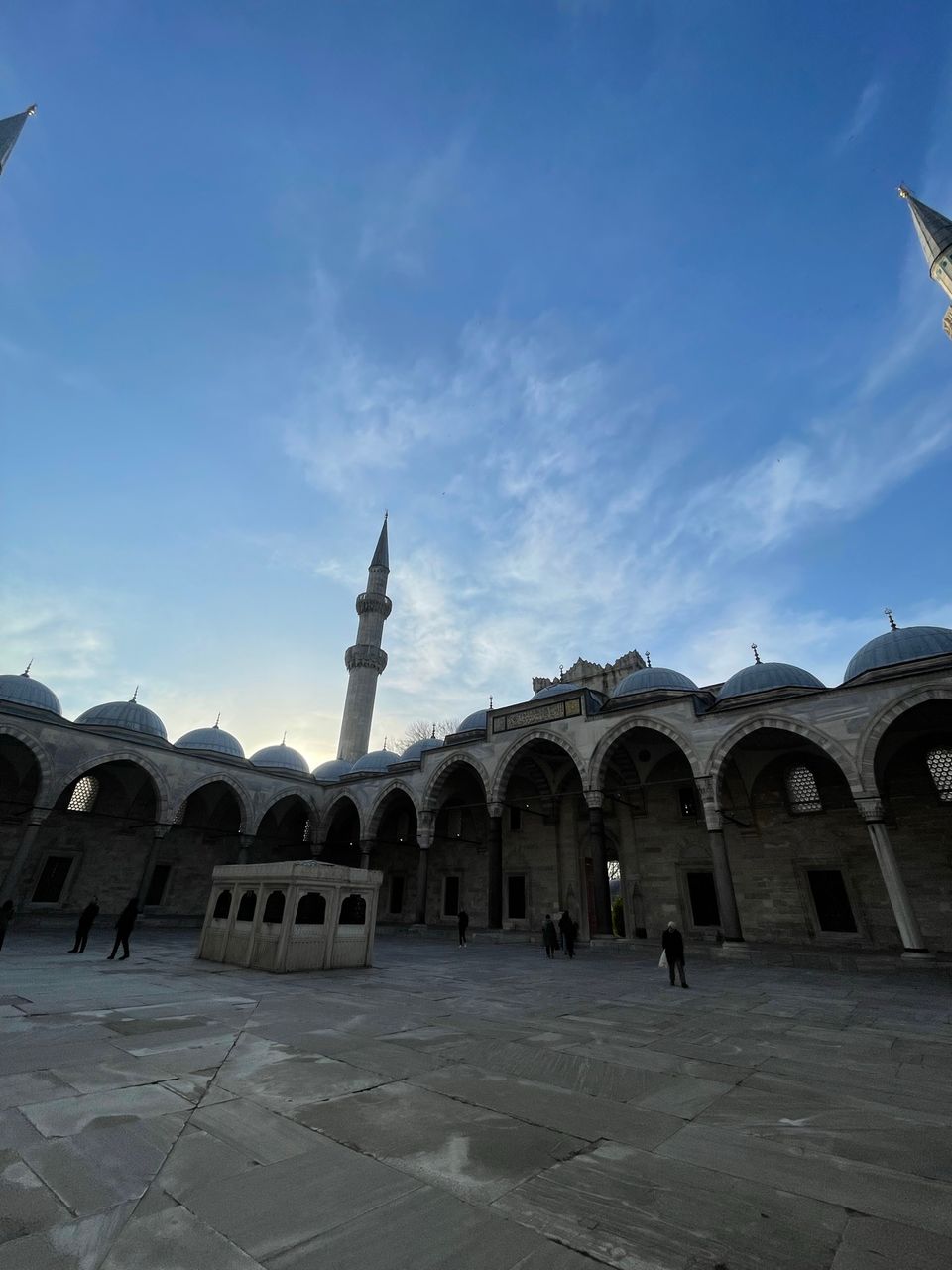
The four minarets of the mosque symbolize that Sultan Suleiman the Magnificent was the fourth sultan after the conquest of Istanbul. A total of ten honors in the minarets indicate that he was the tenth sultan of the Ottoman Empire. Every corner of the mosque, every window and every column is actually a mathematical symbol.


After performing the afternoon prayer under this magnificent dome, even that brief moment when I looked at the Bosphorus from the courtyard despite the cold outside was enough. That view overlooking the city from the top, away from all the chaos of Istanbul; It proved once again why Mimar Sinan chose this hill.


After this visit, which will be one of the best memories of my university years, going to campus and meeting my friends at the iftar table made me forget all the fatigue of the day. Süleymaniye is not just a building; it is a legacy that tells us the genius of the past, the peace of today and the hope of the future.