
One of the most famous wrecks in the Red Sea if not the world is the SS Thistlegorm

Launched in 1940 and built by Joseph Thompson & Sons in Sunderland. The 128m long cargo ship was powered by 2 coal-fired boilers driving a 1850hp triple-expansion steam engine. with a crew of 41, she could cruise at around 10 knots and was very typical of war years midships accommodation cargo ships.
After her launch, she had carried out a few voyages before her ill-fated trip to the Red Sea. Mostly across the U boat alley of the Atlantic to the US, West Indies, and Argentina for steel, rum, and grain.
The Thistlegorms last voyage left Glasgow in June 1941 destined for Alexandrea in Egypt with munitions and supplies for the British army. This cargo for which she is now famous for included trucks, Bren carriers, motorcycles, guns, cases of ammunition, artillery shells, and two steam locomotives with associated coal and water tenders as deck cargo for Egyptian National Railways.

At the time the because of the risks traveling through the Mediterranean the route would take her down the west coast of Africa to Cape Town to refuel and up the east coast into the Red Sea then through the Suez Canal to Alexandria. Arriving off Ras Mohammed at the southern tip of Sinai in September 1941 the ship was unable to proceed due to a collision blocking the canal, so the ship had to anchor at Safe Anchorage F where she remained until the early hours on the 6th of October.
That faithful night 2 Heinkel He 111 aircraft of II Staffeln based in Crete spotted the ships at anchorage and one dropped 2 bombs that struck hold 4 where the ammunition and explosives were stored. The resulting explosion tore the ship apart trowing the locos off the deck and quickly sinking the ship. 4 of the crew and 5 Royal Navy gunners died and the remaining survivors were picked up by HMS Carlisle.
The ship settled upright in about 30m of water with most of her cargo still intact apart from the debris of hold 4 separating the front and stern. The locos were thrown well clear and the debris field from the explosion extends many 100s of meters from the wreck.

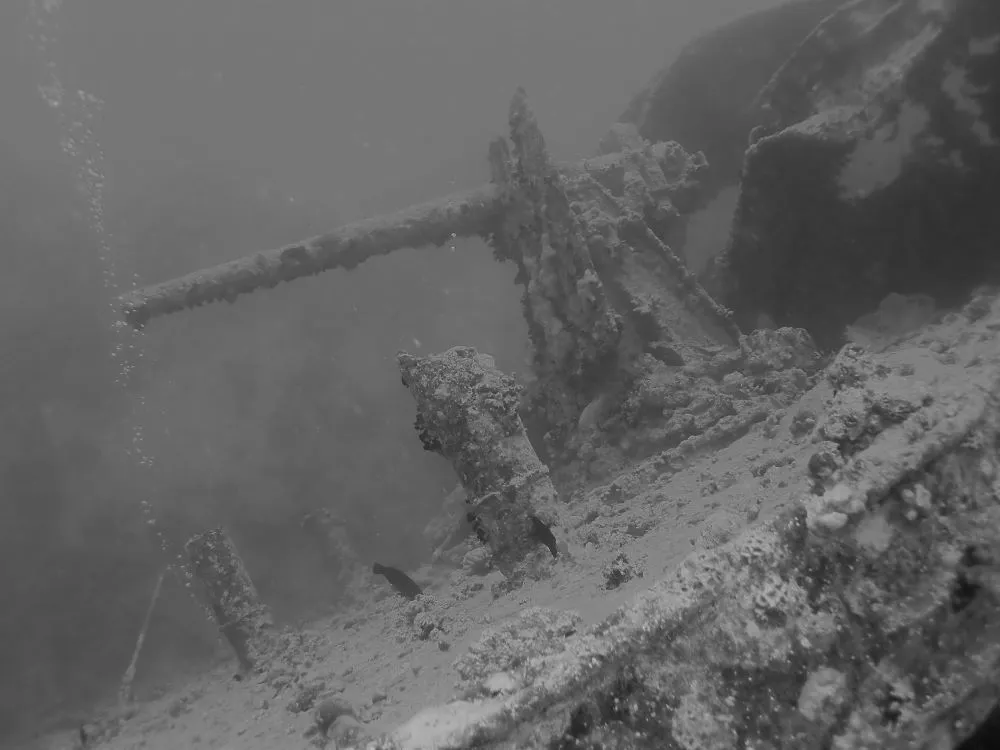
While the main part of the wreck is upright the stern is sitting at about 45 degrees as you can see by the 4.7-inch gun on the aft deck.
The Thistlegorm was left pretty much forgotten apart from a few bedouin fishermen who passed the story on to a certain Capt Jacques Cousteau who "rediscovered" the wreck in the 50s removing many artifacts such as the bell, Captains safe, and motorcycles. Following Cousteau's discovery, the wreck was left undisturbed apart from the local fishermen until the early 90s when recreational scuba divers from Sharm El Sheikh started visiting. Since then it has been one of the major attractions diving the Red Sea with estimates of over 1 million divers visiting the old girl over the years.
There is a tradition that if you rub the prop blades on the Thistalgorm you will always come back to dive the Red Sea.

One of the blade tips is quite shiny. I have rubbed it a few times.

Some of the famous motorcycles.

Unfortunately, some divers seem to feel the need to take souvenirs from the wreck for some reason chunks of motorcycle tire are very popular.

Only one of the radio trucks still has its steering wheel.

But the Captain's bath is still full of water.

While most divers come for the wreck many fish call it home too so it is easy to see why the local fishermen kept coming back.
Lionfish seem to like the locos maybe because of all the glassfish that live there.

Batfish always cruise around the debris field.

Well, Hivers I hope you enjoyed diving the Thistlegorm as much as I have over the years. The only sad thing is seeing how much it has deteriorated from a mixture of dive boats tieing up to the more fragile parts of the wreck, divers taking bits, and corrosion from the diving gases exhaled by the millions who have visited the old girl.