

There are many parents who have children from 8 to 12 years of age who do not want to help at home, at the time of demanding them to do domestic chores they just do not want to because they do not believe that they should do so. This is because of the comfort, they are children who do not feel the need to collaborate in the housework because from very young they have done everything for them.
When this happens, children's thinking is very simple to understand: "Why should I try something if another will come and do it for me?" The sense of responsibility has been lost along the way and the fault in this case is not they. We can correct this error by helping them to understand that the home is a place where many people live together and that together they must collaborate to be able to lead a harmonious and appropriate coexistence. When children refuse to collaborate at home, action must be taken.
Children learn by imitation and children love to help their parents in the tasks of organizing, set the table, keep the glasses, feel useful with mom and dad, it is then the ideal time for the child to start in the interaction to collaborate with the chores of the house.
Below I present practical recommendations to integrate children in household activities:
Involve them
Darles pequeñas tareas, adaptadas a su edad, y enseñarles a colaborar en casa es la mejor manera que inicien a adquirir responsabilidades. Además, esto también le aportará otros valores, como el de ser más colaborador y participativo. Es una vía estupenda para que los niños se involucren y asuman responsabilidades.

Parents must set the example
If all of the members of the family are organized and collaborate in the housework, it will be much easier for the children to get involved. Give them tasks adapted to their age, such as pick up toys, set the table or ask them to help prepare some simple cooking recipes.
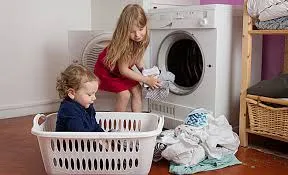
When they are small it is important not to leave them alone. A good idea is to accompany them in the tasks they perform, for example, pick up the nursery, ask them to help us fold the clothes, throw the garbage ... Another good option is to ask them to collaborate when preparing some meals.
It can not be allowed to require children to do housework while the father or mother is watching television or lying down sleeping. The best teacher that exists for children and that really teaches them what to do and how they should do it is the parents.

Establish norms and limits
When children do not want to collaborate at home it is very important to guide them and teach them that each of the components of the home fulfill their obligations and that by fulfilling them all will maintain peace and harmony as a family.
So that they can see it more clearly, a table of tasks can be established and another of rules and limits that all must comply with. And of course the other members of the family should set an example of those responsibilities.

Be realistic about the child's abilities
Before assigning tasks to children, you must be realistic and not be a perfectionist because what you want is to establish the habit so that later they can do things for themselves without the need for parents to remember what they have to do and again.
It is very important that children are assigned home chores according to their abilities and their age with the aim and purpose of increasing their responsibility and self-esteem by doing well at home tasks.
Negative consequences (Punishment) and positive (Rewards)

Even knowing what children should do, they still refuse to carry out their assigned tasks, so it will be necessary to make clear some negative consequences for when they do not comply with what has been assigned. These consequences should be aimed at removing privileges such as: less time to play the console, less time to go out with friends, etc. You should never resort to shouting or physical punishment as this is inadmissible in any case.
As negative consequences are established, positive consequences or rewards must also be established, that is, not everything must be bad or punished. So if the children are able to help at home and do their homework they should also have recognition, affective prizes and increase privileges such as having more time to play the game, hanging out with friends, choosing an activity to do as a family, etc. What is not allowed is that children are rewarded with money or material goods because then it will be like a payment, and domestic chores are an obligation, not something that they should do and that parents should pay for them.

Motivation
In case of younger children and up to 12 years it is productive to use point systems with colors or faces that help them to be motivated to perform tasks.

Teach them from a young age
In order not to have to use the negative consequences of the above, it is convenient to take into account that children must be taught from the time they are small. For this reason it is important that even if they are two years old, they have to assign tasks according to their age, such as collecting toys, helping their parents to do so so that adults can guide them in the process.
As the child grows, assignments must be assigned according to their age and abilities so that the child can grow with a good sense of responsibility in the home.

Schedule
As they grow older, and especially when there are more siblings, it can be useful to set a schedule with the tasks that must be done daily.

Patience
When we initiate a new teaching to children we must have patience, if the first few times it does not do well, nothing happens, it is about strengthening the value of collaboration and seeing it as another aspect of coexistence in the home and feel fully integrated.

In this way we foster the collaboration of children at home, learn the sense of responsibility, work, respect for the group and, most importantly, develop their autonomy. When they reach adulthood they will be equally responsible parents in household chores and will discipline their children in the same way.
