
In contrast to psychodynamic theory that I wrote about yesterday in part 2 of this series, humanistic theory argues that one has free will and is of one trait (self-concept) not three (id, ego and superego). Inherent in this theory is the idea of self realised hierarchical motivation which is discussed subsequently and the notion that human events have meaning such as purpose, awe, love, choice, value, spirituality and self-actualisation.
smartprimaryed.files.wordpress.com
Humanistic theory came about as a reaction to psychodynamic theory (which was seen as pessimistic in nature) and arose in the 1950s. Humanistic therapists endeavour to determine how people view themselves and experience the environment they live in.
youtube.com

Carl Rogers, being one of the theory’s founders, viewed personality structure as one trait or entity, this being self. Self is known more widely as self-concept which is how an individual sees themselves, their beliefs about their own nature, uniqueness and behaviours. The individual’s view of themselves may or may not be accurate. The view may be biased and inaccurately weighted for or against the individual. For example a person may think himself or herself to be emotionally stable, when from an external perspective he or she actually exhibits signs of emotional irrationality.
Rogers called this biased belief of self incongruence. If one has a belief that was in accordance with evidence or experiences, Rogers called this congruence. It is this structure of self-concept promoted by humanistic theory that creates one’s personality. Rogers realised that one’s childhood experience affected the congruence and incongruence structure thinking, but did not rule their adolescence as suggested by the psychodynamic theory.
Rogers’ belief was that all humans need to feel accepted and loved. In the beginning of one’s life this is satisfied mostly by the individual’s parents. Through experience, Rogers came to the belief that unconditional love (such as from an individual’s parents) cultivates congruence whilst conditional love cultivates incongruence. Following this self-concept, it is put forward that a person can learn and grow to maintain their own personality and behaviour structure; choosing not to be a pawn of the environment.
teambuilding.co.uk

Abraham Maslow followed in Rogers’s lead with self-concept saying that an individual has free will enabling him or her to learn and establish his or her own personal growth and personality. Maslow spoke out saying
it is as if Freud supplied us the sick half of psychology and we must now fill it out with the healthy half
It is emphasised that all individuals can change, work towards a healthy personality and live up to their potential, whereas Freud believed that not all individuals can. This growing of a healthy personality follows the process of a need structure. Maslow suggested that there are basic needs that a human must fulfil to have a healthy personality growth.
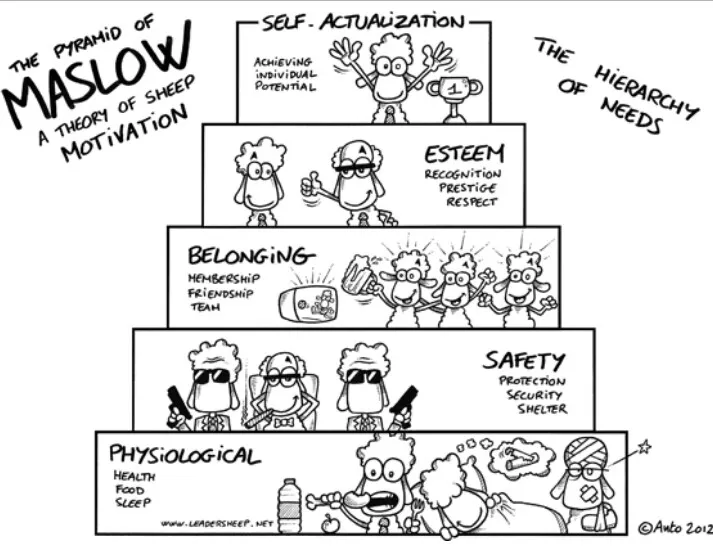
These needs are prioritised and usually portrayed in a pyramid which Maslow called the hierarchy of needs. Maslow recognised that the fundamental desirers of human begins are similar to Freud’s description but many are conscious in nature. In order to achieve growth, an individual will work his or her way up the pyramid traversing the sequence of prioritised needs. An unfulfilled lower need shows in ones thinking and actions until the need is met. Once this need is met or satisfied, one moves on to the next level which will in turn manifest itself in the life of the individual.
According to this premise, each need met or satisfied does not need to be satisfied perfectly but only reasonably well for one to feel content. The levels of needs are ordered from the most fundamental up to the more refined. It follows that the higher levels can only be acquired or indeed are only of interest once lower levels have been established or secured. Briefly, the first level is physiologic such as the need of food, water and air.
Secondly the needs such as safety, stability, protection, security and the freedom from fear.
The third level includes the needs of belonging and love; this is the giving and receiving action of affection.
The fourth level has the need for feeling self-esteem, which can be derived from successful integration into an individual’s surroundings.
At the last level one comes to the need for self-actualisation; attaining one’s unique potential in life.
Maslow describes the refined needs on the tip of the pyramid as growth needs or self-actualisation. The process of traversing the levels of needs satisfies 'the need to fulfil one’s potential’
LETS CONCLUDE AND COMPARE
In conclusion, the principles of psychodynamic and humanistic theory differ significantly. The former is based on the premise that human behaviour is largely unconscious and based on urges, impulses and instinct. Based on this view, a psychodynamic therapist may seek to address conflicts that arise internally between traits of an individual’s personality in order to avoid suffering. According to psychodynamic theory, an individual is not guaranteed to be capable of achieving happiness due to the pre-determined unconscious forces at work.
The latter theory is based on the premise that behaviour is driven by conscious and deliberate activity. A humanistic therapist will attempt to assess and understand human needs. According to this theory, anyone can achieve self-actuality and happiness by progressing through Maslow’s hierarchy of needs. This addresses the pessimistic standpoint adopted by psychodynamic theory.